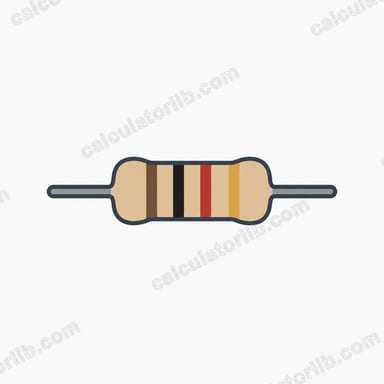

What the Resistor Color Code Calculator Does
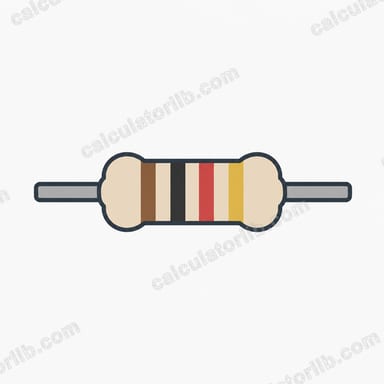
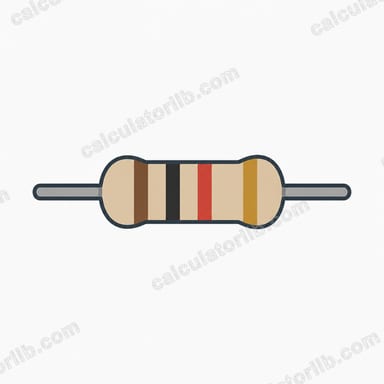
This calculator decodes a standard 4‑band resistor into its resistance value in ohms, along with its tolerance and the resulting minimum and maximum resistance range. Instead of memorising the color chart, you simply pick the color of each painted band and the tool does the math. It uses the internationally recognised electronic color code (used worldwide), so it works for any standard 4‑band carbon‑film or metal‑film resistor.
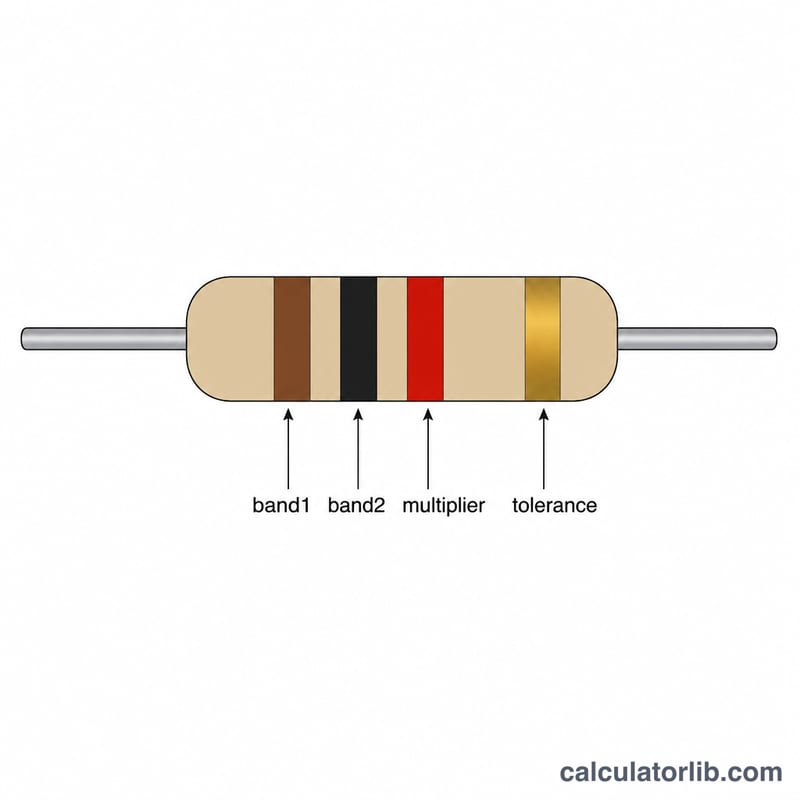
The Input Fields Explained
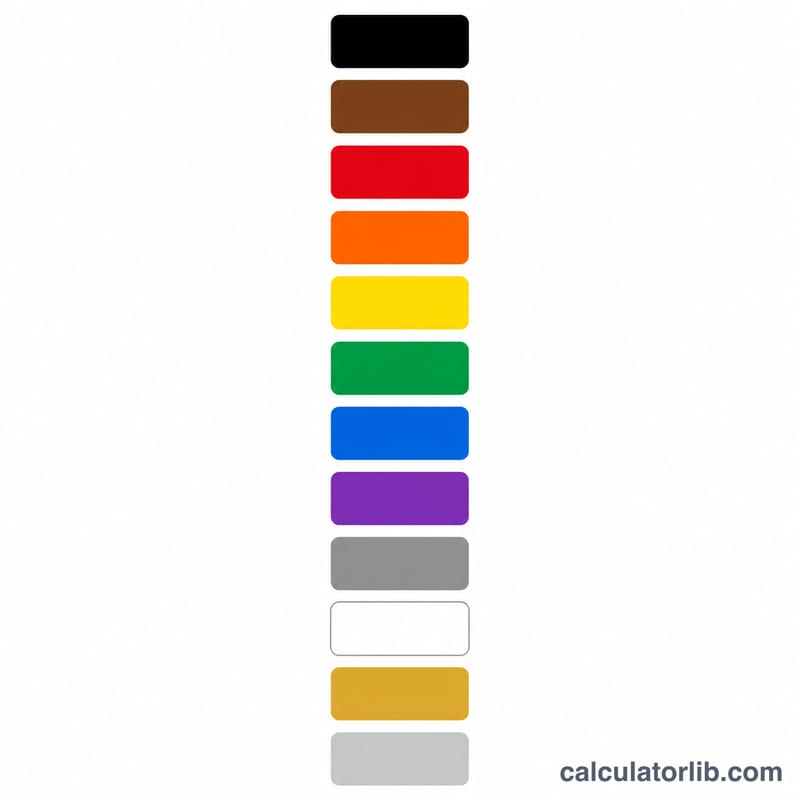
- 1st Band – the first significant digit. Colors run black=0, brown=1, red=2, orange=3, yellow=4, green=5, blue=6, violet=7, gray=8, white=9.
- 2nd Band – the second significant digit, using the same color‑to‑number scale.
- Multiplier – the power of ten the two digits are multiplied by. Black \(\times 1\), brown \(\times 10\), red \(\times 100\), orange \(\times 1\text{k}\), and so on, plus gold (\(\times 0.1\)) and silver (\(\times 0.01\)).
- Tolerance – how far the actual value may stray from the nominal value: brown \(\pm 1\%\), red \(\pm 2\%\), green \(\pm 0.5\%\), blue \(\pm 0.25\%\), violet \(\pm 0.1\%\), gray \(\pm 0.05\%\), gold \(\pm 5\%\), silver \(\pm 10\%\).
The Formula
The calculator combines the bands like this:
$$R = \left(10 \cdot \text{Band 1} + \text{Band 2}\right) \times \text{Multiplier}$$ $$\text{Range} = R \pm \frac{R \cdot \text{Tolerance (\%)}}{100}$$- Resistance = (band1 \(\times\) 10 + band2) \(\times\) multiplier
- Tolerance amount = (resistance \(\times\) tolerance%) \(\div\) 100
- Range = resistance − tolerance amount → resistance + tolerance amount
The result is auto‑formatted: values of 1,000,000 Ω or more show as MΩ, values of 1,000 Ω or more show as kΩ, and smaller values stay in Ω.
Worked Example
Suppose a resistor has bands yellow, violet, red, gold:
- 1st band yellow = 4, 2nd band violet = 7 → digits give 47
- Multiplier red = \(\times 100\)
- Resistance = $$(4 \times 10 + 7) \times 100 = 47 \times 100 = 4{,}700 \ \Omega = 4.70 \ \text{k}\Omega$$
- Tolerance gold = \(\pm 5\%\) → \(4700 \times 5 \div 100 = \pm 235 \ \Omega\)
- So the real value lies between 4,465 Ω and 4,935 Ω
Frequently Asked Questions
Which way do I read the bands? Hold the resistor so the tolerance band (usually gold or silver) is on the right, then read from left to right.
Why is there no third digit option? This tool handles 4‑band resistors, where only the first two bands are significant digits and the third is the multiplier. Five‑band resistors use three digit bands.
What if the tolerance band has no color? A missing fourth band traditionally means \(\pm 20\%\) tolerance, but standard color codes start at silver (\(\pm 10\%\)).