
What Is Rectangular to Polar Conversion?
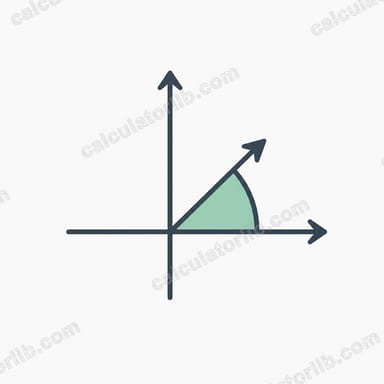
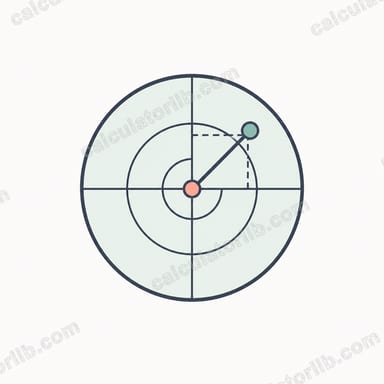
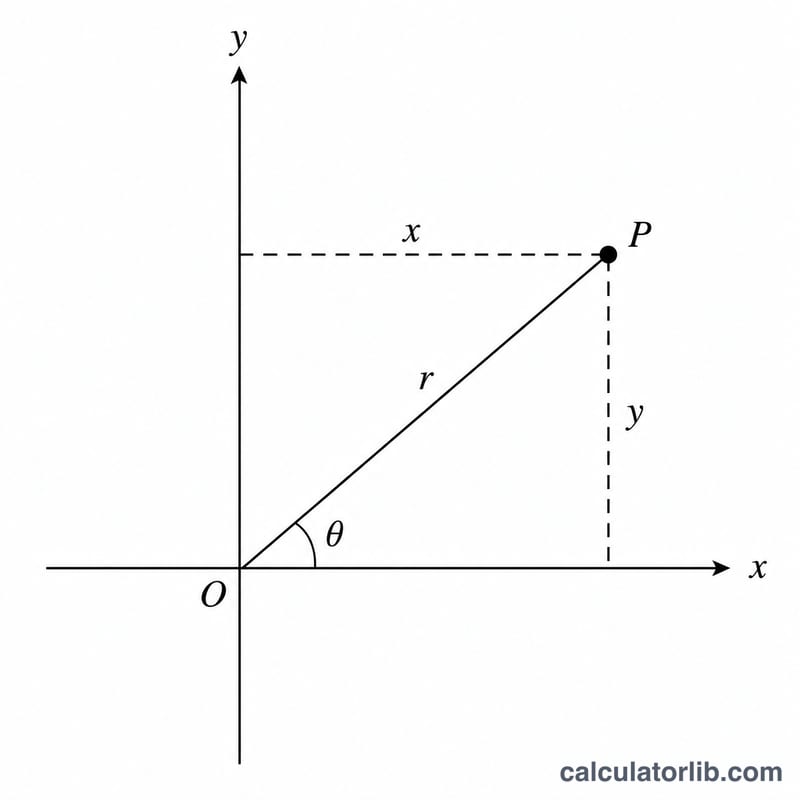
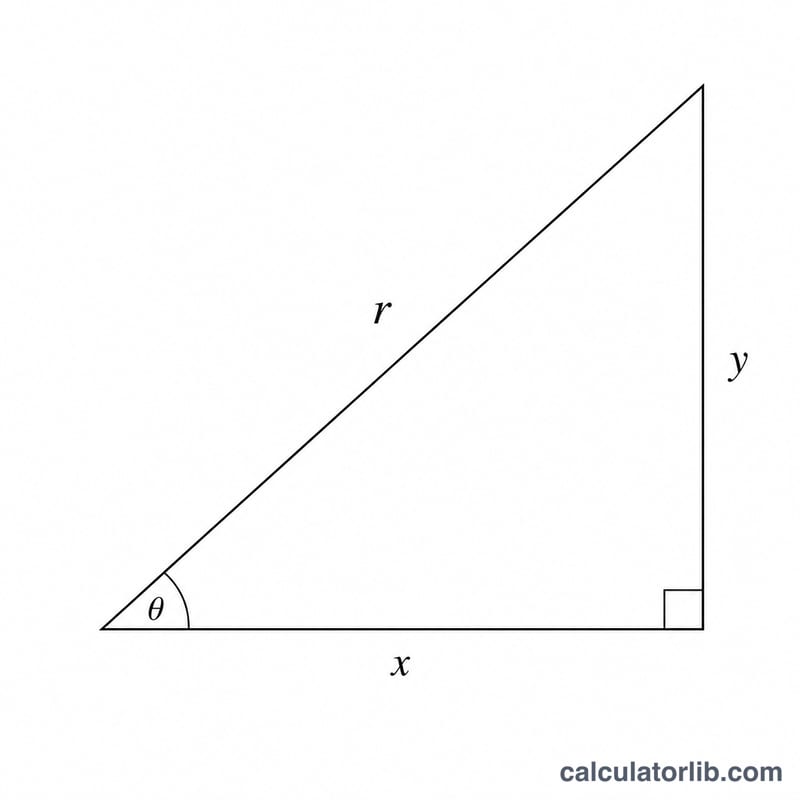
Every point in a plane can be described two ways. In the rectangular (Cartesian) system a point is given by horizontal and vertical distances, written as (x, y). In the polar system the same point is given by its distance from the origin, \(r\), and the angle \(\theta\) it makes with the positive x-axis. This calculator converts a rectangular pair (x, y) into its polar equivalent \((r, \theta)\), reporting \(\theta\) in both degrees and radians.
How to Use the Calculator
Enter the x-coordinate and the y-coordinate of your point. Click calculate and the tool returns the radius \(r\) and the angle \(\theta\). Negative values are fully supported, and the angle is computed with the atan2 function so the result lands in the correct quadrant (between −180° and 180°).
The Formula Explained
The radius comes straight from the Pythagorean theorem, since x and y are the legs of a right triangle and \(r\) is the hypotenuse:
$$r = \sqrt{x^{2} + y^{2}}$$
The angle uses the two-argument arctangent, $$\theta = \operatorname{atan2}(y,\ x).$$ Unlike a plain \(\arctan(y/x)\), atan2 inspects the signs of both x and y, so it correctly distinguishes, for example, the second quadrant from the fourth. Convert radians to degrees by multiplying by \(180/\pi\).
Worked Example
Take the point (3, 4). The radius is $$\sqrt{3^{2} + 4^{2}} = \sqrt{9 + 16} = \sqrt{25} = 5.$$ The angle is $$\operatorname{atan2}(4,\ 3) \approx 0.9273 \text{ radians},$$ which is about 53.13°. So (3, 4) in polar form is approximately (5, 53.13°).
FAQ
Why use atan2 instead of arctan? Plain \(\arctan(y/x)\) loses quadrant information and divides by zero when \(x = 0\). atan2 handles all four quadrants and the axes correctly.
What is the range of the angle? This tool reports \(\theta\) in (−180°, 180°]. To get a 0–360° value, add 360° to any negative result.
What if both x and y are zero? The radius is 0 and the angle is undefined; the calculator returns 0° by convention.