
What Is Rounding to the Nearest Cent?
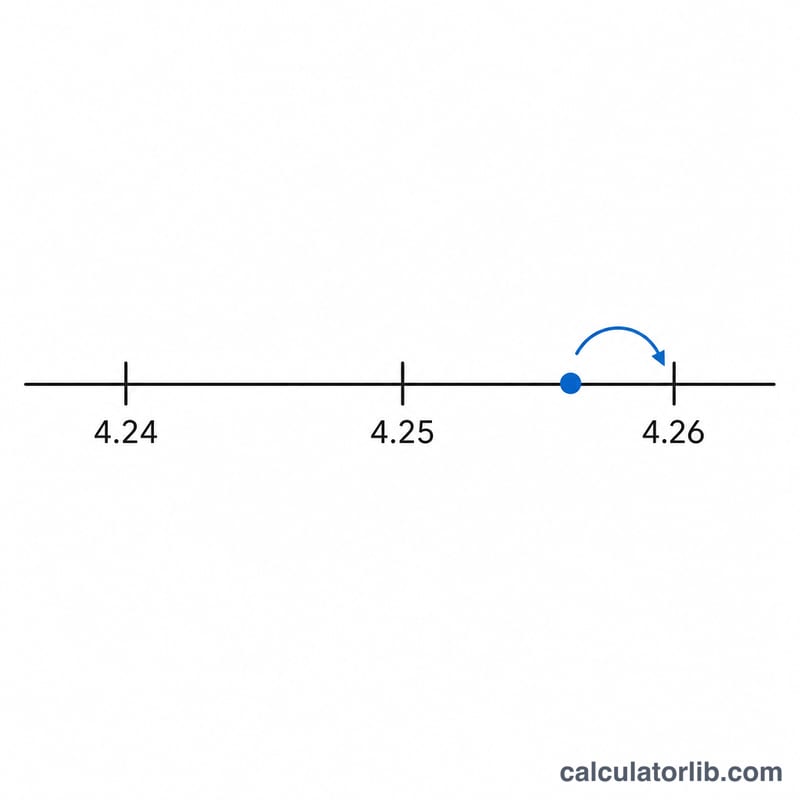
Rounding to the nearest cent means expressing a monetary value to exactly two decimal places — the smallest standard unit of most currencies. This is essential for invoices, receipts, tax calculations, and any situation where fractions of a cent must be resolved into a real, payable amount.
How to Use This Calculator
Type any dollar amount into the field — it can have many decimal places, such as a price after a percentage discount or a split bill. The calculator instantly returns the value rounded to two decimal places, along with the original amount and the rounding difference so you can see exactly how much was added or removed.
The Formula Explained
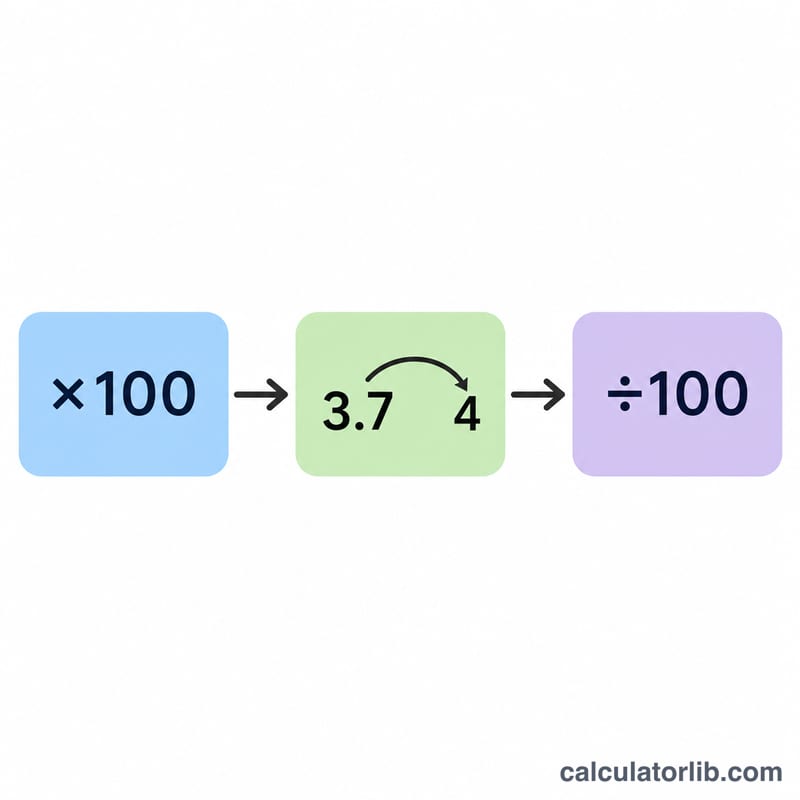
The rule is $$\text{result} = \frac{\operatorname{round}(x \times 100)}{100}$$ Multiplying by 100 shifts the cents into the whole-number position, standard "round half up" rounding snaps to the nearest integer, and dividing by 100 restores the decimal point. Values ending in exactly half a cent (0.005) round up to the next cent.
Worked Example
Suppose a sale item costs $19.99 and you apply a 15% discount: \(19.99 \times 0.85 = 16.9915\). To find the price you actually pay, round to the nearest cent: $$\frac{\operatorname{round}(16.9915 \times 100)}{100} = \frac{\operatorname{round}(1699.15)}{100} = \frac{1699}{100} = \$16.99$$ The rounding difference is −$0.0015.
FAQ
How is a value exactly halfway handled? A value like $2.005 rounds up to $2.01, following the common "round half up" convention.
Can I round negative amounts? Yes — negative values (such as refunds) are rounded the same way.
Is this the same as truncating? No. Truncating simply drops extra digits, while rounding adjusts the cent up or down based on the third decimal place.