
What Is Rounding to the Nearest Thousandth?
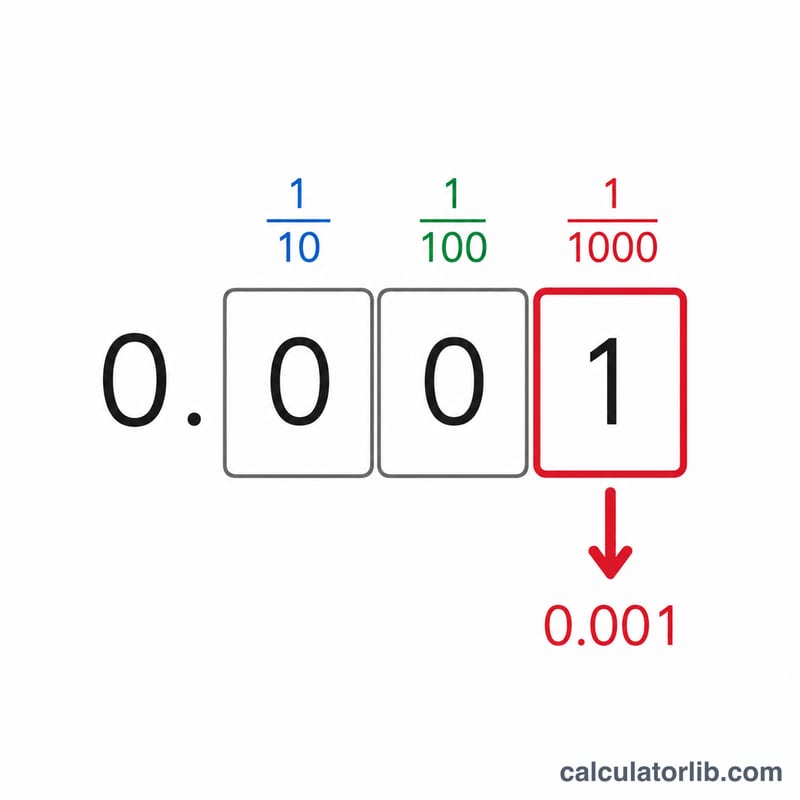
The thousandth is the third digit to the right of the decimal point (the 0.001 place). Rounding to the nearest thousandth means keeping three decimal places and adjusting the last kept digit based on the digit immediately after it. This calculator does it instantly for any number you enter, positive or negative.
How to Use This Calculator
Type the number you want to round into the input box and submit. The tool returns the value rounded to three decimal places along with your original number for reference. It works with long decimals, whole numbers, and negative values.
The Formula Explained
The standard rounding formula is $$\text{Result} = \frac{\left\lfloor \text{Number} \times 1000 + 0.5 \right\rfloor}{1000}$$ Multiplying by 1000 shifts the thousandths place into the ones place, the round function snaps to the nearest whole number, and dividing by 1000 shifts the decimal point back. The "round half up" rule means a trailing digit of 5 or more rounds the third decimal up.
Worked Example
Round 3.14159 to the nearest thousandth. Multiply: \(3.14159 \times 1000 = 3141.59\). Round to the nearest whole number: \(3142\). Divide by 1000: \(3.142\). Because the fourth decimal (5) is 5 or more, the third decimal rounds up from 1 to 2, giving 3.142.
FAQ
What is the nearest thousandth of 2.71828? Multiply by 1000 to get \(2718.28\), round to \(2718\), divide to get \(2.718\).
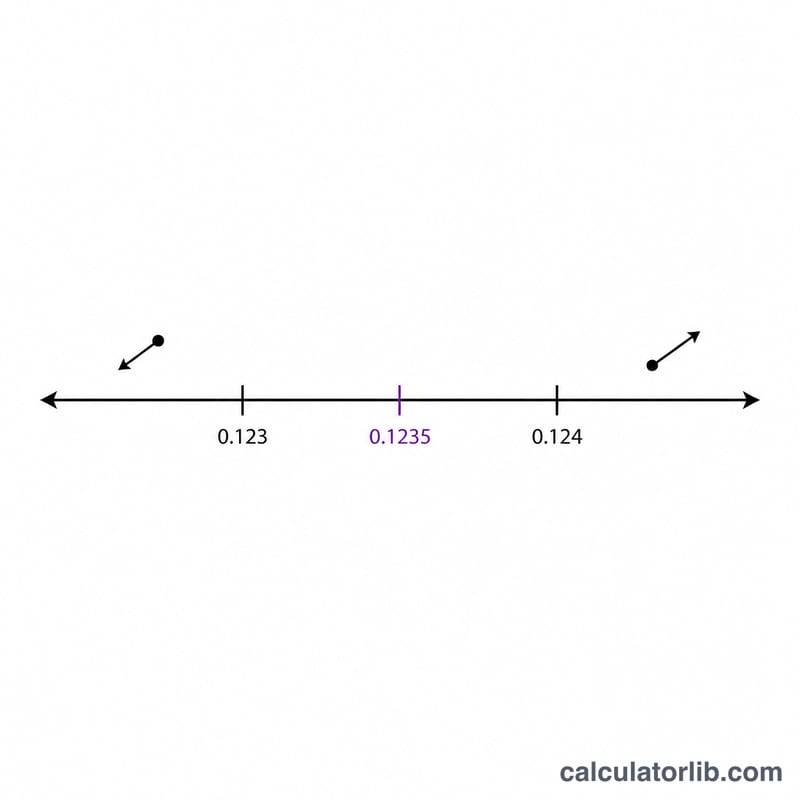
How does it handle a digit of exactly 5? It uses round-half-up, so the fourth decimal digit of 5 rounds the third decimal place upward (e.g. \(1.2345 \to 1.235\)).
Does it work for negative numbers? Yes. For example, \(-4.5678\) rounds to \(-4.568\).