
What Is Rounding to the Nearest Tenth?
The tenths place is the first digit to the right of the decimal point. Rounding a number to the nearest tenth means expressing it with just one decimal digit, keeping the value as close as possible to the original. This calculator does it instantly for any number you enter.
How to Use It
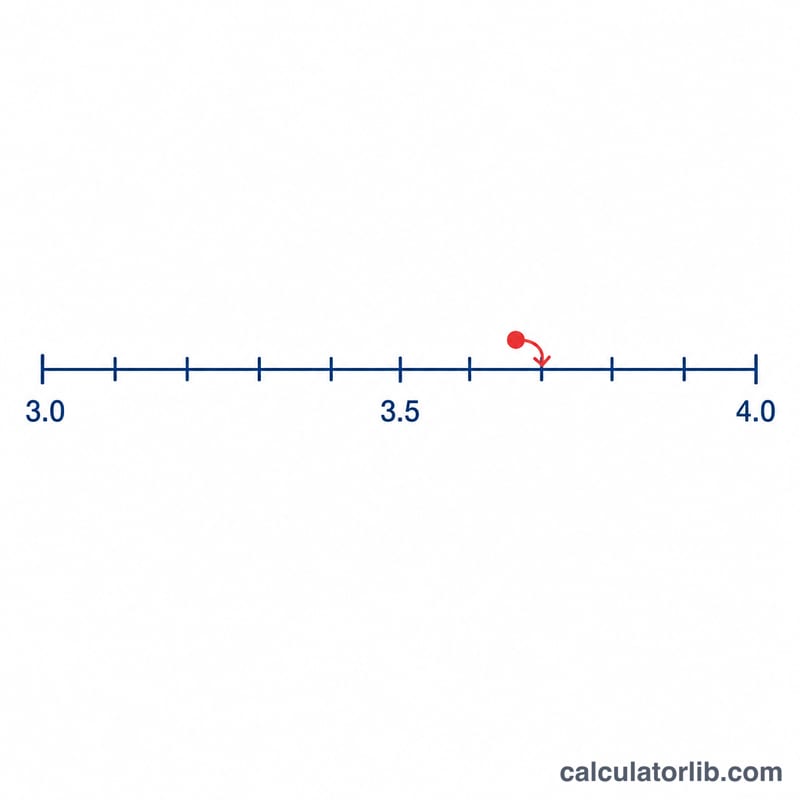
Type any number — positive or negative, with as many decimals as you like — into the input box and submit. The calculator returns the value rounded to one decimal place along with your original number for reference.
The Formula Explained
The standard method is \( \text{Rounded} = \dfrac{\left\lfloor \text{Number} \times 10 + 0.5 \right\rfloor}{10} \). Multiplying by 10 shifts the tenths digit into the ones place; rounding to the nearest whole number applies the round-half-up rule; dividing by 10 shifts it back. Look at the hundredths digit (the second decimal): if it is 5 or more, round the tenths digit up; if it is 4 or less, leave it unchanged.
$$\text{Rounded} = \frac{\left\lfloor \text{Number} \times 10 + 0.5 \right\rfloor}{10}$$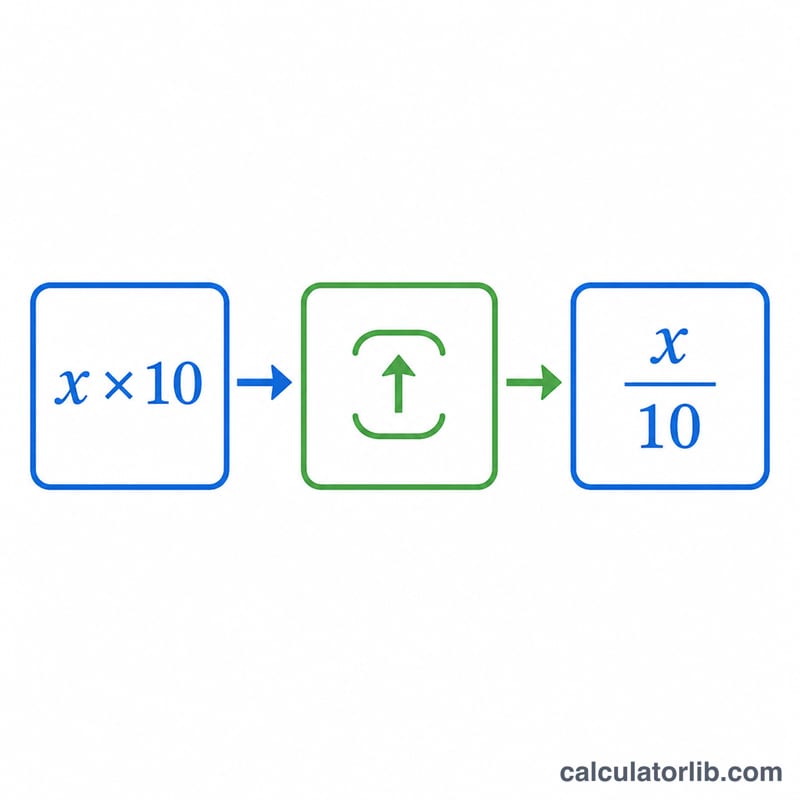
Worked Example
Round 3.14159 to the nearest tenth. The hundredths digit is 4, which is less than 5, so the tenths digit stays the same: the result is 3.1. Using the formula:
$$\text{round}(3.14159 \times 10) = \text{round}(31.4159) = 31, \quad \frac{31}{10} = 3.1$$FAQ
What happens with exactly .x5? The hundredths digit of 5 rounds up, so \(2.45\) becomes \(2.5\).
How are negative numbers handled? Standard rounding applies; for example \(-2.36\) rounds to \(-2.4\).
What if my number has no decimals? A whole number like \(7\) stays \(7.0\) — it is already exact at the tenths place.