
What is rounding to the nearest integer?
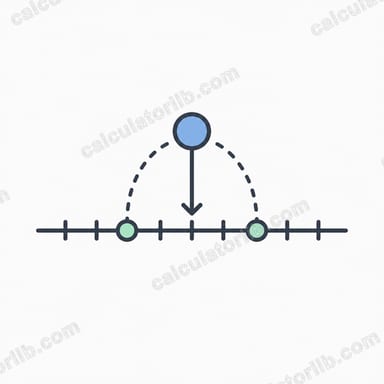
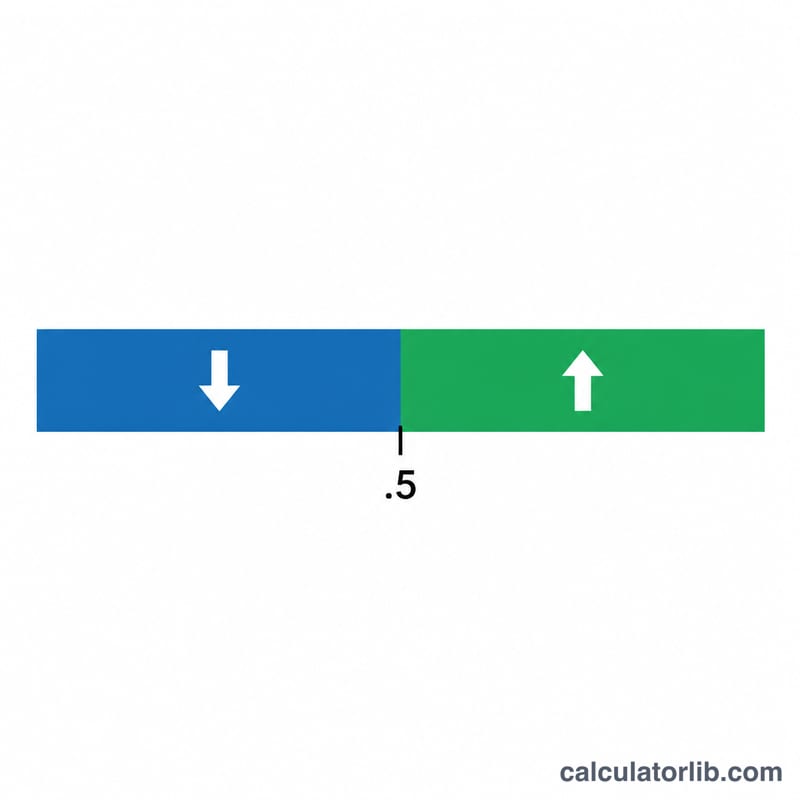
Rounding to the nearest integer takes any decimal number and replaces it with the closest whole number. If the fractional part is less than 0.5, the number rounds down; if it is 0.5 or greater, it rounds up. This calculator does exactly that for any value you enter, positive or negative.
How to use this calculator
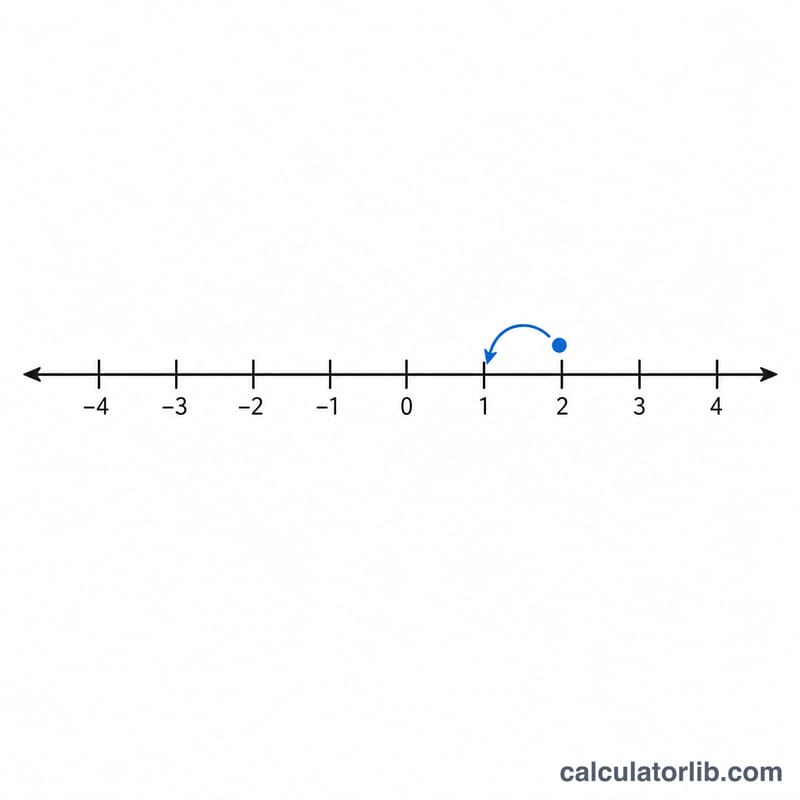
Type any number — for example 7.3, 12.5, or -4.8 — into the input box and the calculator instantly returns the nearest integer. There are no other settings: it always rounds to a whole number using the common "round half up" rule.
The formula explained
The rule is simply result = round(x). A practical way to compute it by hand is to add 0.5 and take the floor (the largest integer not greater than the value): \(\text{round}(x) = \left\lfloor x + 0.5 \right\rfloor\). For 7.3 this gives \(\left\lfloor 7.8 \right\rfloor = 7\); for 7.5 it gives \(\left\lfloor 8.0 \right\rfloor = 8\). This "half up" convention is what most everyday rounding uses.
Worked example
Suppose you enter 3.5. Adding 0.5 gives 4.0, and the floor of 4.0 is 4, so the result is 4:
$$\text{Result} = \left\lfloor 3.5 + 0.5 \right\rfloor = \left\lfloor 4.0 \right\rfloor = 4$$Enter 2.49 and you get 2 because 2.49 + 0.5 = 2.99, whose floor is 2:
$$\text{Result} = \left\lfloor 2.49 + 0.5 \right\rfloor = \left\lfloor 2.99 \right\rfloor = 2$$FAQ
How does it handle exactly .5? Values ending in .5 round up to the next integer (half-up rounding). So 0.5 becomes 1 and 2.5 becomes 3.
What about negative numbers? A value like -4.8 rounds to -5, and -4.5 rounds to -4 (towards positive infinity), consistent with the round-half-up rule used here.
Is this the same as truncating? No. Truncating simply drops the decimals (3.9 becomes 3), while rounding picks the nearest integer (3.9 becomes 4).