
What is the SAS Triangle Calculator?
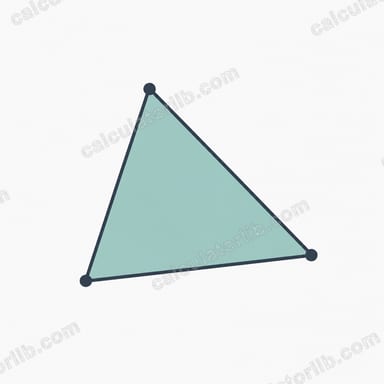
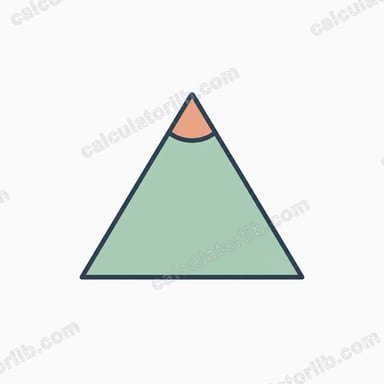
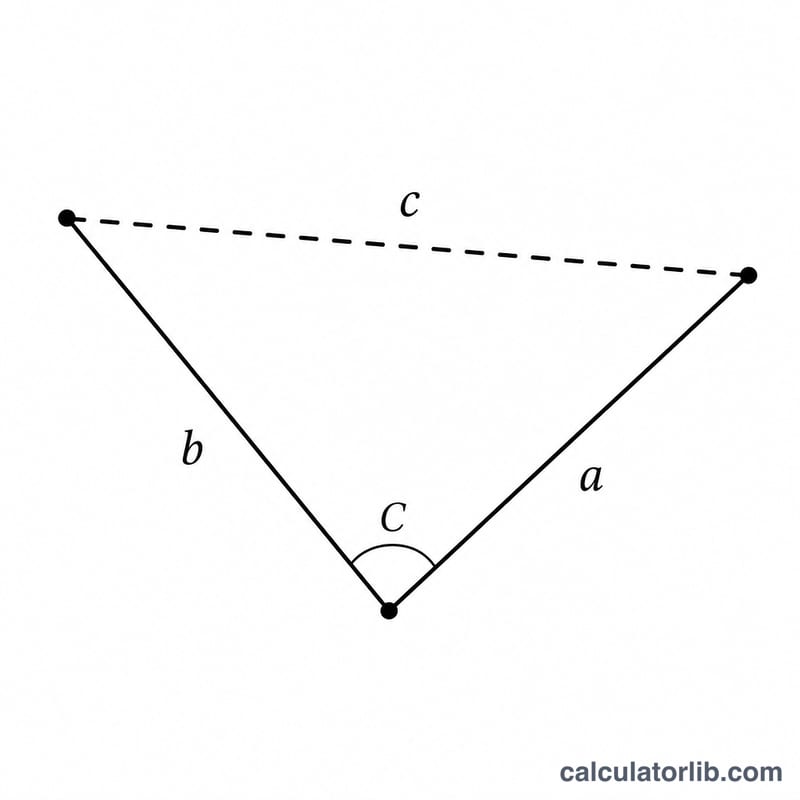
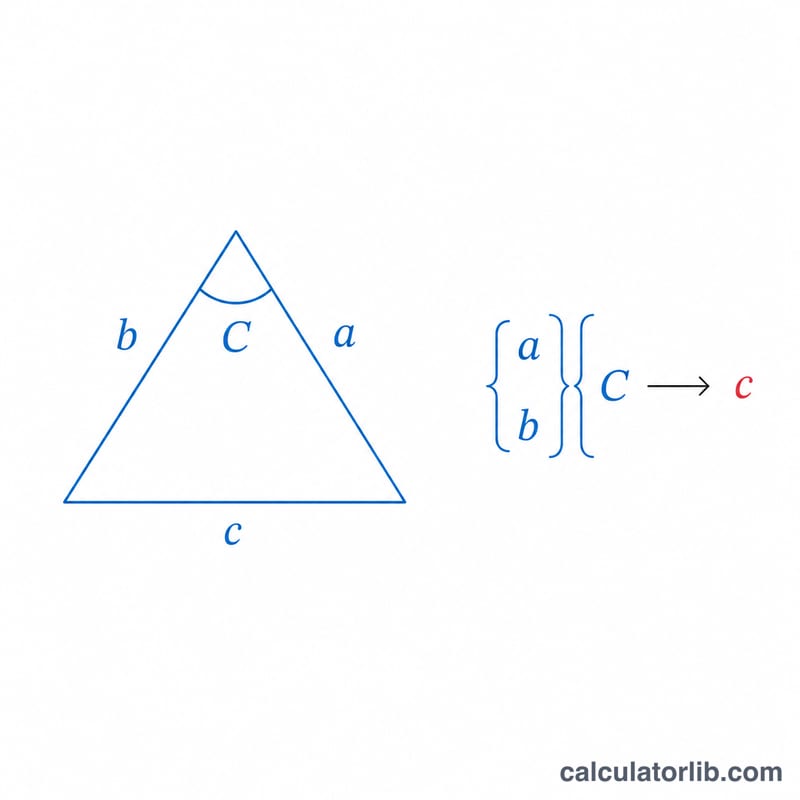
SAS stands for "Side-Angle-Side" — a triangle case where you know the lengths of two sides and the measure of the angle between them (the included angle). This calculator completes the triangle: it finds the third side, the triangle's area, the two remaining angles, and the perimeter. Because the included angle locks the shape, an SAS triangle is always uniquely solvable.
How to use it
Enter side a, side b, and the included angle C (in degrees, between 0 and 180). The angle C must sit between sides a and b. Press calculate to get the opposite side c along with area and the other angles.
The formula explained
The third side comes from the Law of Cosines: $$c = \sqrt{\text{a}^{2} + \text{b}^{2} - 2\,\text{a}\,\text{b}\cos\!\left(\text{C}\right)}$$ When C = 90°, \(\cos \text{C} = 0\) and this reduces to the Pythagorean theorem. The area uses the SAS area formula: $$\text{Area} = \tfrac{1}{2}\,\text{a}\,\text{b}\,\sin\!\left(\text{C}\right)$$ Once c is known, angle A is recovered with \(\cos A = \dfrac{\text{b}^{2} + c^{2} - \text{a}^{2}}{2\,\text{b}\,c}\), and angle B is whatever remains so the angles total 180°.
Worked example
Suppose a = 5, b = 7, and C = 60°. Then $$c = \sqrt{25 + 49 - 2\cdot5\cdot7\cdot\cos 60^{\circ}} = \sqrt{74 - 70\cdot0.5} = \sqrt{39} \approx 6.245$$ The area is \(\tfrac{1}{2}\cdot5\cdot7\cdot\sin 60^{\circ} = 17.5\cdot0.8660 \approx 15.155\) square units. Angle A ≈ 43.9° and angle B ≈ 76.1°.
FAQ
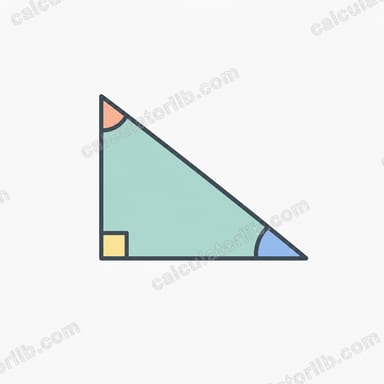
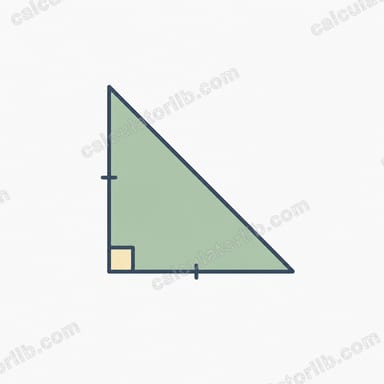
What if the angle is exactly 90°? The formula becomes the Pythagorean theorem, \(c = \sqrt{\text{a}^{2} + \text{b}^{2}}\).
Can the angle be 0 or 180°? No — those collapse the triangle into a line and give zero area, so use values strictly between 0 and 180.
Which side is "c"? Side c is always the one opposite the angle you entered (C), i.e. the side not adjacent to that angle.