
What Is a Scalene Triangle?
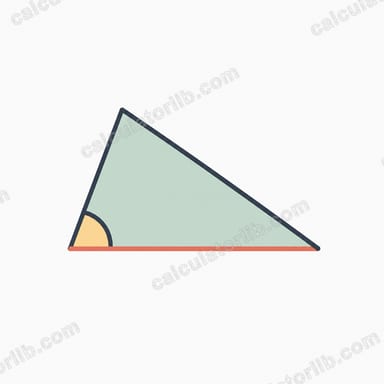
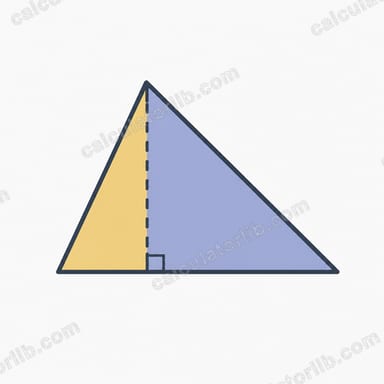
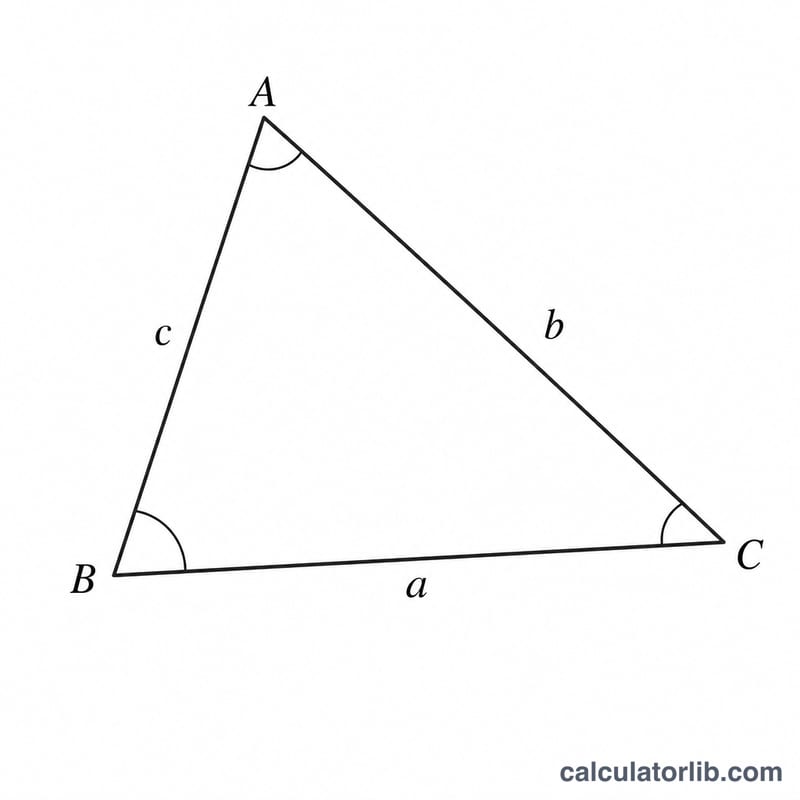
A scalene triangle is a triangle in which all three sides have different lengths, which also means all three interior angles are different. This calculator takes the three side lengths and instantly returns the area, perimeter, semi-perimeter, the three interior angles, and the altitude (height) dropped to each side. It works for any valid triangle — not only scalene ones — as long as the three sides can actually form a closed triangle.
How to Use It
Enter the lengths of the three sides — a, b, and c — in any consistent unit (cm, m, inches, etc.). The calculator checks the triangle inequality (the sum of any two sides must exceed the third). If the sides form a valid triangle, you'll get the area in square units along with angles in degrees and the three heights.
The Formula Explained
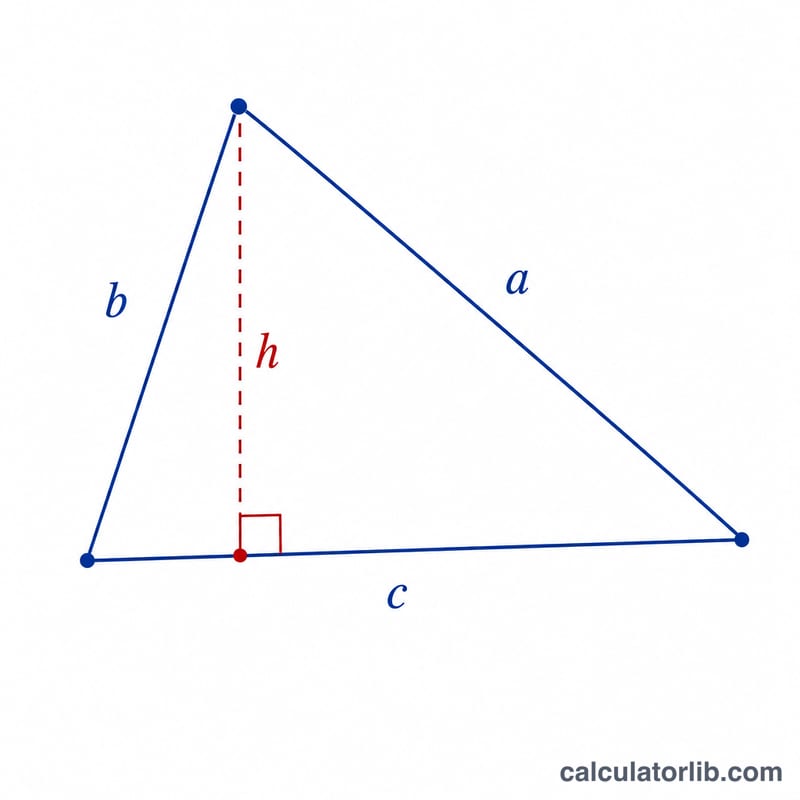
The area uses Heron's formula. First compute the semi-perimeter \(s = (a + b + c) / 2\), then the area is \(\sqrt{s(s - a)(s - b)(s - c)}\). Interior angles come from the law of cosines, e.g. $$\cos A = \frac{b^2 + c^2 - a^2}{2bc}.$$ Each altitude is found from the area: the height to side a equals \(2\cdot\text{Area} \div a\).
Worked Example
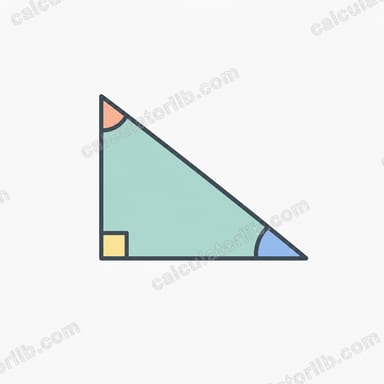
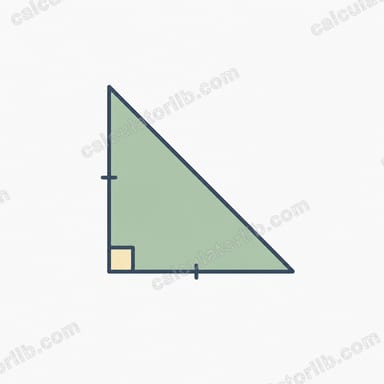
Take a triangle with sides a = 3, b = 4, c = 5. The semi-perimeter is \(s = (3 + 4 + 5) / 2 = 6\). $$\text{Area} = \sqrt{6(6-3)(6-4)(6-5)} = \sqrt{6 \times 3 \times 2 \times 1} = \sqrt{36} = 6$$ square units. Because \(3^2 + 4^2 = 5^2\), this is a right triangle, so angle C (opposite the side of length 5) is 90°. The perimeter is 12.
FAQ
What if my sides don't form a triangle? If the longest side is greater than or equal to the sum of the other two, no triangle exists and the area returns as 0.
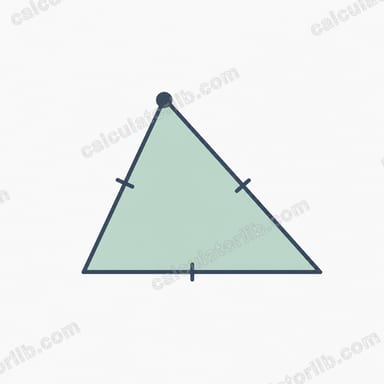
Does it work for equilateral or isosceles triangles? Yes — Heron's formula and the law of cosines apply to all triangles.
What units does the area use? Square units of whatever length unit you entered, e.g. cm in gives cm² out.