
What is power regression?
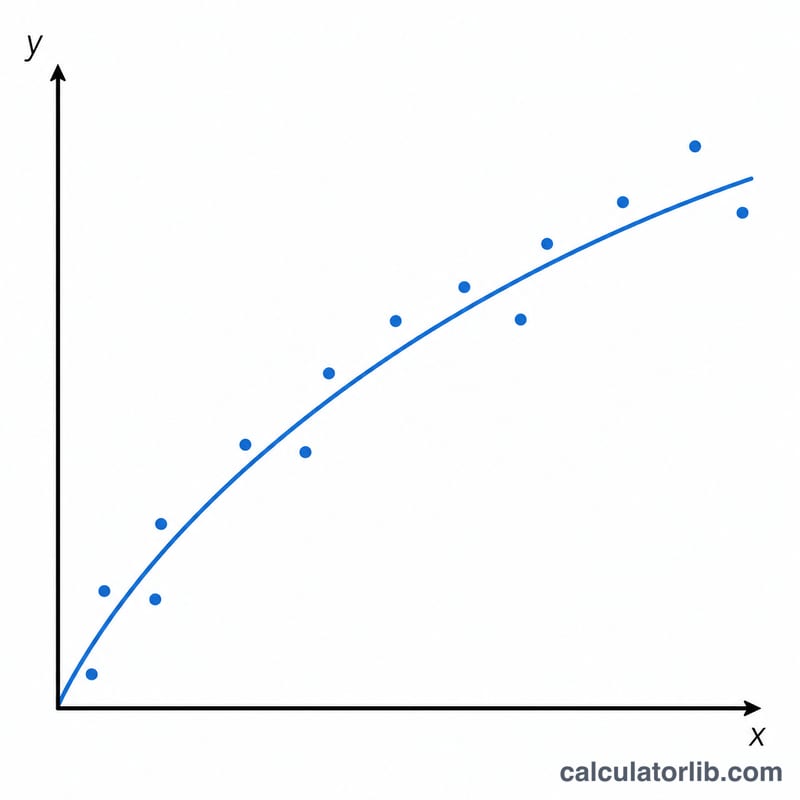
Power regression fits the model \(y = A \cdot x^{B}\) to a set of data points. This curve is common in physics, biology, and economics whenever one quantity scales as a power of another — allometric growth, learning curves, and many scaling laws. The exponent B tells you the rate of scaling and the coefficient A sets the overall magnitude.
How to use this calculator
Enter your X values and Y values as comma- or space-separated lists, matched by position (the first X pairs with the first Y, and so on). Every value must be strictly positive because the fit uses natural logarithms; any row with a value of zero or below is ignored. Choose how many significant digits to display, then read off the coefficients and the correlation coefficient r.
The formula explained
The trick is linearization. Taking the natural log of both sides of \(y = A \cdot x^{B}\) gives \(\ln y = \ln A + B \cdot \ln x\), a straight line in the transformed variables \(t = \ln x\) and \(u = \ln y\). We then run ordinary least-squares regression: compute the means, the sum of squares \(S_{xx}\) and \(S_{yy}\), and the cross product \(S_{xy}\). The slope \(B = S_{xy}/S_{xx}\) is the exponent, and \(A = \exp(\operatorname{mean}(\ln y) - B \cdot \operatorname{mean}(\ln x))\). The correlation coefficient \(r = S_{xy}/\sqrt{S_{xx} \cdot S_{yy}}\) measures how well the log-transformed points line up.
$$y = A \cdot x^{B}$$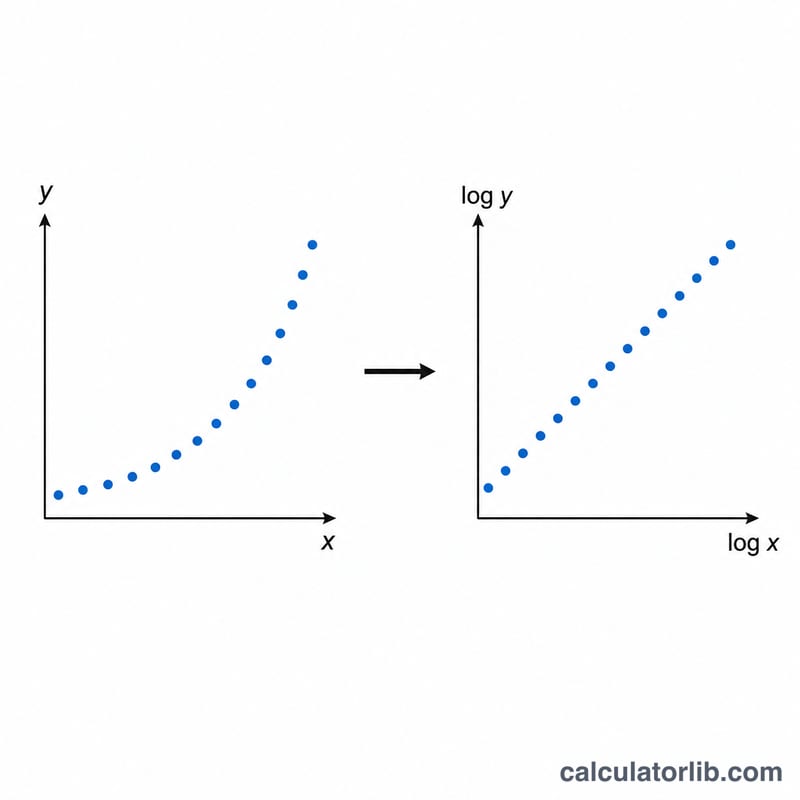
Worked example
For the data (1,2), (2,5), (3,11), (4,21), (5,33) with \(n = 5\), the log sums give \(S_{xx} \approx 1.6155\), \(S_{xy} \approx 2.8340\), and \(S_{yy} \approx 5.0410\). Then
$$B = \frac{2.8340}{1.6155} \approx 1.7544$$and
$$A = \exp(2.2483 - 1.7544 \cdot 0.9575) \approx 1.7655$$The correlation is \(r \approx 0.9933\), a strong fit. The model is \(y \approx 1.7655 \cdot x^{1.7544}\).
FAQ
Why must all values be positive? The method takes \(\ln(x)\) and \(\ln(y)\); the logarithm of zero or a negative number is undefined, so non-positive points cannot be used.
How do I read the correlation r? Values with \(|r|\) above 0.7 indicate a strong relationship, 0.4–0.7 moderate, 0.2–0.4 weak, and below 0.2 essentially none.
Does it matter whether I use natural or base-10 logs? No — the exponent \(B\) and correlation \(r\) are identical either way. We use natural logs and compute \(A\) consistently with \(\exp()\), so results match standard references.