
What Are Similar Right Triangles?
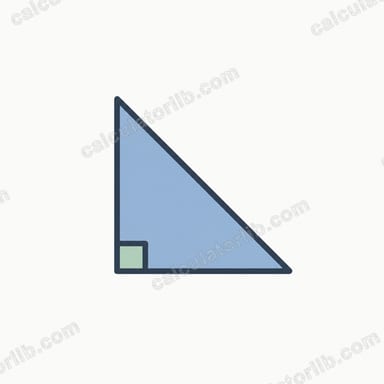
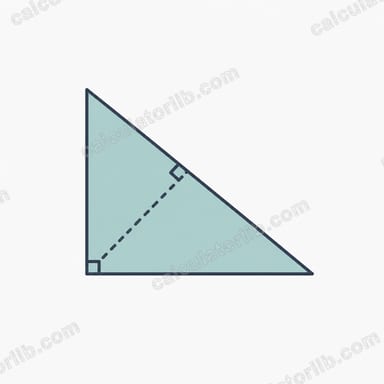
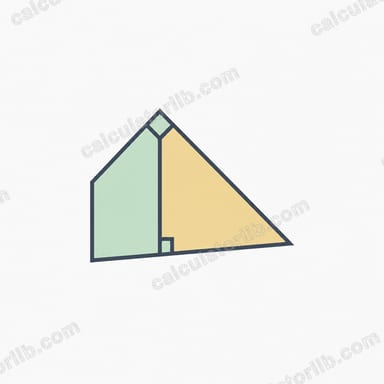
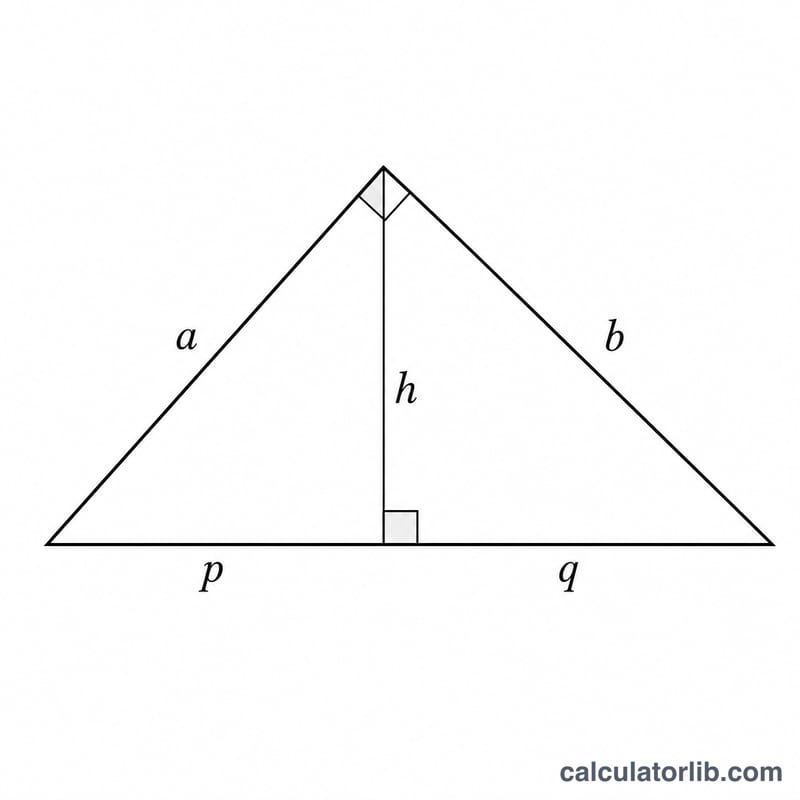
When the altitude is drawn from the right angle of a right triangle to its hypotenuse, it divides the original triangle into two smaller triangles. All three triangles — the original and the two pieces — are similar to one another. This similarity produces the famous geometric mean (or "right triangle altitude") relationships, which let you find the altitude and the two legs purely from the two segments the altitude carves out of the hypotenuse.
How to Use This Calculator
Enter the two hypotenuse segments, p and q. Segment p sits adjacent to one leg and q adjacent to the other; together they make up the full hypotenuse. The calculator returns the altitude h, the full hypotenuse length, and both legs.
The Formula Explained
The altitude to the hypotenuse is the geometric mean of the segments: \(h = \sqrt{p \cdot q}\). Each leg is the geometric mean of the whole hypotenuse and the segment adjacent to it: \(a = \sqrt{p \cdot (p+q)}\) and \(b = \sqrt{q \cdot (p+q)}\). These follow directly from the proportions between similar triangles.
$$ h = \sqrt{p \cdot q} \\[1.5em] \text{where}\quad \left\{ \begin{aligned} c &= p + q \\ a &= \sqrt{p \cdot c} \\ b &= \sqrt{q \cdot c} \end{aligned} \right. $$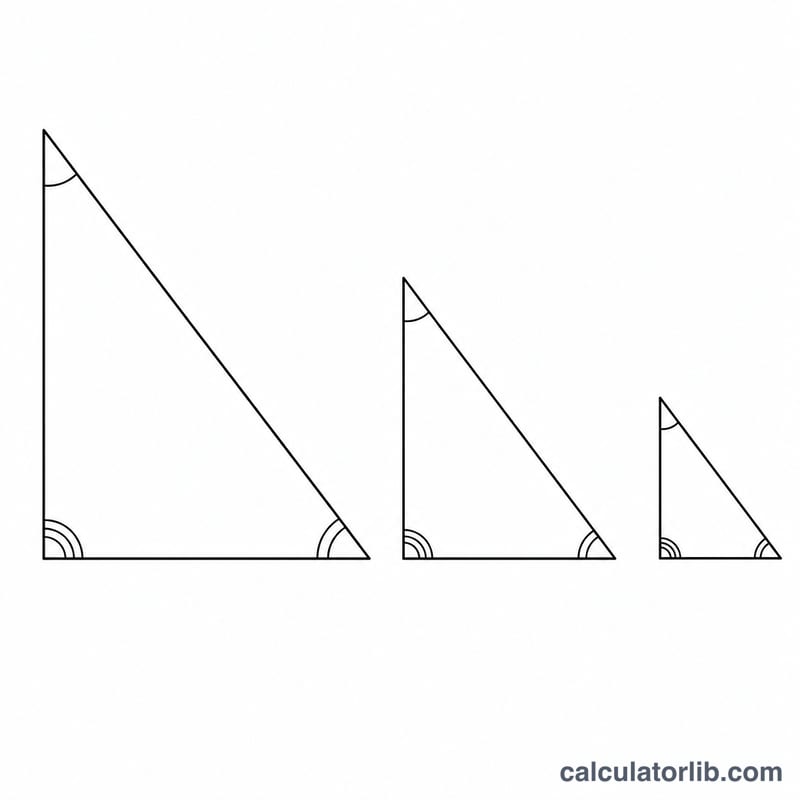
Worked Example
Suppose \(p = 4\) and \(q = 9\). The hypotenuse is \(4 + 9 = 13\). The altitude is \(\sqrt{4 \cdot 9} = \sqrt{36} = 6\). The legs are \(\sqrt{4 \cdot 13} = \sqrt{52} \approx 7.2111\) and \(\sqrt{9 \cdot 13} = \sqrt{117} \approx 10.8167\). You can verify with the Pythagorean theorem: $$ 7.2111^2 + 10.8167^2 \approx 52 + 117 = 169 = 13^2. $$
FAQ
What is a geometric mean? The geometric mean of two numbers a and b is \(\sqrt{a \cdot b}\) — the value \(x\) where \(a/x = x/b\).
Can p and q be equal? Yes. If \(p = q\) the triangle is isosceles right at the foot, and the altitude equals each segment.
What if I only know the legs? Use the standard Pythagorean theorem instead; this tool is specifically for the segment-based geometric mean relationships.