
What this calculator does
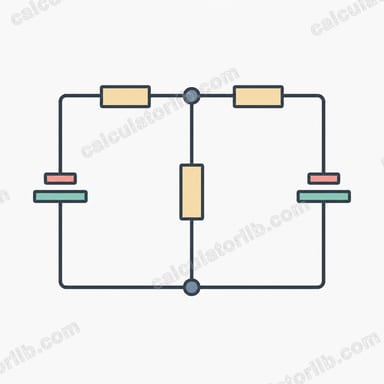
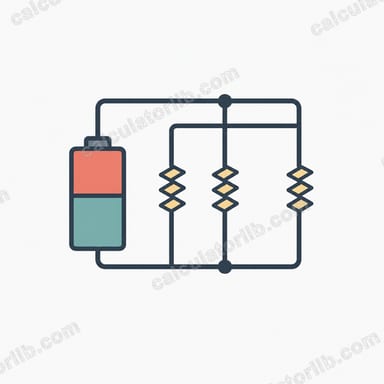
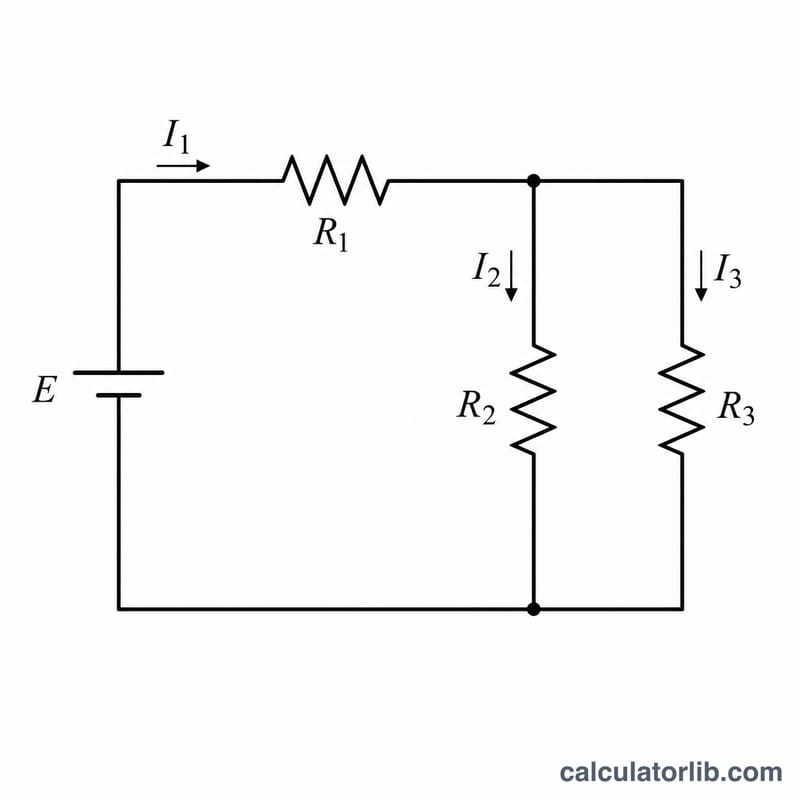
This tool solves a classic DC circuit made of a single ideal voltage source (EMF E1) and three resistors. The topology is R1 in series with the parallel combination of R2 and R3: current I1 leaves the source and flows through R1, reaches a node where it splits into I2 (through R2) and I3 (through R3), then the two branches reunite and return to the source. It is pure physics and works identically anywhere.
How to use it
Enter the source voltage E1 and pick its unit (V, kV, mV, etc.). Enter R1, R2 and R3; all three resistors share one unit selector (Ohm, kOhm, MOhm, ...). All values are normalized to SI volts and ohms before solving, and the three branch currents are returned in amperes. Keep each resistance greater than zero for a normal solution.
The formula explained
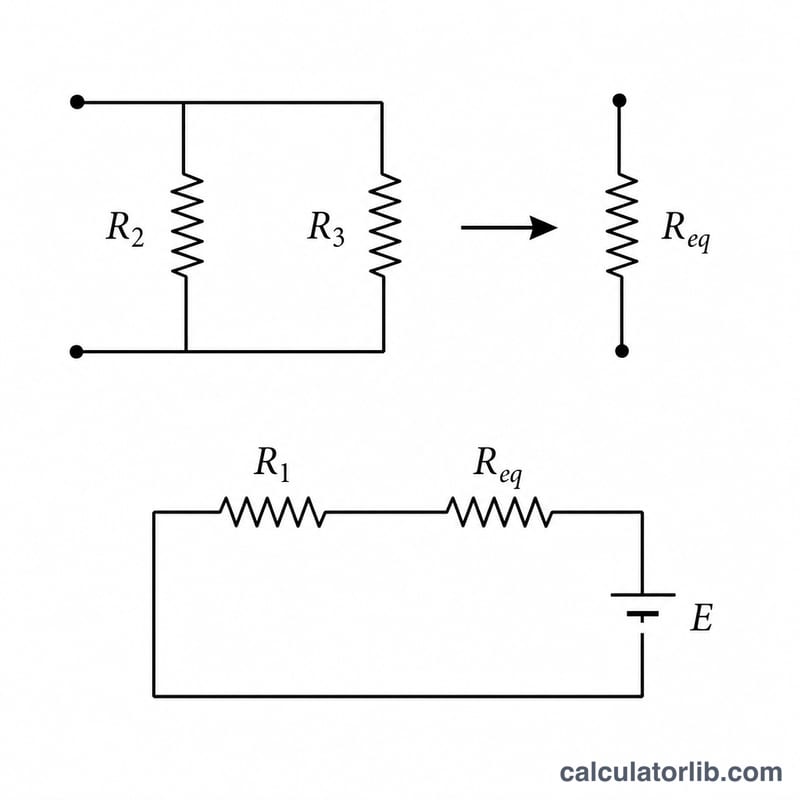
By Kirchhoff's current law, \(I_1 = I_2 + I_3\). The parallel section has resistance \(R_p = \frac{R_2\cdot R_3}{R_2+R_3}\), so the total seen by the source is \(R_{total} = R_1 + R_p\). Ohm's law gives the source current \(I_1 = \frac{E}{R_{total}}\). The voltage across the parallel section is \(V_p = I_1\cdot R_p\), and each branch carries \(V_p\) divided by its own resistance, which simplifies to the current-divider rule: $$I_2 = I_1\cdot\frac{R_3}{R_2+R_3} \quad\text{and}\quad I_3 = I_1\cdot\frac{R_2}{R_2+R_3}.$$
Worked example
With E = 12 V, R1 = 8 Ohm, R2 = 4 Ohm, R3 = 2 Ohm: $$R_p = \frac{4\times 2}{4+2} = 1.3333\ \text{Ohm}, \quad R_{total} = 9.3333\ \text{Ohm}.$$ Then $$I_1 = \frac{12}{9.3333} = 1.2857\ \text{A}.$$ The split gives $$I_2 = 1.2857 \times \frac{2}{6} = 0.4286\ \text{A} \quad\text{and}\quad I_3 = 1.2857 \times \frac{4}{6} = 0.8571\ \text{A}.$$ Check: \(0.4286 + 0.8571 = 1.2857\ \text{A} = I_1\), confirming Kirchhoff's current law.
FAQ
Why does the smaller resistor carry more current? In a parallel pair the two branches share the same voltage, so current is inversely proportional to resistance — the lower-resistance branch (R3 here) carries the larger current.
Can the voltage be negative? Yes; a negative source simply reverses polarity and all currents come out negative. Resistances, however, must be positive for a physically meaningful result.
What if R2 or R3 is zero? A zero resistor shorts the parallel section (\(R_p = 0\)), so all current bypasses the other branch — for example R2 = 0 forces I3 = 0 and I2 = I1. If both R1 and Rp are zero the circuit is an ideal short and the current is reported as undefined.