
What is the Pareto Distribution Calculator?
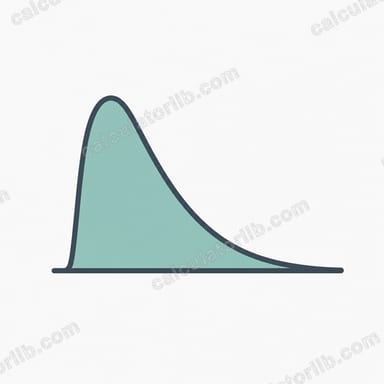
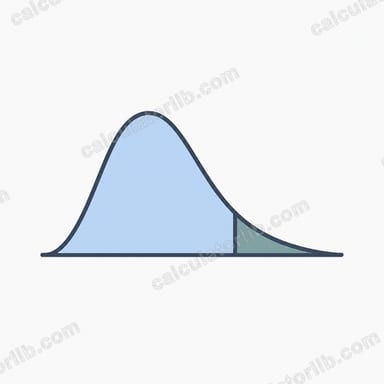
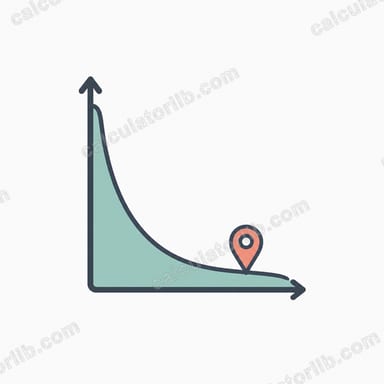
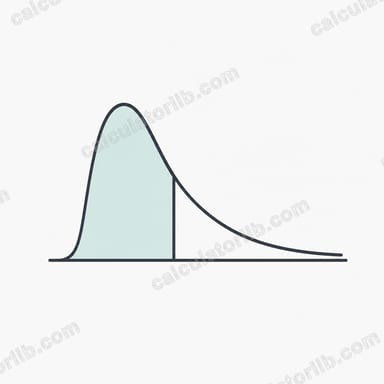
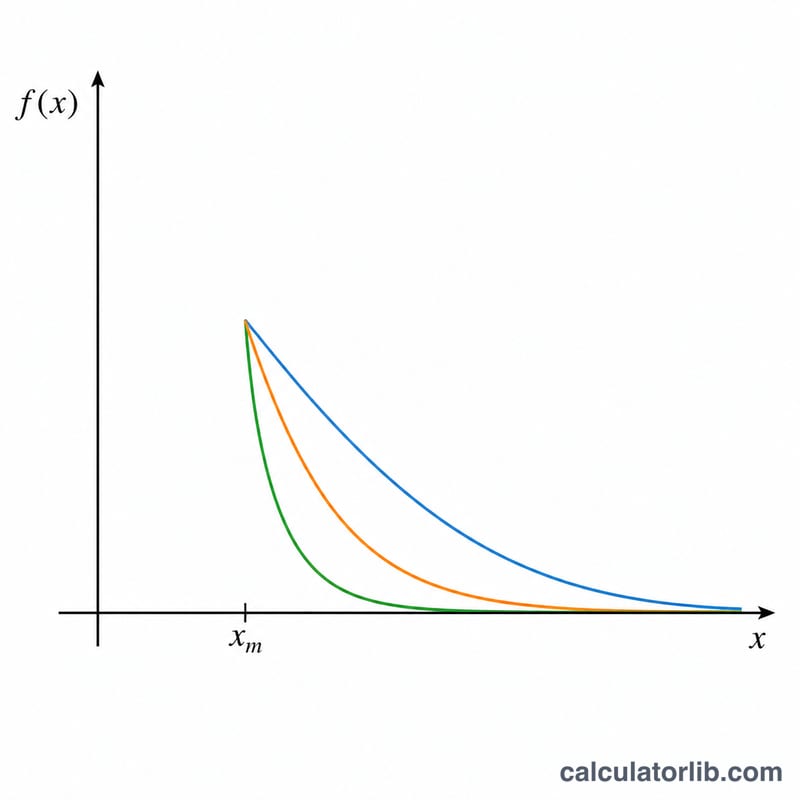
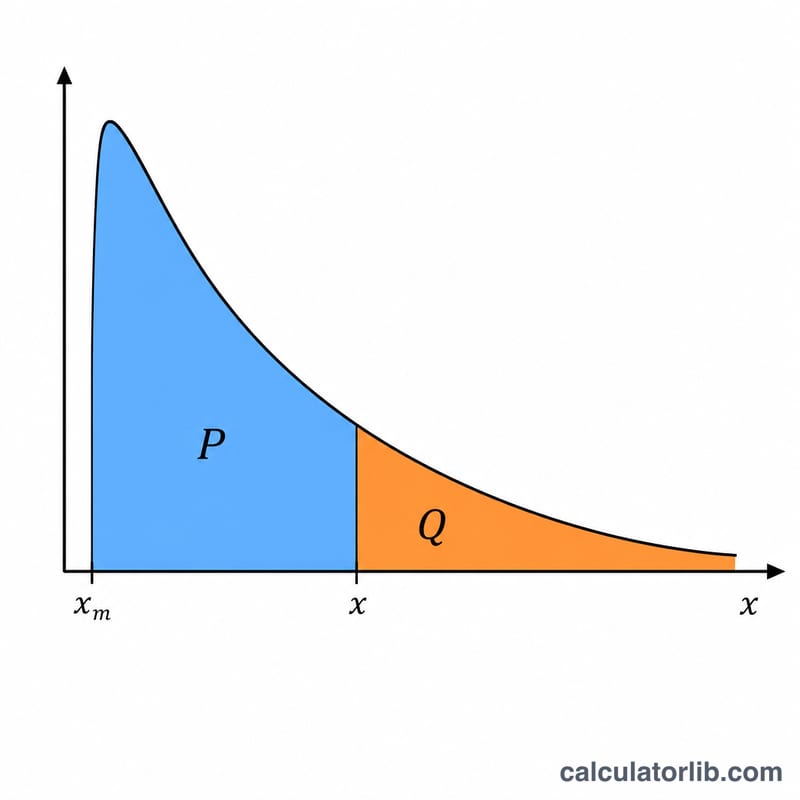
This tool evaluates the Pareto (Type I) distribution — a classic heavy-tailed power-law distribution used to model wealth, city sizes, file sizes and the "80/20" rule. Given a scale parameter xm (the minimum value) and a shape parameter alpha, it computes the probability density f, the lower cumulative probability (CDF) P, and the upper cumulative probability (survival function) Q at any point x. It is a pure-math statistics tool with no regional assumptions.
How to use it
Pick which function you want (density, CDF, or survival). Enter the scale parameter xm (must be greater than 0), the shape parameter alpha (must be greater than 0), and the point x (the initial value of x). The optional increment and number of repetitions describe a series of x points for plotting a graph: \(x_i = \text{startX} + i \times \text{stepX}\) for \(i = 0 \ldots \text{loopCount} - 1\).
The formula explained
For \(x \ge x_m > 0\) and \(\alpha > 0\):
Density: $$f(x) = \frac{\alpha\;x_m^{\alpha}}{x^{\,\alpha+1}}$$ CDF: $$P(x) = 1 - \left(\frac{x_m}{x}\right)^{\alpha}$$ Survival: $$Q(x) = \left(\frac{x_m}{x}\right)^{\alpha}$$ Note that \(P + Q = 1\) always. When \(x < x_m\) the support is not yet reached, so \(f = 0\), \(P = 0\) and \(Q = 1\).
Worked example
Let \(x_m = 1\), \(\alpha = 1\), \(x = 2\). Then $$f = \frac{1 \cdot 1}{2^{2}} = 0.25,$$ $$P = 1 - \left(\frac{1}{2}\right)^{1} = 0.5,$$ and $$Q = \left(\frac{1}{2}\right)^{1} = 0.5.$$ Check: \(P + Q = 1.0\). For \(x_m = 2\), \(\alpha = 3\), \(x = 4\): $$f = \frac{3 \cdot 8}{256} = 0.09375,$$ $$P = 1 - 0.125 = 0.875,$$ \(Q = 0.125\).
FAQ
What does the shape parameter alpha control? Larger \(\alpha\) makes the tail decay faster (less heavy); the mean is finite only when \(\alpha > 1\).
Why is the density zero below xm? The Pareto distribution has support only on \(x \ge x_m\), so no probability mass exists below the scale parameter.
What is the survival function? \(Q(x)\) is the probability that a random variable exceeds \(x\), i.e. the complementary CDF, equal to \(1 - P(x)\).