
What Is the Economic Order Quantity (EOQ)?
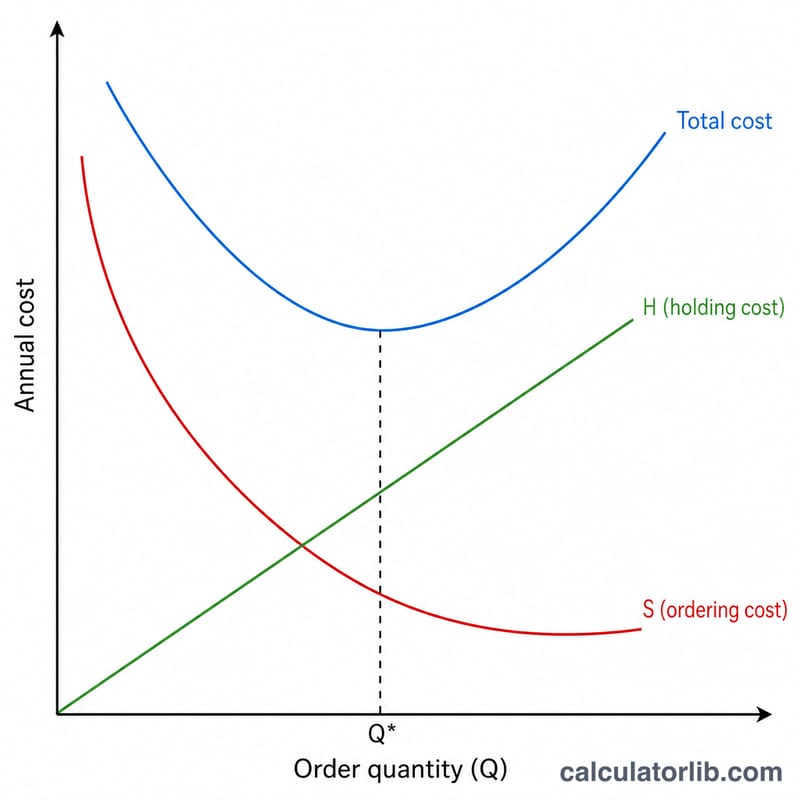
The Economic Order Quantity (EOQ) is the order size that minimizes the total cost of managing inventory. It balances two opposing costs: ordering cost (which falls when you order in large batches less often) and holding cost (which rises when you keep more stock on hand). EOQ pinpoints the sweet spot where these two costs are equal and their total is lowest. The model is universal and applies to any business or supply chain, regardless of country or currency.
How to Use the Calculator
Enter three numbers: your annual demand (how many units you sell or use per year), your order cost (the fixed cost of placing one order — paperwork, shipping, setup), and your holding cost (the cost to store one unit for a full year — warehousing, insurance, capital). The calculator returns the optimal order quantity along with how many orders you'll place per year, the days between orders, and your annual ordering, holding, and total inventory costs.
The Formula Explained
$$\text{EOQ} = \sqrt{\dfrac{2 \cdot D \cdot S}{H}}$$ Doubling the product of demand and order cost increases EOQ, while a higher holding cost shrinks it. The optimal order quantity grows with the square root of demand, not linearly — so a 4× jump in demand only doubles the ideal order size.
Worked Example
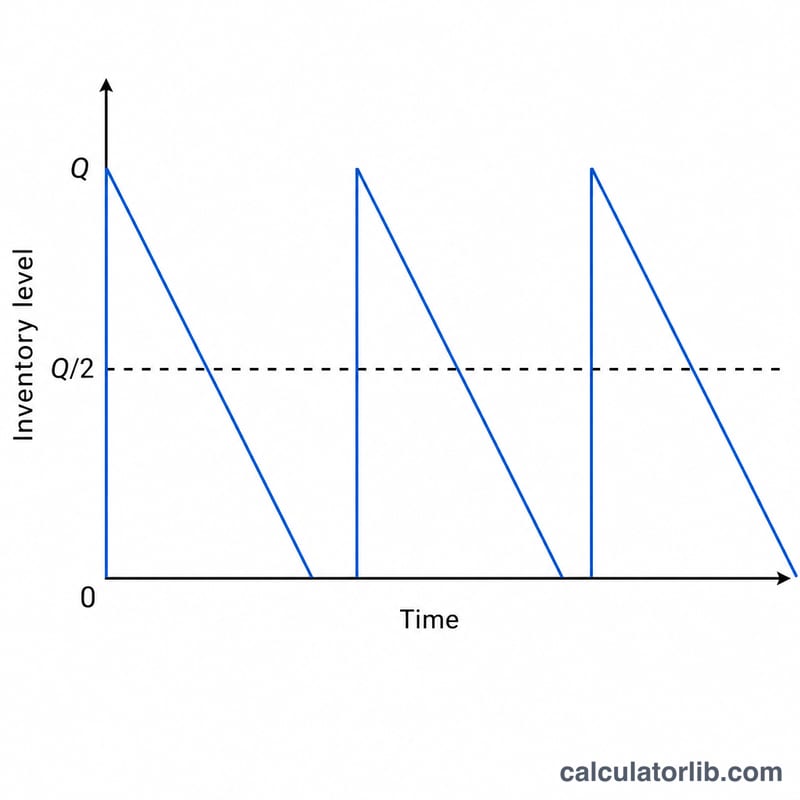
Suppose annual demand \(D = 10{,}000\) units, order cost \(S = \$50\), and holding cost \(H = \$5\) per unit per year. $$\text{EOQ} = \sqrt{\dfrac{2 \times 10{,}000 \times 50}{5}} = \sqrt{\dfrac{1{,}000{,}000}{5}} = \sqrt{200{,}000} \approx 447.21 \text{ units}$$ You would place about 22.36 orders per year (one roughly every 16.3 days), with ordering and holding costs each near $1,118 — a total annual inventory cost of about $2,236.
FAQ
What if my holding cost is a percentage? Multiply the unit's value by the annual holding rate (e.g., 20% of a $25 item = $5) and enter that dollar figure.
Does EOQ account for discounts or lead time? The basic EOQ assumes constant demand and no quantity discounts. Use it as a strong baseline, then adjust for bulk-discount tiers or safety stock separately.
Why are ordering and holding costs equal at the EOQ? The EOQ is mathematically the point where annual ordering cost equals annual holding cost, which is exactly where total cost is minimized.