What Is Share of Voice (SOV)?
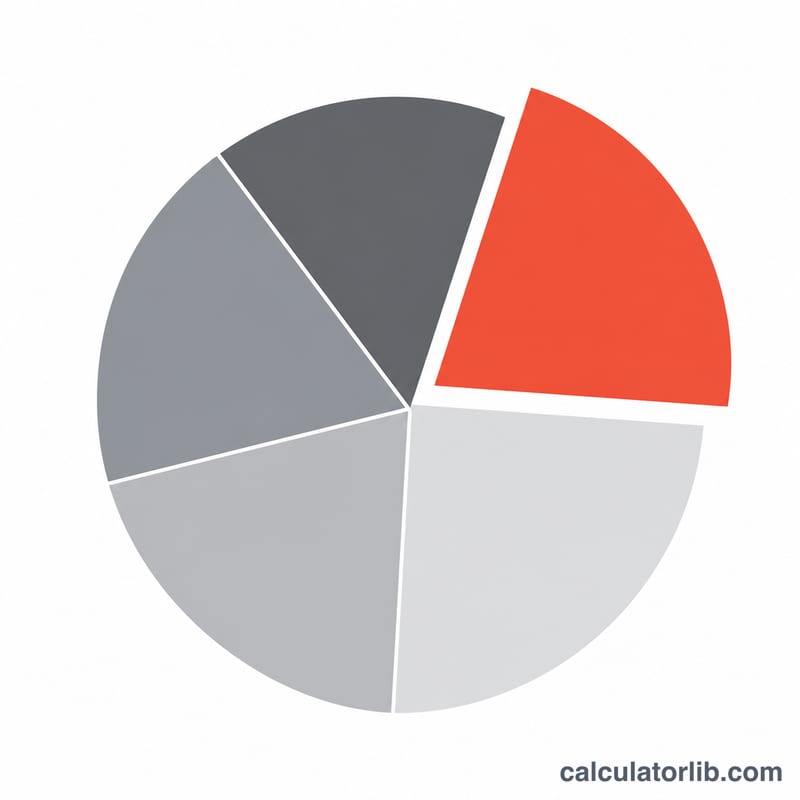
Share of Voice (SOV) measures how much of a market your brand owns relative to the competition for a chosen metric. It is widely used in marketing, advertising, PR, SEO, and social media to gauge brand visibility and dominance. Whatever metric matters to you — ad spend, impressions, social mentions, organic search clicks, or media coverage — SOV expresses your slice as a percentage of the total.
How to Use This Calculator
Enter two numbers: Your Brand Metric (your brand's value for the chosen metric) and the Total Market Metric (the combined value across all brands, including yours). The calculator returns your Share of Voice as a percentage, plus the remaining share held by competitors or other sources. Make sure both numbers use the same unit and time period for an accurate result.
The Formula Explained
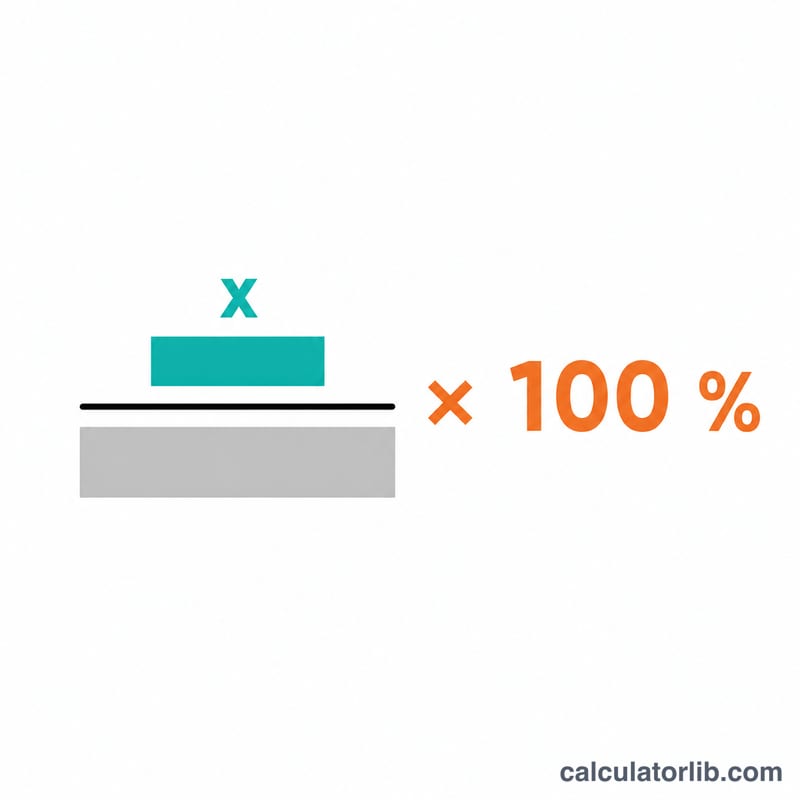
The math is simple division turned into a percentage:
$$\text{SOV} = \frac{\text{Your Brand Metric}}{\text{Total Market Metric}} \times 100\%$$
The numerator is your brand's portion; the denominator is the whole market. Multiplying by 100 converts the ratio into a percentage that is easy to compare over time or against competitors.
Worked Example
Suppose your brand earned 25,000 social media mentions last month, while the entire industry — your brand plus all competitors — generated 100,000 mentions. Your Share of Voice is $$(25{,}000 \div 100{,}000) \times 100 = 25\%$$ That means competitors and other sources hold the remaining 75%.
Interpreting Your Share of Voice Result
Share of Voice (SOV) is your brand's metric (for example impressions, mentions, or ad spend) divided by the total for the whole market, shown as a percentage: \(\text{SOV} = \frac{ \text{brand}}{ \text{total}} \times 100\%\). A single number means little by itself. It becomes useful when you compare it with (a) your competitors' SOV figures, measured the same way over the same period, and (b) your brand's market share.
Comparing with competitors
Calculate SOV for each major competitor using the same metric, channel, and time window. The shares should add up to about 100% if the total market metric is the sum of all the brands you are tracking. A brand with the largest SOV has the greatest visibility in that definition of the market, but not necessarily the largest sales.
Excess Share of Voice (ESOV)
Excess Share of Voice is the gap between your SOV and your market share:
$$\text{ESOV} = \text{SOV} - \text{Market Share}$$
Example: if a brand has 18% SOV and 12% market share, then \(\text{ESOV} = 18\% - 12\% = 6\) percentage points. Researchers Les Binet and Peter Field, in their analyses of advertising effectiveness case studies, found that brands whose SOV exceeds their market share tend to be associated with growth in market share, while brands whose SOV is below their market share tend to be associated with decline. The larger the excess, the stronger the association with growth has generally been reported to be.
| Case | ESOV | What it generally indicates |
|---|---|---|
| SOV > market share | Positive | Brand is more visible than its current size; associated with growth potential |
| SOV = market share | Zero | Visibility is in line with size; share is likely to hold roughly steady |
| SOV < market share | Negative | Brand is less visible than its size; associated with risk of share decline over time |
Important caveats
- Results depend on the metric you choose (spend, impressions, mentions, search share) and on the time period measured.
- How the market and competitor set are defined changes the percentage substantially.
- SOV is a directional indicator, not a guarantee. Creative quality, pricing, distribution, and product strength also affect outcomes, and the Binet and Field relationship is an observed association rather than a fixed rule.
Key Terms in Share of Voice
- Share of Voice (SOV)
- The proportion of total category visibility or activity that belongs to your brand, expressed as a percentage. It can be based on advertising spend, impressions, mentions, search visibility, or other measures.
- Market share
- The proportion of total category sales (by revenue or units) that your brand holds. It reflects what customers actually buy, whereas SOV reflects how visible or talked about the brand is.
- SOV vs. market share
- SOV measures presence and attention; market share measures commercial results. Comparing the two shows whether your visibility is ahead of or behind your sales position.
- Excess Share of Voice (ESOV)
- SOV minus market share, in percentage points. Positive ESOV means you are more visible than your size suggests; negative means less.
- Paid SOV
- Visibility gained through paid media such as advertising, sponsored search, or paid social.
- Organic SOV
- Visibility gained without direct payment for placement, such as unpaid search rankings or unpaid social posts from your own channels.
- Earned SOV
- Visibility from others talking about your brand, such as press coverage, reviews, shares, and influencer or customer mentions.
- Impressions
- The number of times content or an ad is displayed. One person can generate multiple impressions, so impressions are not the same as unique people reached.
- Mentions
- Instances where your brand is named in media, social platforms, forums, or reviews. Mentions are often counted by social listening or media monitoring tools.
Note on the total: the total market metric must include your own brand's figure. For example, if your brand has 2,000 mentions and competitors have 8,000 combined, the total is 10,000 (not 8,000) and SOV is \(\frac{2{,}000}{10{,}000} \times 100\% = 20\%\). Use the same metric and time period for both inputs.
FAQ
What metrics can I use? Any quantifiable, comparable metric works: ad spend, impressions, clicks, mentions, backlinks, keyword rankings, or earned media value.
Is a higher SOV always better? Generally yes — higher SOV signals stronger market presence. Many marketers track SOV against market share, since a Share of Voice greater than your market share often predicts future growth.
What if I don't know the total market metric? Estimate it by summing your brand's metric and your top competitors' metrics. The total must include your own brand to keep the percentage accurate.