
What Is Break-Even ROAS?
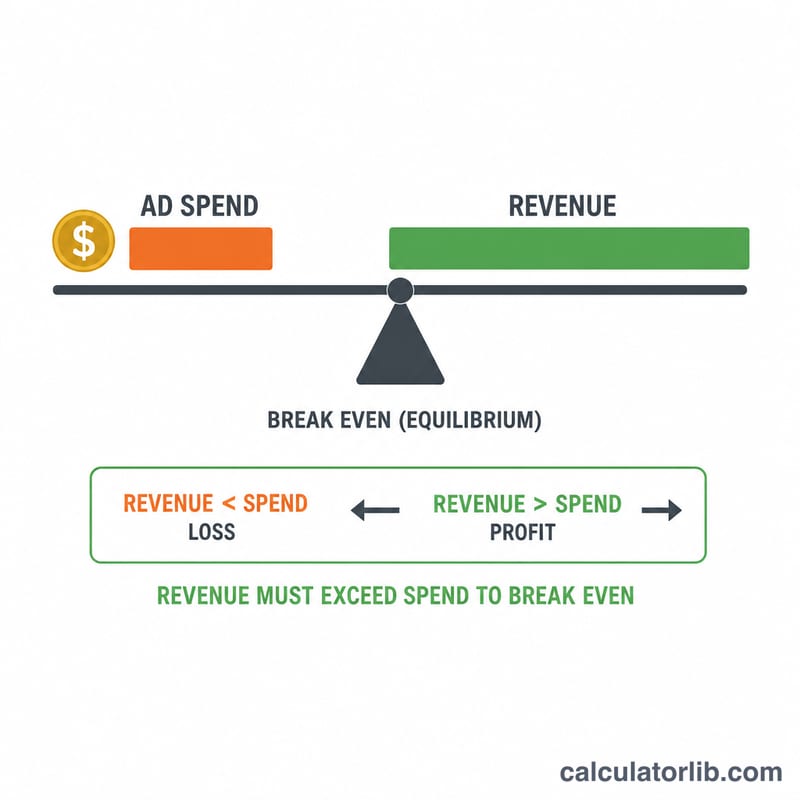
Return on Ad Spend (ROAS) measures how much revenue you earn for every dollar spent on advertising. Your break-even ROAS is the exact point where the gross profit generated by a campaign equals the money you spent to run it. Above it you profit; below it you lose money. Because it depends only on your profit margin, it is the single most important benchmark for setting bid targets, evaluating channels, and deciding whether a campaign is worth scaling.
How to Use This Calculator
Enter your profit margin as a percentage. This is the share of each sale that is gross profit before advertising costs — that is, revenue minus cost of goods, shipping, fees, and other variable costs, divided by revenue. The calculator returns your break-even ROAS (revenue needed per dollar of ad spend) and the equivalent break-even ACoS (advertising cost as a percent of sales).
The Formula Explained
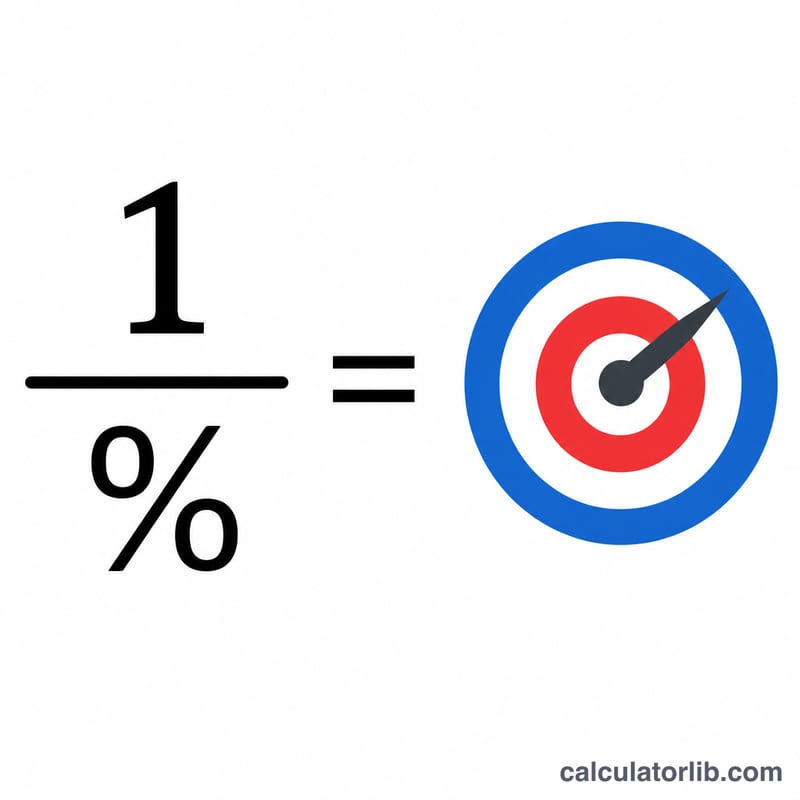
The math is simple: Break-Even ROAS = 1 ÷ Profit Margin. If you keep 25 cents of profit on every dollar of sales (a 25% margin), then for advertising to pay for itself each ad dollar must generate enough sales that the 25% profit covers that dollar. That requires $4 in sales per $1 spent, so the break-even ROAS is 1 ÷ 0.25 = 4.
Worked Example
Suppose your profit margin is 40%. Break-Even ROAS = 1 ÷ 0.40 = 2.5x. Any campaign delivering a ROAS above 2.5 is profitable; below 2.5 it loses money. The equivalent break-even ACoS is 1 ÷ 2.5 = 40%.
Key Terms Defined
Understanding the vocabulary behind break-even ROAS helps you enter the right number and interpret the result correctly. The single most important input for this calculator is your contribution margin — the percentage of revenue left after the variable costs of fulfilling a sale, before advertising spend.
- ROAS (Return on Ad Spend)
- Revenue generated divided by the advertising cost that produced it, usually expressed as a ratio or multiple. For example, \(\text{ROAS} = \frac{\$4{,}000\text{ revenue}}{\$1{,}000\text{ ad spend}} = 4\) (often written 4:1 or 400%). It measures top-line return, not profit.
- ACoS (Advertising Cost of Sale)
- The inverse of ROAS, expressed as a percentage: \(\text{ACoS} = \frac{\text{Ad Spend}}{\text{Revenue}} \times 100\). A ROAS of 4 equals an ACoS of 25%. The term is most common on Amazon Advertising; it answers "what share of my sales revenue did I spend on ads?"
- Break-Even ROAS
- The minimum ROAS at which an ad campaign exactly covers its own cost — no profit, no loss — given your margin. It is the reciprocal of your contribution margin expressed as a decimal: \(\text{Break-Even ROAS} = \frac{1}{\text{Margin}\%/100}\). With a 25% margin the break-even point is a ROAS of 4. Any ROAS above this earns a profit on ad spend; below it loses money.
- Target ROAS
- The ROAS you actually aim for, set above break-even to leave room for profit and to absorb returns, overhead, or platform fees. If your break-even ROAS is 4 and you want a healthy cushion, you might set a target of 5 or 6.
- Profit Margin / Contribution Margin
- The percentage of each sale's revenue that remains after variable costs (product cost, shipping, payment processing, per-unit fees). This is the figure to enter into this calculator, because it represents the money available to pay for advertising and then contribute to fixed costs and profit. Formula: \(\text{Contribution Margin}\% = \frac{\text{Revenue} - \text{Variable Costs}}{\text{Revenue}} \times 100\).
- Gross Margin
- Revenue minus cost of goods sold (COGS), divided by revenue. It often excludes some variable selling costs (like shipping or transaction fees) that contribution margin includes, so it can be slightly higher. If gross margin is all you have, it is a usable approximation — but contribution margin gives a more accurate break-even ROAS.
- Variable vs. Fixed Costs
- Variable costs rise and fall with each unit sold (manufacturing, shipping, packaging, card fees) and are subtracted to find contribution margin. Fixed costs (rent, salaries, software subscriptions) do not change with one extra sale and are not included in the margin you enter — they are covered out of the profit that remains after you clear break-even ROAS. Use the margin before deducting fixed costs and ad spend.
FAQ
Should I aim for exactly the break-even ROAS? No — break-even means zero profit from advertising. Set your target ROAS above break-even to leave room for actual profit and fixed-cost coverage.
What margin should I enter? Use your contribution margin: revenue minus all variable costs, excluding ad spend and fixed overhead.
Is ROAS the same as ACoS? They are inverses. ROAS is revenue ÷ ad spend; ACoS is ad spend ÷ revenue. A 4x ROAS equals a 25% ACoS.