
What is a Sales Funnel Conversion Calculator?
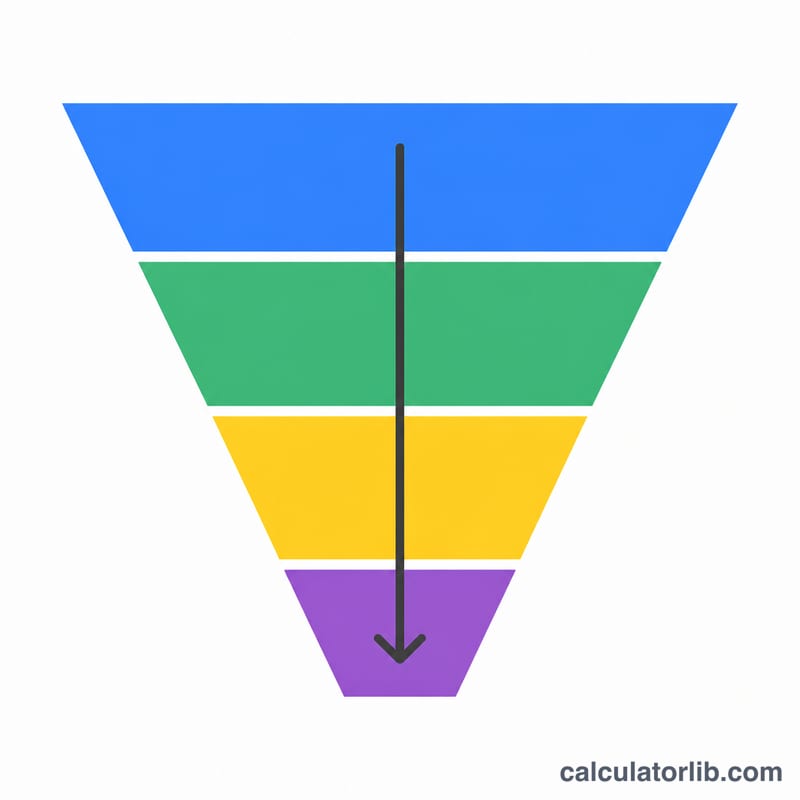
A sales funnel describes the journey a prospect takes from first contact to becoming a paying customer. At each stage some people drop off, so measuring how many advance from one stage to the next tells you where your process leaks. This calculator computes the conversion rate for every transition in a four-stage funnel — Leads, Qualified, Opportunities, Customers — plus the overall lead-to-customer rate.
How to use it
Enter the number of records that reached each stage. Stage 1 is the top of the funnel (all leads or visitors). Each later stage should be a subset of the one before it. Click calculate and you'll see three stage conversion rates and the single overall percentage.
The formula explained
Each stage rate is simply the output divided by the input, multiplied by 100:
$$\text{Stage Conversion \%} = \frac{\text{Stage Output}}{\text{Stage Input}} \times 100$$
The overall conversion is customers divided by leads × 100. Mathematically this equals the product of all the individual stage rates, which is why a small leak at any stage compounds across the whole funnel.
$$\text{Overall Conversion} = \frac{\text{Customers}}{\text{Leads}} \times 100\%$$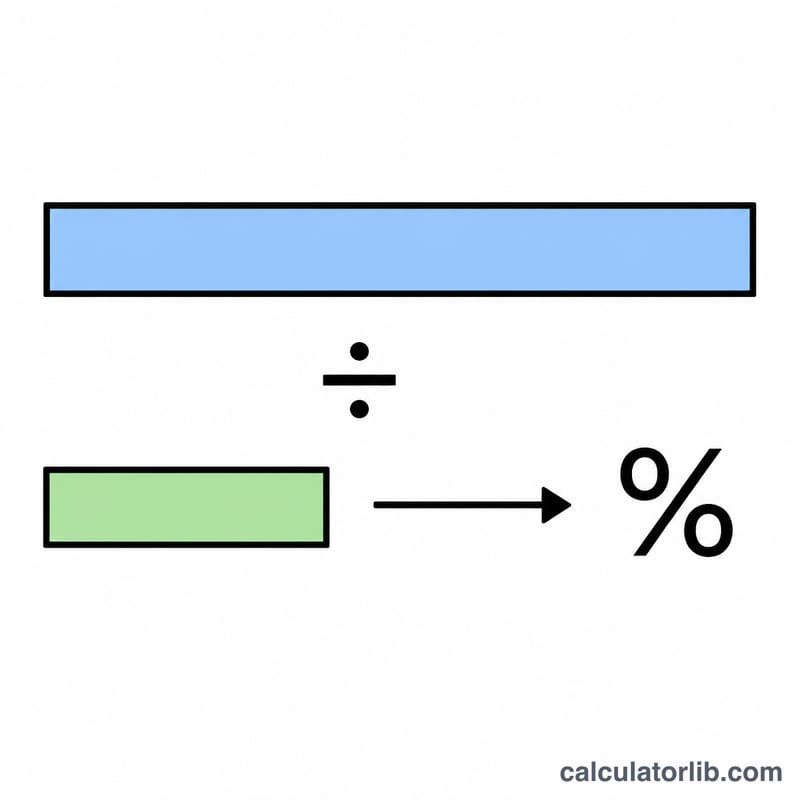
Worked example
Suppose 1,000 leads, 400 qualified, 150 opportunities and 30 customers. Leads→Qualified = \(400/1000 = 40\%\). Qualified→Opportunities = \(150/400 = 37.5\%\). Opportunities→Customers = \(30/150 = 20\%\). Overall = \(30/1000 = 3\%\). Note $$0.40 \times 0.375 \times 0.20 = 0.03 = 3\%$$ confirming the product rule.
FAQ
What is a good funnel conversion rate? It varies widely by industry and channel; B2B end-to-end rates of 1–5% are common, while a single high-intent step may exceed 50%.
Can I use fewer than four stages? Yes — set unused stages equal to the previous one so that transition shows 100% and doesn't distort the overall rate.
Why use stage rates instead of just the overall number? Stage rates pinpoint exactly where prospects drop off, so you know which part of the process to fix.