
What is the Ping & Round-Trip Latency Calculator?
This tool estimates the theoretical minimum ping — the smallest possible round-trip latency — between two locations based purely on the speed of light and the distance a signal must travel. Real-world ping is always higher because of routing detours, switching, queuing, and processing delays, but this physics-based floor tells you the best latency you could ever achieve over a direct link.
How to use it
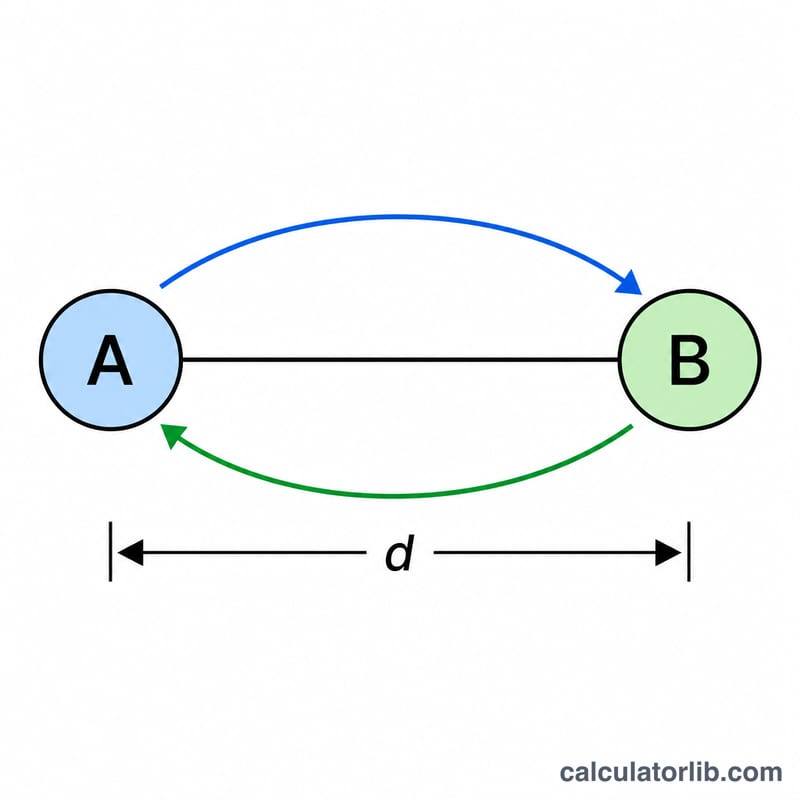
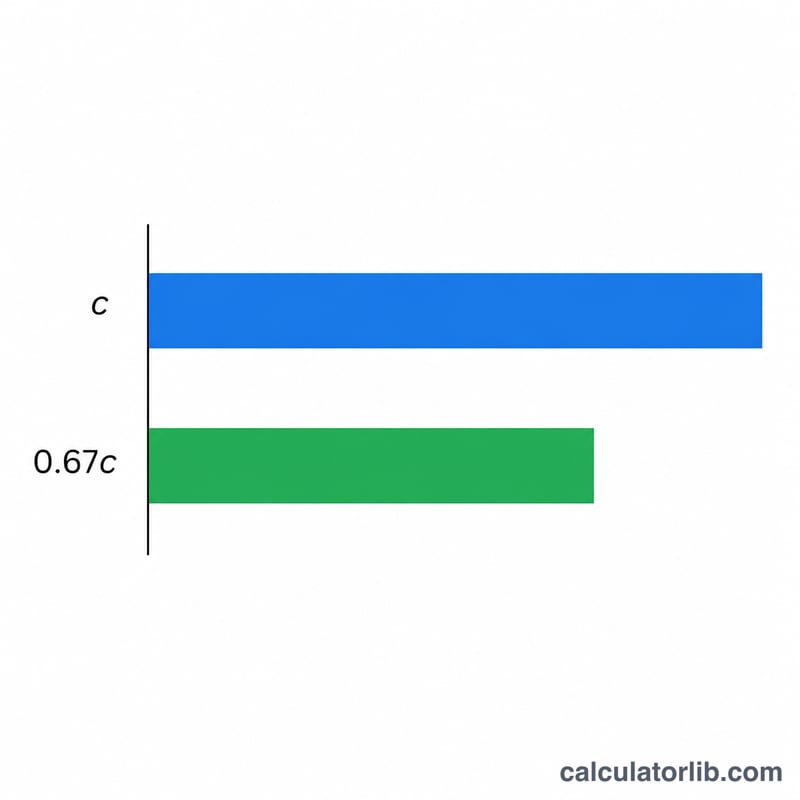
Enter the one-way distance in kilometers between the two endpoints (the straight-line or cable distance). Then set the velocity factor — the fraction of the speed of light at which your signal travels. Use about 0.67 for fiber-optic cable, and 1.0 for radio/microwave in free space (e.g. satellite or line-of-sight wireless). The calculator returns the minimum possible round-trip time in milliseconds.
The formula explained
Light travels at \(c = 299{,}792.458 \text{ km/s}\), which is \(299.792458 \text{ km/ms}\). In a medium, the effective speed is \(c \times \text{velocity factor}\). The one-way time is distance divided by that effective speed, and ping is the round trip, so we multiply by 2:
$$\text{Latency}_{ms} = \frac{\text{distance}_{km}}{(299.792458 \times vf)} \times 2$$
Worked example
For two cities 1,000 km apart over fiber (vf = 0.67): effective speed = \(299.792458 \times 0.67 \approx 200.86 \text{ km/ms}\). One-way time = \(1000 / 200.86 \approx 4.978 \text{ ms}\). Round-trip ping $$\approx 9.96 \text{ ms}$$ So even a perfect cable can't beat ~10 ms of ping at that distance.
FAQ
Why is my real ping much higher? Actual networks add hops, congestion, and processing; this is only the light-speed floor.
What velocity factor should I use? ~0.67 for typical fiber, ~0.65–0.70 for copper, and 1.0 for vacuum/free-space radio.
Should I use straight-line distance? Cables rarely run straight; using the real route length gives a more realistic estimate.