What is the Screen Resolution to Megapixels Calculator?
This tool converts a display or image resolution, expressed as a pixel width and height, into megapixels (MP). A megapixel is simply one million pixels, so it provides a compact way to describe how much detail a screen or sensor can show. Whether you are comparing monitors, camera sensors, or exported image sizes, megapixels give a single, easy-to-compare number.
How to use it
Enter the horizontal resolution (width) and vertical resolution (height) in pixels. For example, a Full HD display is 1920 \(\times\) 1080. Click calculate and the tool returns the total pixel count and the equivalent megapixels. The calculation is universal — it works for any screen, image, or camera sensor regardless of country or device.
The formula explained
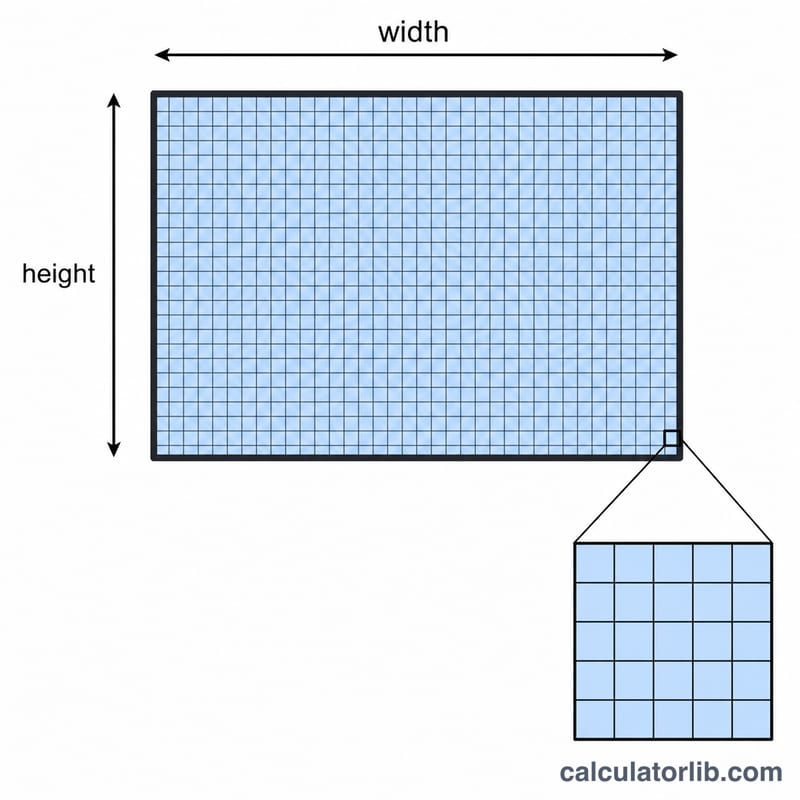
The math is straightforward: multiply width by height to get the total number of pixels, then divide by 1,000,000 to convert to megapixels. In formula form, $$\text{Megapixels} = \frac{\text{Width (px)} \times \text{Height (px)}}{1{,}000{,}000}$$ Because a megapixel is exactly one million pixels, the division simply rescales the total into millions.
Worked example
Take a 4K UHD display at 3840 \(\times\) 2160. Total pixels $$= 3840 \times 2160 = 8{,}294{,}400$$ Divide by 1,000,000 to get 8.29 megapixels. So a 4K screen contains roughly 8.3 MP, while a Full HD (1920 \(\times\) 1080) screen contains about 2.07 MP — about a quarter of the detail.
Common Screen and Camera Resolutions in Megapixels
Megapixels (MP) are the total pixel count divided by 1,000,000: \(\text{MP} = \frac{ \text{width} \times \text{height} }{1{,}000{,}000}\). The values below are rounded to two decimals.
| Name | Width × Height | Total pixels | Megapixels |
|---|---|---|---|
| HD | 1280 × 720 | 921,600 | 0.92 MP |
| HD+ | 1600 × 900 | 1,440,000 | 1.44 MP |
| Full HD | 1920 × 1080 | 2,073,600 | 2.07 MP |
| QHD / 1440p | 2560 × 1440 | 3,686,400 | 3.69 MP |
| WQHD ultrawide | 3440 × 1440 | 4,953,600 | 4.95 MP |
| 4K UHD | 3840 × 2160 | 8,294,400 | 8.29 MP |
| DCI 4K | 4096 × 2160 | 8,847,360 | 8.85 MP |
| 5K | 5120 × 2880 | 14,745,600 | 14.75 MP |
| 8K UHD | 7680 × 4320 | 33,177,600 | 33.18 MP |
| Typical 12 MP camera image | 4000 × 3000 | 12,000,000 | 12 MP |
| Typical 24 MP camera image | 6000 × 4000 | 24,000,000 | 24 MP |
Interpreting Your Megapixel Result
Megapixels only describe the total number of pixels, not how sharp an image or screen looks. Sharpness also depends on lens or panel quality, sensor size, compression, and viewing distance.
- Aspect ratio: The same MP value can have different shapes. 1920 × 1080 (16:9) and 1600 × 1296 (about 5:4) are both close to 2.07 MP but look very different. MP says nothing about shape, so check width and height as well.
- Pixel density: For a screen, \(\text{PPI} = \frac{ \sqrt{\text{width}^2 + \text{height}^2} }{ \text{diagonal (inches)} }\). A 27-inch 3840 × 2160 display has a diagonal of about 4405.8 pixels, so \(\text{PPI} \approx 4405.8 / 27 \approx 163\). The same 8.29 MP on a 32-inch panel gives a lower density, so it looks less sharp up close.
- Squared scaling: Pixel count grows with the square of linear resolution. Doubling both width and height gives 4× the pixels: 1920 × 1080 is 2.07 MP, while 3840 × 2160 is 8.29 MP, exactly four times as many.
- Print size: Print size is pixels divided by the target PPI/DPI. A 12 MP image at 4000 × 3000 pixels prints at \(4000/300 \times 3000/300 \approx 13.3 \times 10\) inches at 300 DPI. A lower DPI gives a larger print but less fine detail.
- Display vs. camera MP: A display's MP is its fixed pixel grid, while a camera's MP is the sensor's photosite count. Camera pixels depend on demosaicing, sensor size, noise, and optics, so a 12 MP camera and a 12 MP display cannot be compared directly for image quality.
FAQ
Is a higher megapixel count always better? Not necessarily. More megapixels mean more detail, but factors like pixel density (PPI), panel quality, and viewing distance also matter.
Does this work for camera sensors? Yes. A sensor's megapixel rating is derived the same way — its pixel width times height divided by one million.
Why is my result not a round number? Most resolutions don't divide evenly into millions, so results are commonly fractional (e.g., 2.07 MP for 1080p).