
What Is Revenue Churn Rate?
Revenue churn rate measures the percentage of recurring revenue your business loses over a given period due to cancellations and downgrades. Unlike customer churn (which counts logos), revenue churn weights each loss by its dollar value, so losing one large account hurts more than losing one small one. It is one of the most important health metrics for any subscription or SaaS business.
How to Use This Calculator
Enter your MRR at the start of the period (your monthly recurring revenue at the beginning of the month, quarter, or year) and the MRR lost in the period (recurring revenue lost to cancellations and downgrades — exclude new and expansion revenue). The calculator returns your gross revenue churn rate, your retention rate, and the dollar amounts retained and lost.
The Formula Explained
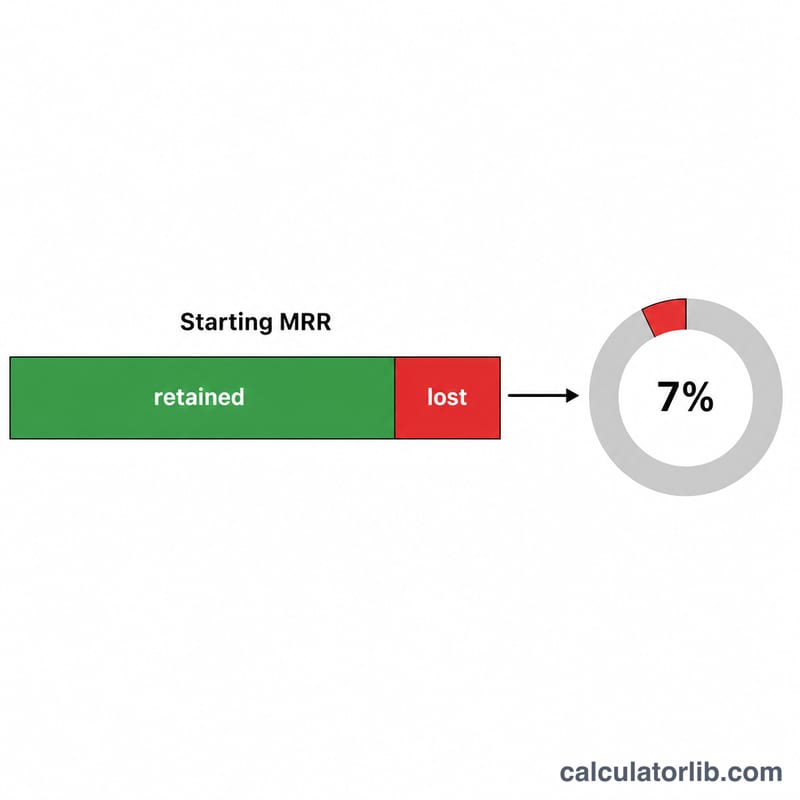
The core formula is $$\text{Revenue Churn \%} = \frac{\text{MRR Lost in Period}}{\text{MRR at Start}} \times 100$$ Because the denominator is the starting MRR only, this is a gross revenue churn figure — it does not net out upsells or expansion. Retention rate is simply 100% minus the churn rate.
Worked Example
Suppose you start a month with $50,000 in MRR and lose $2,500 to cancellations. $$\text{Churn} = \frac{2{,}500}{50{,}000} \times 100 = \mathbf{5\%}$$ Your gross revenue retention is 95%, you retained $47,500, and you lost $2,500. Over a year, a steady 5% monthly churn compounds significantly, so even small reductions matter.

FAQ
Is a 5% monthly churn good? For SaaS, healthy monthly revenue churn is typically under 1%; 5% monthly is high. Annual benchmarks differ from monthly ones.
Should I include expansion revenue? No — this is gross revenue churn. To get net revenue churn, subtract expansion MRR from MRR lost before dividing (which can be negative for strong businesses).
What period should I use? Any consistent window works (monthly is most common) as long as the starting MRR and lost MRR cover the same period.