
What Is a Conduit Fill Calculator?
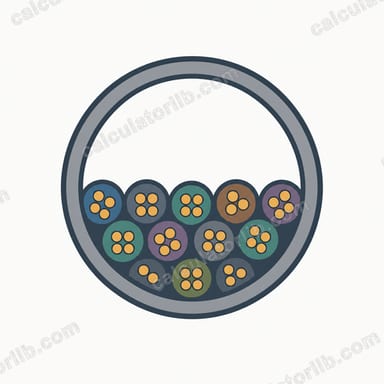
This tool applies to the United States National Electrical Code (NEC, Chapter 9, Table 1). It estimates how much of a conduit's internal cross-sectional area is occupied by the conductors inside it, then checks that figure against the maximum fill the NEC allows. Keeping fill within limits prevents overheating, makes pulling wire easier, and protects insulation from damage.
How to Use It
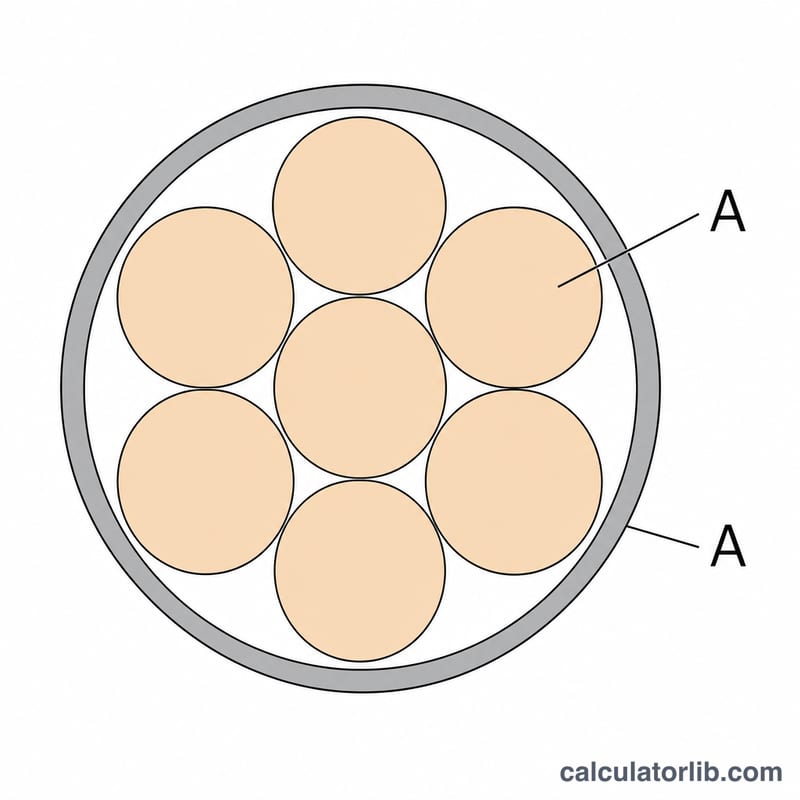
Enter the conduit's internal cross-sectional area in square inches (available from NEC Chapter 9, Table 4 for each conduit type and trade size), the cross-sectional area of a single conductor (NEC Table 5 lists this per AWG and insulation type), and how many conductors of that size you are installing. The calculator multiplies the wire area by the count, divides by the conduit area, and reports the fill percentage plus a pass/fail against the NEC limit.
The Formula Explained
Percent fill:
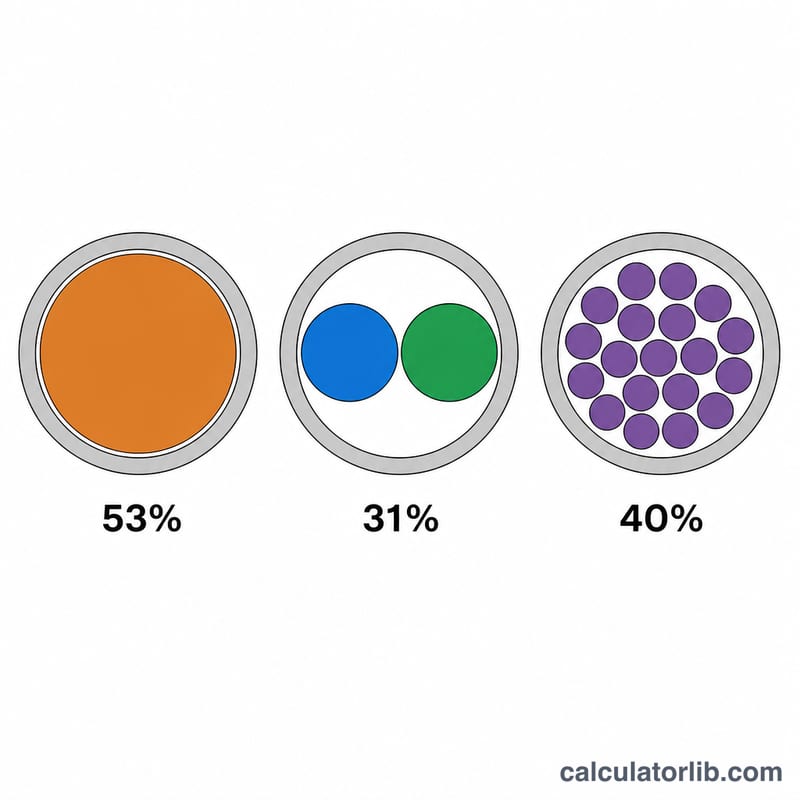
$$\text{Fill \%} = \frac{\text{Area per Wire} \times \text{Number of Wires}}{\text{Conduit Area}} \times 100\%$$The allowable limit depends on the number of conductors: 53% for a single wire, 31% for two wires, and 40% for three or more. The calculator also reports the maximum wire area you may install and the remaining usable area.
Worked Example
Three 12 AWG THHN conductors (\(0.0133\ \text{in}^2\) each) in 1/2-inch EMT (\(0.304\ \text{in}^2\) internal area): total wire area:
$$3 \times 0.0133 = 0.0399\ \text{in}^2$$Fill:
$$\frac{0.0399}{0.304} \times 100 \approx 13.13\%$$The 3-wire limit is 40%, so this run is well within code.
FAQ
Why is the single-wire limit 53%? The NEC permits a higher fill for a single conductor because there is no need to leave room for multiple wires to slide past each other during a pull.
What areas should I enter? Use NEC Chapter 9 Table 4 for conduit internal area and Table 5 for conductor area; both depend on type/size and insulation.
Does this replace code lookup? No. It is a planning aid — always confirm against the current NEC edition and local amendments.