

What Is the Defensive Interval Ratio?
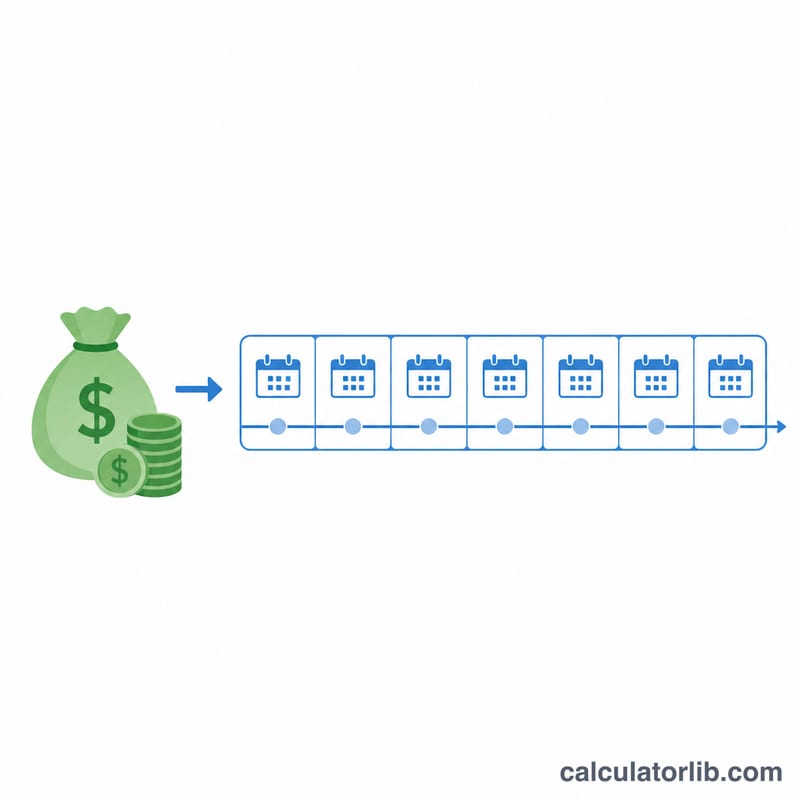
The Defensive Interval Ratio (DIR), also called the Defensive Interval Period, is a liquidity metric that estimates how many days a business can keep operating using only its most liquid ("defensive") assets — cash, marketable securities, and net receivables — without needing any new cash inflow. Unlike the current or quick ratio, the DIR translates liquidity into an intuitive number of days, making it easy to understand how long a company could survive a revenue interruption.
How to Use This Calculator
Enter your liquid assets (cash plus near-cash assets) and your annual operating expenses. The calculator divides annual expenses by 365 to get the average daily operating burn, then divides your liquid assets by that figure. The result is the number of days your reserves would last.
The Formula Explained
$$\text{DIR} = \frac{\text{Liquid Assets}}{\text{Daily Operating Expenses}}$$ where \(\text{Daily Operating Expenses} = \text{Annual Operating Expenses} / 365\). A higher DIR signals stronger short-term financial resilience. There is no universal "good" value — it depends on the industry — but many analysts look for at least 30–90 days of coverage.

Worked Example
Suppose a company holds $150,000 in liquid assets and incurs $365,000 in annual operating expenses. Daily expenses = \(365{,}000 / 365 = \$1{,}000\). $$\text{DIR} = \frac{150{,}000}{1{,}000} = 150 \text{ days}$$ The firm could fund operations for roughly five months from liquid assets alone.
FAQ
What counts as a liquid asset? Cash and cash equivalents, short-term marketable securities, and net accounts receivable expected to convert to cash quickly.
Why divide by 365? Using a full calendar year gives the average daily cash outflow, including weekends and holidays. Some analysts use 360 or 250 working days instead.
Is a higher DIR always better? A high DIR means strong liquidity, but an extremely high value may indicate idle cash that could be invested for higher returns. Balance safety with efficiency.