
What Is Tax-Equivalent Yield?
Tax-equivalent yield (TEY) tells you what a fully taxable bond would have to yield to match the after-tax return of a tax-free investment, such as a municipal bond whose interest is exempt from income tax. Because the interest on a muni bond is not taxed, its stated yield is worth more than the same yield from a corporate bond or savings account that is taxed. This calculator levels the playing field so you can compare investments apples-to-apples. Tax rules referenced here (interest taxed at your marginal rate) reflect a typical US federal scenario; state and local rules may differ.
How to Use It
Enter the tax-free yield of the bond or fund you are considering and your marginal tax rate (the rate on your last dollar of income). The calculator returns the tax-equivalent yield — the pre-tax yield a taxable alternative must beat to be the better choice.
The Formula Explained
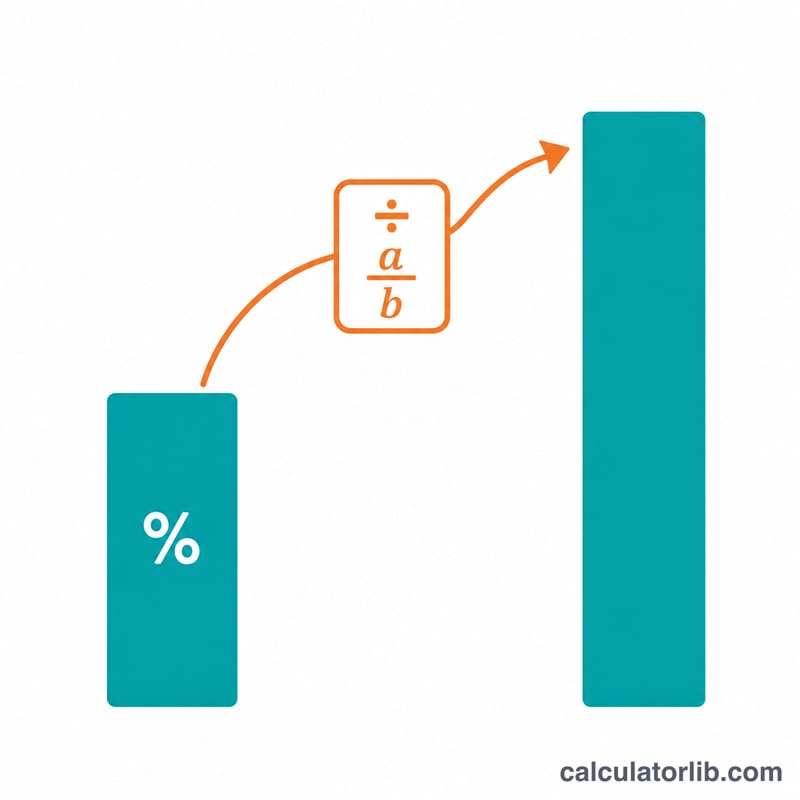
The formula is $$\text{TEY} = \frac{\text{Tax-Free Yield (\%)}}{1 - \dfrac{\text{Tax Rate (\%)}}{100}}$$ Dividing by \(1 - \text{tax rate}\) "grosses up" the tax-free yield. A higher tax rate makes the denominator smaller, which raises the tax-equivalent yield — meaning tax-free bonds become more attractive the higher your tax bracket.
Worked Example
Suppose a municipal bond yields 3.5% and you are in the 24% marginal tax bracket. $$\text{TEY} = 3.5 \div (1 - 0.24) = 3.5 \div 0.76 = 4.605\%$$ So a taxable bond would need to yield about 4.61% to give you the same after-tax return as the 3.5% tax-free bond.
FAQ
Which tax rate should I use? Use your marginal (top) tax rate, since that is the rate the taxable interest would be taxed at. For municipal bonds you may combine federal and state rates if the bond is also state-tax exempt.
What if the comparison taxable yield is higher than my TEY? Then the taxable investment gives a better after-tax return, despite being taxed.
Does this account for capital gains? No — it compares interest yields only. Capital gains taxes and fees should be evaluated separately.