What is effective duration?
Effective duration measures how much a bond's price is expected to change when interest rates move, expressed in years. Unlike modified duration, it works for bonds with embedded options (callable, putable, or mortgage-backed securities) because it is derived directly from observed or modeled prices after small yield shifts rather than from a fixed cash-flow schedule. A duration of 6 means a 1% rise in yields would push the price down roughly 6%.
How to use this calculator
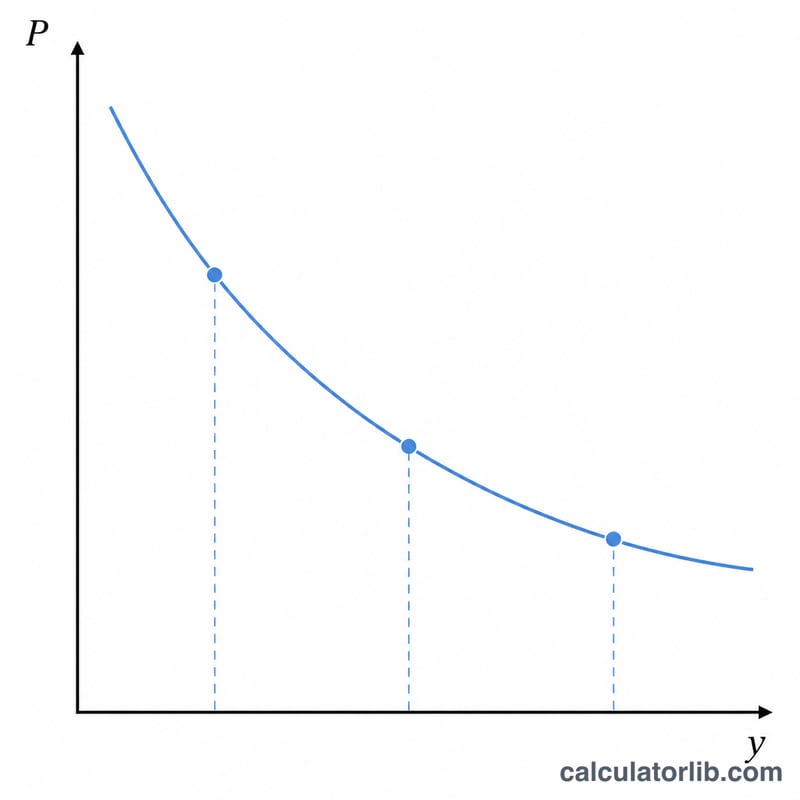
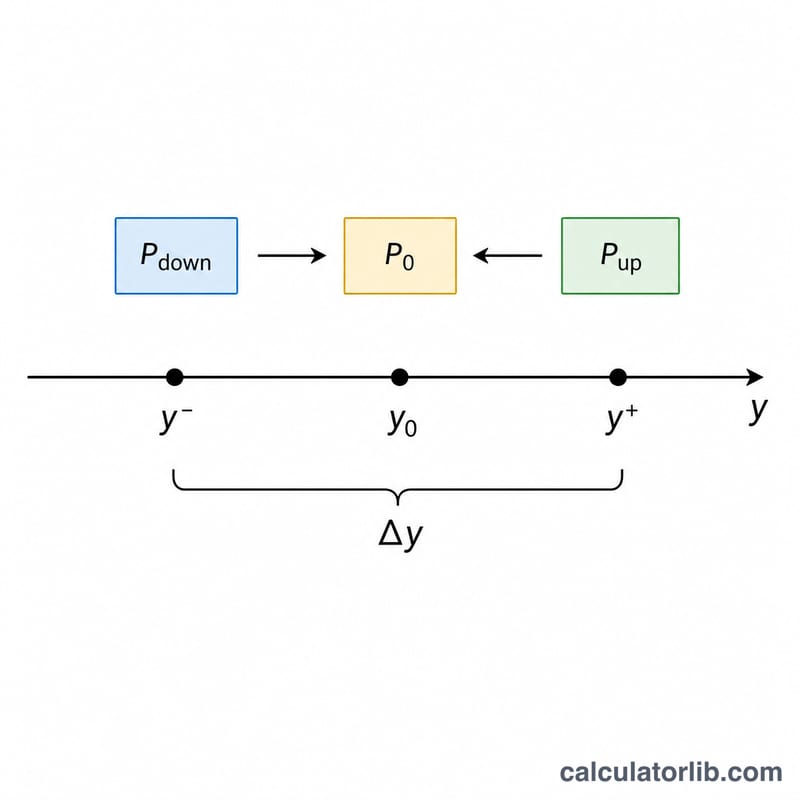
Enter four values: the bond's price if yields rise by Δy (P_up), its price if yields fall by Δy (P_down), its current price (P0), and the size of the yield shift Δy expressed as a decimal (for example, 0.005 for 50 basis points). The calculator returns the effective duration and an estimate of the percentage price change for a 1% move in yields.
The formula explained
The equation is:
$$D_{\text{eff}} = \frac{\text{P}_{\text{down}} - \text{P}_{\text{up}}}{2 \times \text{P}_0 \times \Delta y}$$
The numerator captures the total price swing between the down-yield and up-yield scenarios. Dividing by \(2 \times \text{P}_0 \times \Delta y\) normalizes that swing per unit of yield change and scales it to the original price, producing a value in years.
Worked example
Suppose a bond trades at P0 = 100. If yields rise 50 bps the price falls to P_up = 98.50; if yields fall 50 bps the price rises to P_down = 101.60. With Δy = 0.005:
$$\text{Effective Duration} = \frac{101.60 - 98.50}{2 \times 100 \times 0.005} = \frac{3.10}{1.00} = \textbf{3.10 years}$$
A 1% rise in yields would therefore move the price by roughly −3.1%.
Interpreting Your Effective Duration
Effective duration estimates how much a bond's price changes for a given change in yields. A duration of D implies a price change of roughly D% for every 1% (100 basis point) move in yield, in the opposite direction. A bond with an effective duration of 4.1 would be expected to lose about 4.1% if yields rise 1%, and gain about 4.1% if yields fall 1%. The longer the duration, the greater the sensitivity to interest rates.
The calculator uses the formula:
$$D_{\text{eff}} = \frac{P_{\text{down}} - P_{\text{up}}}{2 \times P_0 \times \Delta y}$$
Example: a bond has P0 = 100, a price of 96.00 if yields rise 1% (Pup), and a price of 104.20 if yields fall 1% (Pdown), with Δy = 0.01. Then \(D_{\text{eff}} = \frac{104.20 - 96.00}{2 \times 100 \times 0.01} = \frac{8.20}{2.00} = \)4.10 years.
Linear approximation and convexity
Duration is a first-order (linear) approximation. The price-yield relationship of a bond is curved, so for large yield moves the duration estimate becomes less accurate. Adding a convexity term improves the estimate:
$$\frac{\Delta P}{P_0} \approx -D_{\text{eff}}\,\Delta y + \tfrac{1}{2}\,C\,(\Delta y)^2$$
For a standard bond with positive convexity, duration alone understates the gain when yields fall and overstates the loss when yields rise. The effect grows with the size of the yield move.
Embedded options
Effective duration is calculated from prices produced by a valuation model that reprices the bond under shifted yields, so it can reflect embedded options. For a callable bond, when rates fall the issuer is more likely to call, so the price gains are capped and the effective duration shortens. This behavior is called negative convexity. Mortgage-backed securities behave similarly because of prepayments. Modified duration assumes cash flows do not change when yields change, so for bonds with embedded options it can differ materially from effective duration. For option-free bonds the two are usually very close.
This is a general estimate based on the prices you supply, not investment advice. Results depend on the valuation model and assumptions behind your input prices.
Typical Effective Duration Ranges by Bond Type
The ranges below are indicative only. Actual effective duration varies with coupon, maturity, yield level, and any embedded options. Lower coupons and lower yields generally lead to higher duration for a given maturity.
| Bond type | Indicative effective duration | Notes |
|---|---|---|
| T-bills and money market instruments | Under 1 year | Very low rate sensitivity |
| Short-term Treasuries and corporates | About 1–3 years | Modest price sensitivity |
| Intermediate-term bonds | About 3–7 years | Moderate sensitivity |
| Long-term Treasuries | Typically 15–20+ years | High sensitivity; large price swings when yields move |
| Mortgage-backed securities | Varies widely, often roughly 2–6 years | Depends on prepayments; duration can extend when rates rise and shorten when rates fall |
For broad context, the Bloomberg US Aggregate Bond Index (a US investment-grade benchmark) has historically had an effective duration in the vicinity of 6 years, though the figure changes over time with market yields and index composition. Other countries and benchmark families have their own typical durations.
These ranges are general reference points, not predictions or advice.
Key Terms and Variables
- Effective duration: A measure of a bond's price sensitivity to a parallel shift in yields, computed from model prices when yields move up and down. It accounts for cash flows that may change because of embedded options.
- Modified duration: Price sensitivity to yield changes assuming the bond's cash flows stay fixed. It is derived from Macaulay duration and is appropriate for option-free bonds.
- P0 (current price): The bond's starting price at the current yield.
- Pup: The bond's price if yields rise by Δy. The name refers to the direction of yields, not price, so this is normally the lower price.
- Pdown: The bond's price if yields fall by Δy. This is normally the higher price.
- Δy (yield shift): The size of the yield change entered as a decimal. 1% = 0.01 and 1 basis point = 0.0001, so a 50 bp shift is 0.005.
- Basis point (bp): One hundredth of a percentage point (0.01%).
- Embedded option: A feature written into the bond, such as a call, put, or prepayment right, that can change the bond's cash flows depending on interest rates.
- Convexity: A measure of the curvature of the price-yield relationship. It captures how duration itself changes as yields move. It is positive for most option-free bonds and can be negative for callable bonds and mortgage-backed securities.
- Parallel yield curve shift: A change in which yields at all maturities move by the same amount. Effective duration assumes this kind of shift.
Government bond yields today
U.S. Treasury yields by maturity on 2026-11-16 and 10-year government bond yields in the euro area, updated automatically: the market rates that bond prices, mortgages and savings products follow.
- 10-year Treasury
- 5.12%
- 2-year Treasury
- 4.83%
- 3-month Treasury
- 4.34%
- 10-year minus 2-year
- +0.29 pp
| Maturity | Yield | A month earlier (2026-10-16) | Change |
|---|---|---|---|
| 1 mo | 4.10% | 4.12% | −2 bp |
| 3 mo | 4.34% | 4.26% | +8 bp |
| 6 mo | 4.42% | 4.34% | +8 bp |
| 1 yr | 4.62% | 4.46% | +16 bp |
| 2 yr | 4.83% | 4.74% | +9 bp |
| 3 yr | 4.87% | 4.82% | +5 bp |
| 5 yr | 4.93% | 4.89% | +4 bp |
| 7 yr | 5.01% | 4.98% | +3 bp |
| 10 yr | 5.12% | 5.09% | +3 bp |
| 20 yr | 5.51% | 5.47% | +4 bp |
| 30 yr | 5.46% | 5.43% | +3 bp |
Average interest rate the U.S. Treasury pays on its debt, October 2026
The average interest rate on outstanding U.S. Treasury securities by type, published monthly by the Bureau of the Fiscal Service. The total moves slowly: fixed-rate securities already issued keep the rate they were sold at until they mature; bills and floating rate notes follow market rates sooner.
- Marketable debt, October 2026
- 3.570%
- Change in 1 year
- +18 bp
| Security type | Average rate, October 2026 | October 2025 | Change |
|---|---|---|---|
| Treasury bills | 4.014% | 4.075% | −6 bp |
| Treasury notes | 3.399% | 3.124% | +28 bp |
| Treasury bonds | 3.483% | 3.338% | +15 bp |
| Inflation-protected securities (TIPS) | 1.227% | 0.964% | +26 bp |
| Floating rate notes (FRN) | 4.170% | 3.901% | +27 bp |
| Total marketable debt | 3.570% | 3.393% | +18 bp |
| Total interest-bearing debt | 3.580% | 3.355% | +23 bp |
10-year government bond yields in the euro area, 2026-09
Euro area average: 3.93%
| Country | Yield |
|---|---|
| France | 4.44% |
| Italy | 4.36% |
| Greece | 4.22% |
| Malta | 4.19% |
| Slovakia | 4.16% |
| Latvia | 4.15% |
| Belgium | 4.12% |
| Bulgaria | 4.09% |
| Estonia | 4.09% |
| Spain | 3.93% |
| Cyprus | 3.92% |
| Slovenia | 3.86% |
| Portugal | 3.85% |
| Finland | 3.80% |
| Luxembourg | 3.70% |
| Austria | 3.69% |
| Ireland | 3.59% |
| Croatia | 3.59% |
| Netherlands | 3.56% |
| Germany | 3.47% |
| Lithuania | 2.88% |
Latest figure: 2026-11-16 Data last updated 2026-11-16 · current
Source: U.S. Department of the Treasury, Daily Treasury Par Yield Curve Rates Public domain (U.S. government work); European Central Bank, long-term interest rate statistics ECB reuse policy; U.S. Department of the Treasury, Bureau of the Fiscal Service U.S. Government work
The 10-year minus 2-year spread and the changes in basis points (1 bp = 0.01 percentage point) are computed by CalculatorLib from these data.
Source details and methodology
- U.S. Department of the Treasury, Daily Treasury Par Yield Curve Rates
- European Central Bank, long-term interest rate statistics
- U.S. Department of the Treasury, Bureau of the Fiscal Service — Average Interest Rates on U.S. Treasury Securities
Government bond yields: United States: all figures and history
FAQ
What yield change should I use? A small, symmetric shift such as 25–50 bps (0.0025–0.005) is standard. Too large a shift reduces accuracy because convexity becomes significant.
Why is effective duration better than modified duration? It accounts for the way cash flows can change when rates move — essential for callable and mortgage bonds whose prices behave non-linearly.
Is duration negative for some bonds? Rarely; certain structured products (like some interest-only strips) can show negative effective duration, meaning their price rises with yields.