
What this calculator does
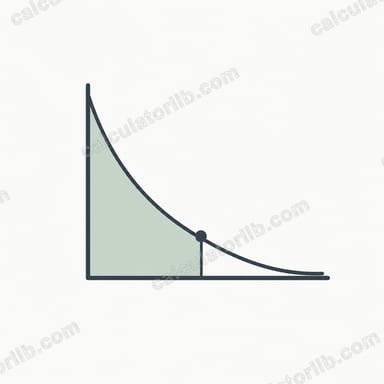
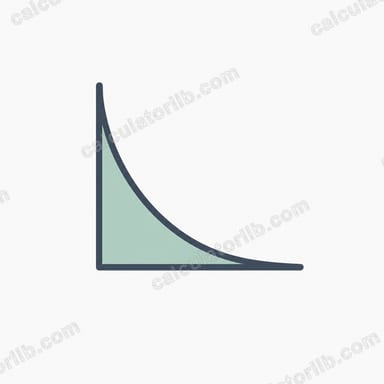
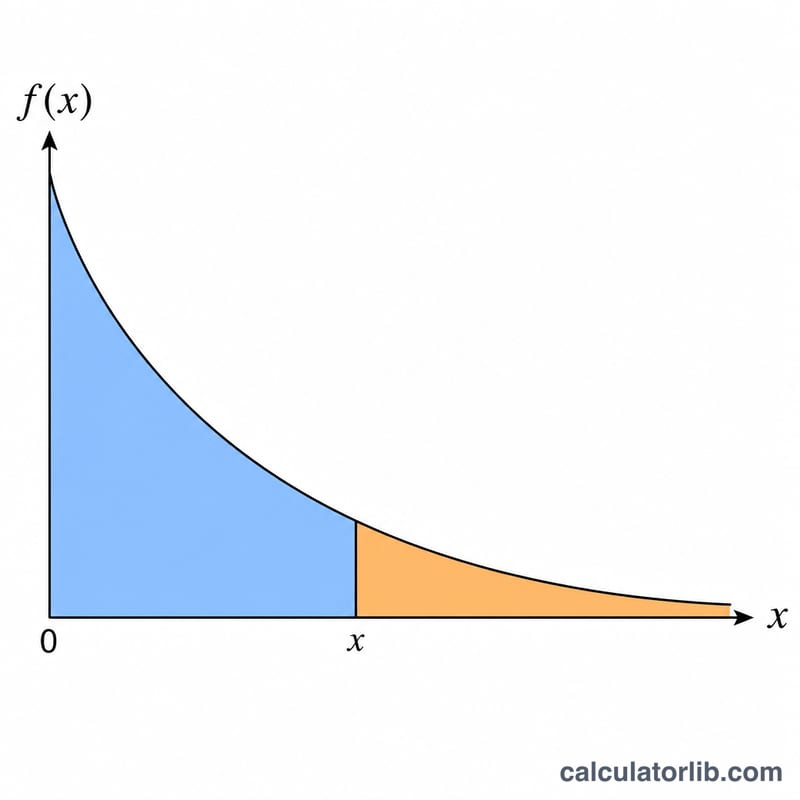
This tool evaluates the exponential distribution at a chosen point x for a given scale parameter b. It returns three quantities: the probability density f(x), the lower (left) cumulative probability P(X ≤ x), and the upper (right) cumulative probability P(X > x). The exponential distribution is universal mathematics — the same everywhere — and is widely used to model waiting times, lifetimes, and the gaps between independent random events.
How to use it
Enter a non-negative percentile point x and a strictly positive scale parameter b, then read the three outputs. Here b is the scale, equal to the mean of the distribution; the rate parameter is \(\lambda = 1/b\). If your textbook uses the rate parameterization, simply set \(b = 1/\lambda\) before entering it.
The formula explained
For \(x \ge 0\) and \(b > 0\):
- Density: $$f(x) = \frac{1}{b}\, e^{-x/b}$$
- Lower cumulative (CDF): $$P(X \le x) = 1 - e^{-x/b}$$
- Upper cumulative (survival): $$P(X > x) = e^{-x/b}$$
Because the survival term \(e^{-x/b}\) is computed once and reused, the lower and upper cumulative probabilities always add to exactly 1.
Worked example
Take \(x = 2\) and \(b = 1\). The ratio \(x/b = 2\), and \(e^{-2} \approx 0.135335\). So the density is $$f(2) = \frac{1}{1}\cdot 0.135335 = 0.135335,$$ the lower cumulative is \(1 - 0.135335 = 0.864665\), and the upper cumulative is \(0.135335\). Check: \(0.864665 + 0.135335 = 1.0\).
FAQ
What is the scale parameter b? It is the mean of the exponential distribution. A larger b spreads the distribution out and lowers the density near zero.
What if b is the rate instead? If you have the rate \(\lambda\), enter \(b = 1/\lambda\). For example, rate 0.5 means scale \(b = 2\).
What happens at x = 0? The density equals \(1/b\), the lower cumulative is 0, and the upper cumulative is 1, since no time has elapsed yet.