
What is the Binomial Distribution Percentile Point Calculator?
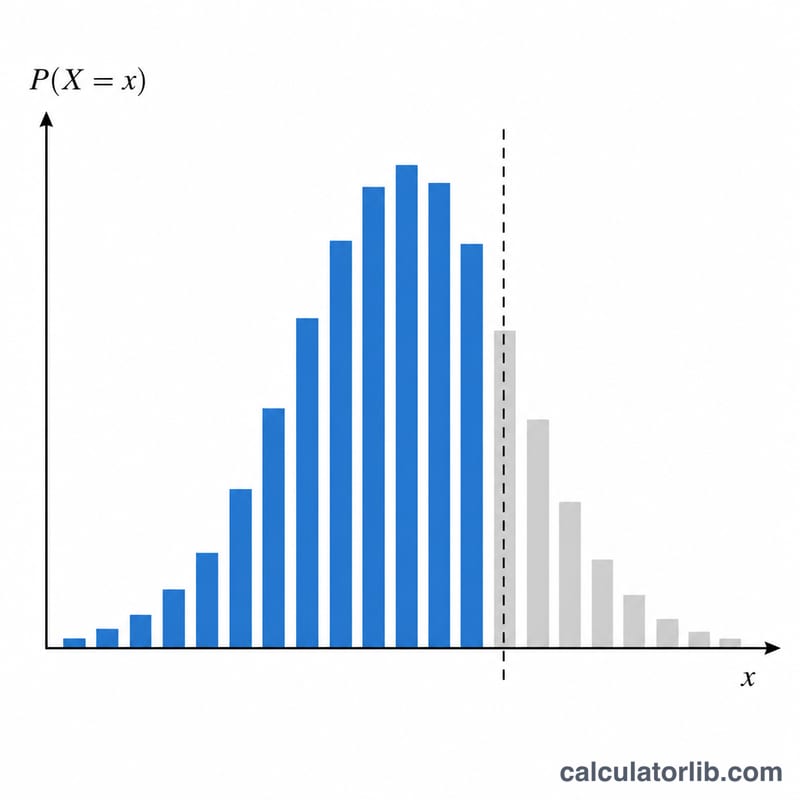
This tool inverts the cumulative distribution function (CDF) of a binomial distribution \(B(n, p)\). Given a target cumulative probability, it returns the value x — the percentile point — at which that probability is reached. Because the binomial is discrete, the result is a continuous interpolation between the surrounding integer values, so x is generally not a whole number.
How to use it
Choose a cumulative mode: Lower cumulative P treats your probability as \(P(X \le x)\); Upper cumulative Q treats it as \(P(X \ge x)\). Enter the target cumulative probability (between 0 and 1), the number of trials n, and the success probability p of a single trial. The calculator returns the percentile point x.
The formula explained
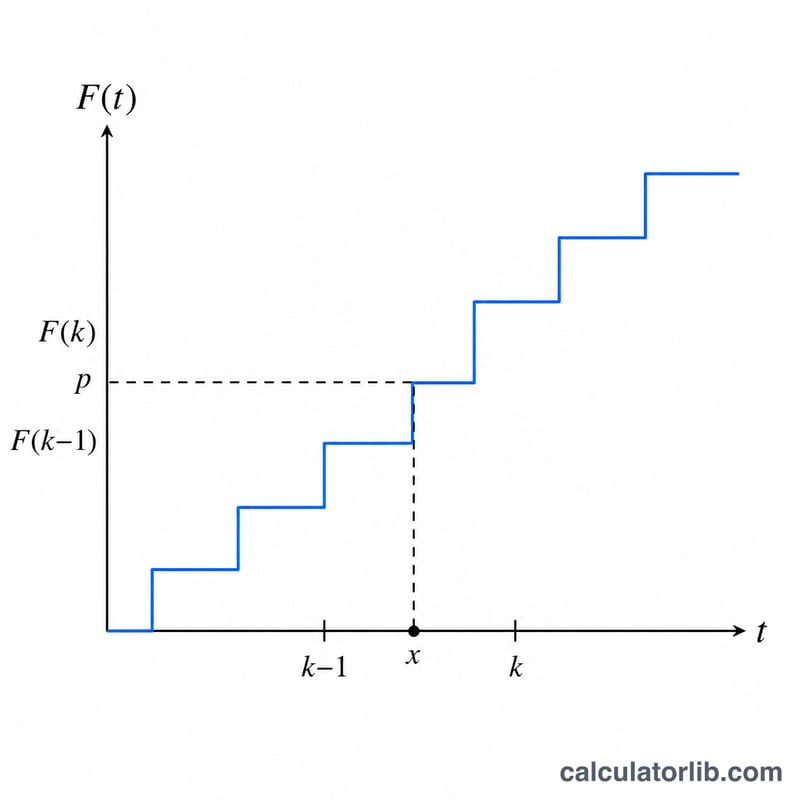
The probability mass function is \(f(x,n,p) = C(n,x)\cdot p^{x}\cdot(1-p)^{n-x}\). The lower cumulative distribution is \(P(x) = \sum_{t=0}^{x} f(t)\). The tool computes \(F(k)\) for every integer k, finds the step where \(F(k-1) < P \le F(k)\), then interpolates:
$$x = (k-1) + \frac{P - F(k-1)}{F(k) - F(k-1)}.$$Upper mode uses the complementary tail \(G(k) = P(X \ge k)\) analogously.
Worked example
With \(n = 20\), \(p = 0.25\), lower cumulative \(P = 0.3\): the CDF gives \(F(3) = 0.225156\) and \(F(4) = 0.414842\). Since 0.3 falls in this step,
$$x = 3 + \frac{0.3 - 0.225156}{0.414842 - 0.225156} = 3 + 0.394672 = 3.3947.$$Definitions & Glossary
The binomial distribution \(B(n,p)\) models the number of successes \(X\) in \(n\) independent trials, each with success probability \(p\). This calculator inverts its cumulative distribution function (CDF) to find the percentile point \(x\) that corresponds to a chosen cumulative probability.
- Trials \(n\)
- The fixed number of independent Bernoulli trials. Must be a positive integer. In the form this is the field trials.
- Success probability \(p\)
- The probability of a success on a single trial, with \(0 \le p \le 1\). The same value applies to every trial. In the form this is successProbability.
- Probability mass function (PMF)
- The probability of exactly \(k\) successes: \(P(X=k)=\binom{n}{k}p^{k}(1-p)^{n-k}\) for \(k = 0,1,\dots,n\).
- Cumulative distribution function (CDF)
- The running total of the PMF up to and including \(k\): \(F(k)=\sum_{t=0}^{k}\binom{n}{t}p^{t}(1-p)^{n-t}=P(X\le k)\). It is a non-decreasing step function that jumps at each integer.
- Lower cumulative \(P = P(X \le x)\)
- The probability that the number of successes is at most \(x\). When you select lower mode (cumulativeMode = lower), the calculator returns the smallest \(x\) with \(F(x) \ge P\).
- Upper cumulative \(Q = P(X \ge x)\)
- The probability that the number of successes is at least \(x\). Because the support is discrete, \(P(X\ge x)=1-F(x-1)\). In upper mode the calculator returns the smallest \(x\) such that \(P(X\ge x)\le Q\) (equivalently the largest tail whose mass does not exceed \(Q\)).
- Percentile point \(x\)
- The success count at the requested cumulative probability — the quantile or inverse-CDF value. For example, the 90th percentile is the smallest \(x\) with \(F(x)\ge 0.90\).
- Interpolation within a step
- Because the binomial CDF is a step function, an exact target probability usually falls between two integer values \(k-1\) and \(k\). A linear interpolation estimates a continuous percentile as \(x \approx (k-1) + \dfrac{P - F(k-1)}{F(k)-F(k-1)}\), where \(F(k)-F(k-1)=P(X=k)\). The integer percentile point itself is always \(k\); interpolation is only a fractional refinement for reporting.
FAQ
Why is x not an integer? The binomial CDF is a step function. To return a meaningful percentile, the tool linearly interpolates inside the step that contains your target probability.
What happens at P = 1? The full distribution is covered, so x equals n. At \(P = 0\), x equals 0.
What if p = 0 or p = 1? All mass sits at \(x = 0\) or \(x = n\) respectively, and the percentile point reflects that degenerate case.