

What Is the Student Loan Payoff Calculator?
This calculator estimates the fixed monthly payment required to fully repay a student loan over a chosen term, along with the total interest you will pay and the total amount repaid. It uses the standard amortizing loan formula, the same math lenders use for federal and private student loans. The tool works for any currency, though student loan rules vary by country.
How to Use It
Enter your current loan balance, the annual interest rate (APR), and the repayment term in years. The calculator converts the term to monthly payments and the annual rate to a monthly rate, then computes your fixed monthly payment, total interest, and overall cost. A shorter term raises the monthly payment but slashes total interest.
The Formula Explained
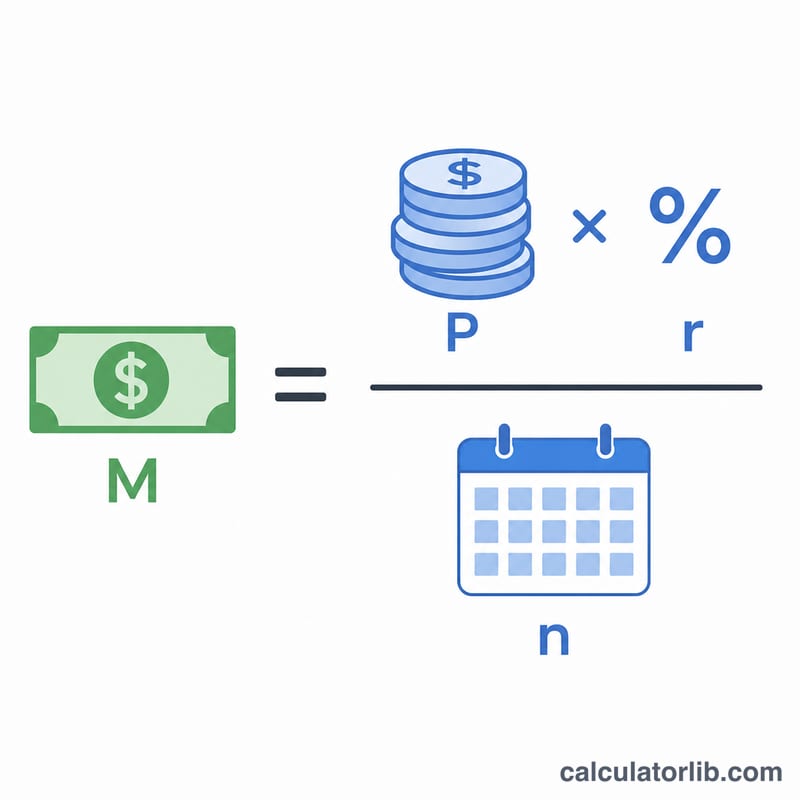
The monthly payment is given by $$M = P \cdot \frac{r\,(1+r)^{n}}{(1+r)^{n}-1}$$ where \(P\) is the principal (loan balance), \(r\) is the monthly interest rate (annual rate divided by 12 and by 100), and \(n\) is the number of monthly payments (years \(\times\) 12). Total interest is simply \(M \times n - P\). If the interest rate is zero, the payment is just \(P\) divided by \(n\).
Worked Example
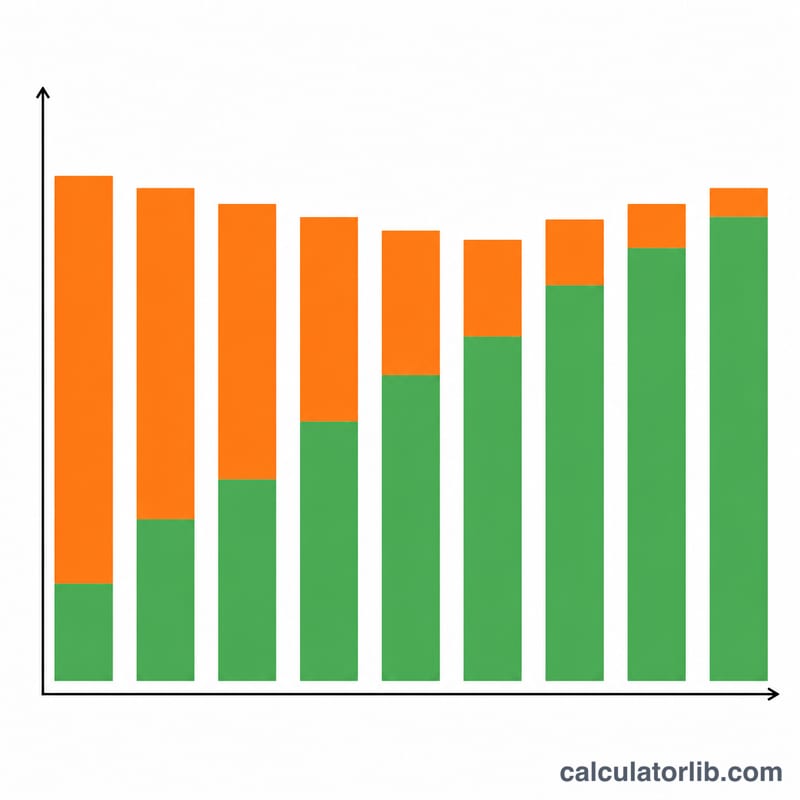
Suppose you owe $30,000 at 6% APR over 10 years. The monthly rate is \(0.06/12 = 0.005\) and \(n = 120\) payments. Plugging in gives a monthly payment of about $333.06. Over 120 months you pay roughly $39,967, meaning about $9,967 goes to interest.
FAQ
Does this include loan fees or capitalized interest? No. It assumes a single fixed-rate balance with no extra fees; add capitalized interest into the balance if needed.
What if I make extra payments? Extra payments reduce both the term and total interest. This tool shows the baseline scheduled payment for the full term.
Is the rate fixed or variable? The calculation assumes a fixed rate for the whole term. Variable-rate loans will differ as the rate changes.