
What Is the Target Heart Rate Zone Calculator?
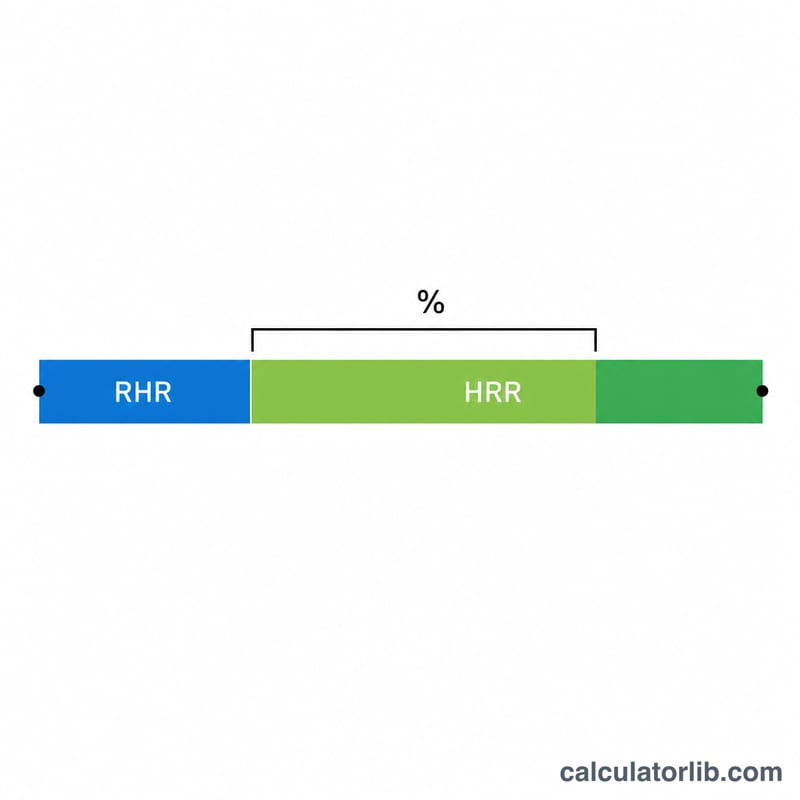
This calculator uses the Karvonen formula to estimate your ideal training heart rate zone based on your age and resting heart rate. Unlike a simple percentage of maximum heart rate, the Karvonen method factors in your heart rate reserve (the difference between your maximum and resting heart rates), giving a more personalized and accurate training target. It is widely used by coaches, athletes, and fitness enthusiasts to guide cardio intensity.
How to Use It
Enter your age, your resting heart rate (best measured first thing in the morning before getting out of bed), and the intensity percentage you want to train at. The calculator returns your estimated maximum heart rate, your heart rate reserve, and the recommended beats-per-minute for the chosen intensity. The lower (50%) and upper (85%) limits of the general aerobic training zone are also shown.
The Formula Explained
The Karvonen equation is:
$$\text{Target HR} = \left(\left(220 - \text{age}\right) - \text{resting HR}\right) \times \text{intensity\%} + \text{resting HR}$$
First we estimate maximum heart rate as \(220 - \text{age}\). Subtracting resting HR gives the heart rate reserve. We then take the desired percentage of that reserve and add resting HR back to get the working target.
Worked Example
For a 30-year-old with a resting heart rate of 60 bpm training at 70% intensity: Max HR = \(220 - 30 = 190\). Reserve = \(190 - 60 = 130\). Target = $$130 \times 0.70 + 60 = 91 + 60 = \mathbf{151 \text{ bpm}}$$
FAQ
Why use the Karvonen method instead of plain percentage of max HR? It accounts for your individual resting heart rate, so fitter people with lower resting rates get a more tailored target.
What intensity should I train at? 50–70% suits general fitness and fat burning; 70–85% builds cardiovascular endurance. Always consult a doctor before starting vigorous exercise.
How accurate is 220 − age? It is a population estimate with significant individual variation. For precision, a measured maximum heart rate from a stress test is more reliable.