
What This Calculator Does
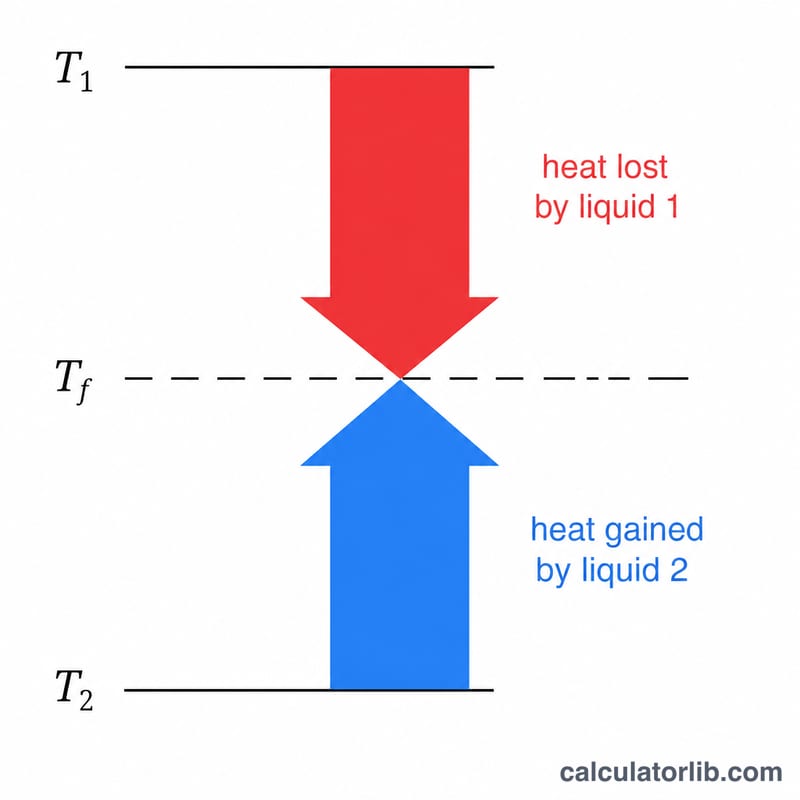
When two liquids at different temperatures are mixed in an insulated container, heat flows from the hotter liquid to the cooler one until they reach a common final temperature. This calculator finds that equilibrium temperature using the principle of conservation of energy: the heat lost by the warmer liquid equals the heat gained by the cooler one. It works for water, oils, alcohols, or any liquids whose specific heat capacities you know.
How to Use It
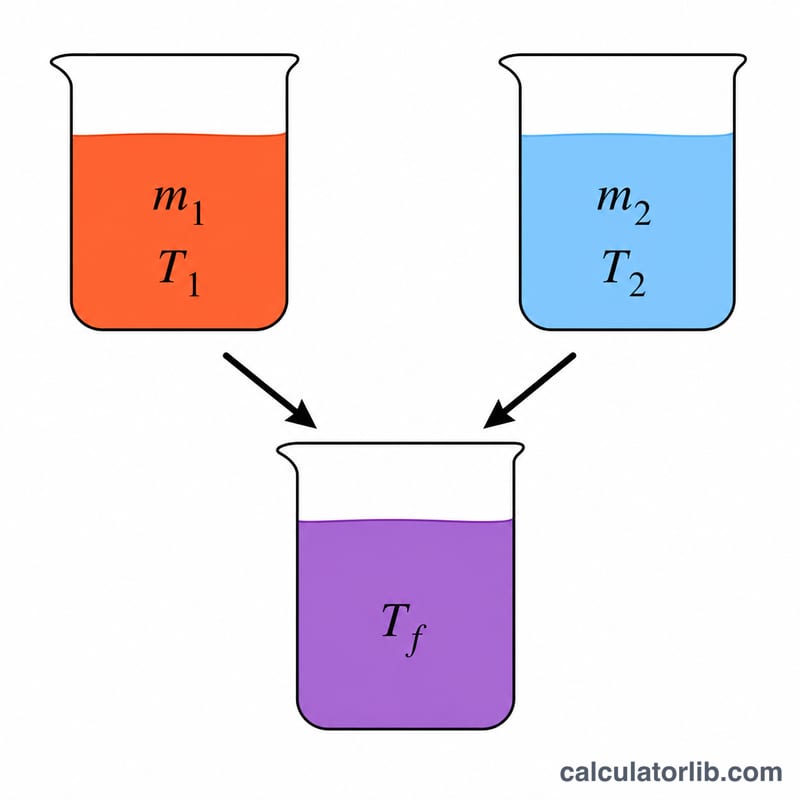
Enter the mass (in grams), specific heat capacity (in J/g·°C), and starting temperature (in °C) for each of the two liquids. The calculator returns the final mixed temperature plus the amount of heat exchanged by each liquid. For pure water, use a specific heat of 4.18 J/g·°C for both liquids; the formula then simplifies to a mass-weighted average of the temperatures.
The Formula Explained
The equilibrium temperature is given by:
$$T_f = \frac{m_1 c_1 T_1 + m_2 c_2 T_2}{m_1 c_1 + m_2 c_2}$$Each term \(mcT\) represents the "heat content weighting" of a liquid. The numerator sums these contributions, and the denominator (total heat capacity) normalizes the result. The heat exchanged by each liquid is \(Q = mc(T_f - T_i)\); a negative value means the liquid cooled down (released heat), a positive value means it warmed up.
Worked Example
Mix 200 g of water at 80°C with 300 g of water at 20°C (both c = 4.18). Numerator = \(200 \cdot 4.18 \cdot 80 + 300 \cdot 4.18 \cdot 20 = 66{,}880 + 25{,}080 = 91{,}960\). Denominator = \(200 \cdot 4.18 + 300 \cdot 4.18 = 836 + 1{,}254 = 2{,}090\).
$$T_f = \frac{91{,}960}{2{,}090} = 44°C$$The hot water cools from 80 to 44 (releases heat); the cool water warms from 20 to 44.
FAQ
Does this assume no heat is lost to surroundings? Yes. It models a perfectly insulated system, so real-world results may be slightly lower in temperature spread.
Can I use any temperature unit? Use a consistent unit (°C used here). Since the formula is a weighted average, Celsius works fine without converting to Kelvin.
What if both liquids are the same substance? The specific heats cancel and the result is simply the mass-weighted average of the two temperatures.