
What this calculator does
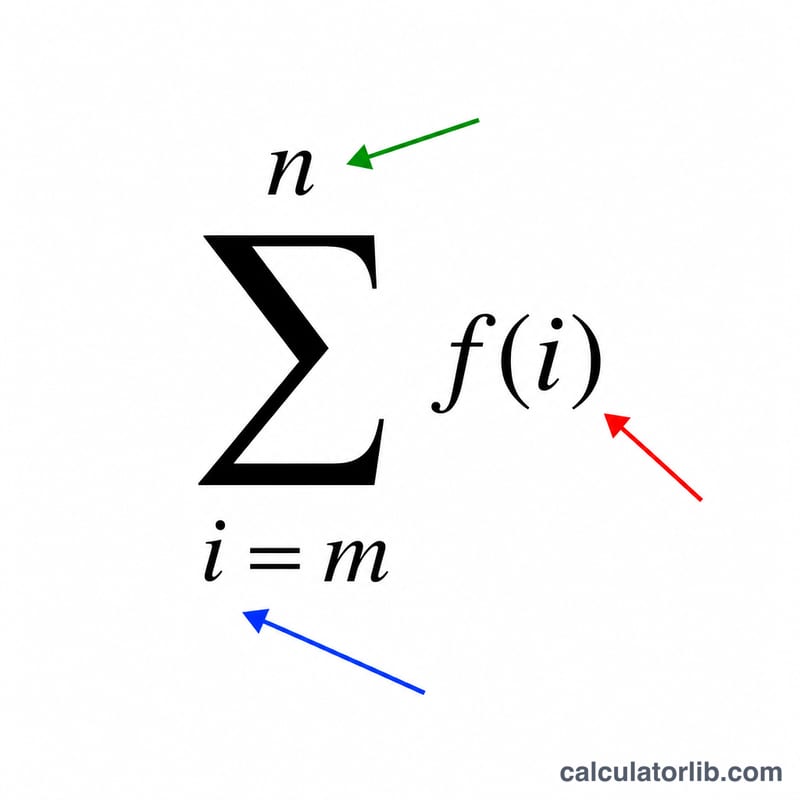
This tool evaluates a partial sum written in sigma notation, \( \sum_{i=m}^{n} f(i) \). It adds up the value of a chosen function for every integer index between the lower bound \(m\) and the upper bound \(n\), inclusive. Partial sums appear throughout algebra, calculus, and computer science whenever you need the running total of a sequence.
How to use it
Pick a function pattern: \(i\) (the natural numbers), \(i^2\) (squares), \(i^3\) (cubes), a linear form \(a\cdot i + b\), a geometric form \(a\cdot r^{\,i}\), or the harmonic \(1/i\). Enter the lower index \(m\) and upper index \(n\). For the linear and geometric patterns, fill in the coefficients \(a\), \(b\), and ratio \(r\). The calculator returns the total, the number of terms summed, and the average term.
The formula explained
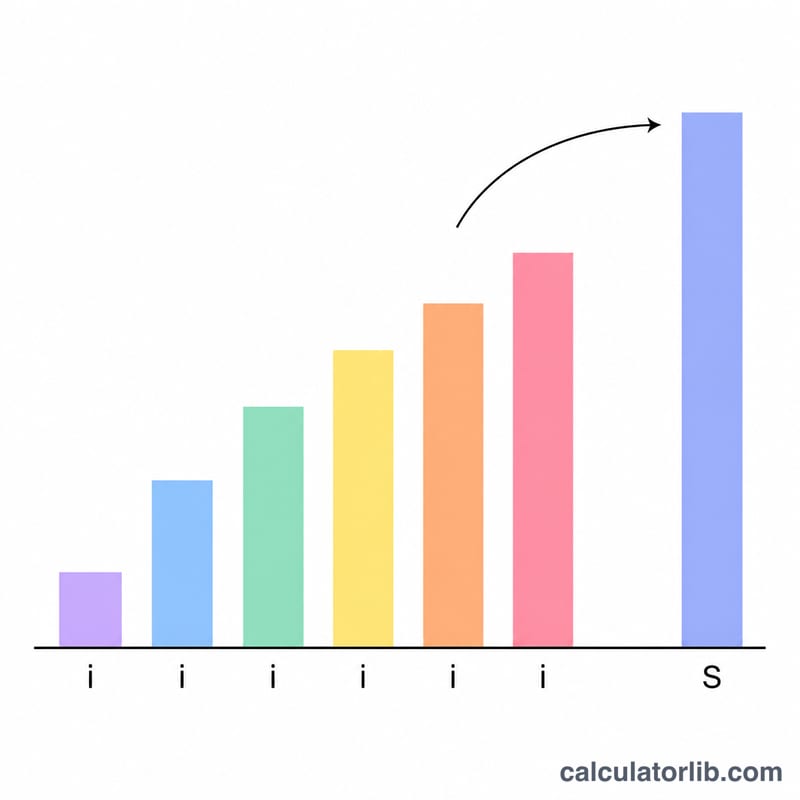
The expression $$ S = \sum_{i=m}^{n} f(i) $$ simply means: start at \(i = m\), evaluate \(f(i)\), move to \(i = m+1\), and keep going until \(i = n\), summing every result. The number of terms is \(n - m + 1\). For example the sum of squares uses \(f(i) = i^2\), which has the closed form \( \frac{n(n+1)(2n+1)}{6} \) when \(m = 1\).
Worked example
Sum of squares from 1 to 5: $$ 1^2 + 2^2 + 3^2 + 4^2 + 5^2 = 1 + 4 + 9 + 16 + 25 = 55 $$ across 5 terms, average 11.
FAQ
Are both endpoints included? Yes, the sum is inclusive of \(i = m\) and \(i = n\).
What if n is less than m? The sum is treated as empty and returns 0.
Can the index be negative? Yes — \(m\) and \(n\) may be any integers, as long as \(n \geq m\). For the harmonic \(1/i\), the \(i = 0\) term is skipped to avoid division by zero.