
What is the common difference?
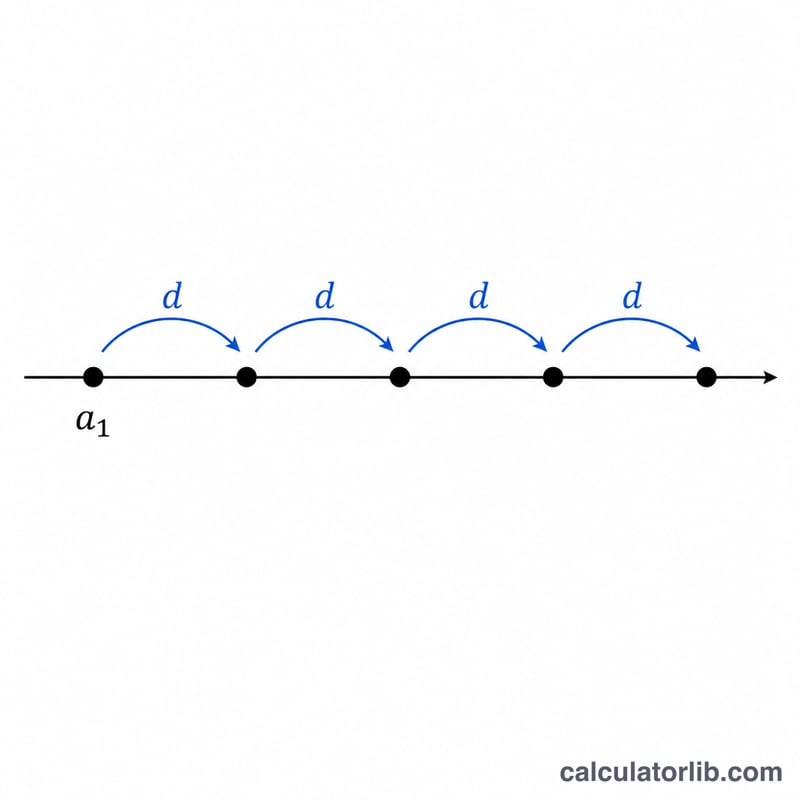
In an arithmetic sequence, every term increases (or decreases) by the same fixed amount. That fixed amount is called the common difference, written as \(d\). For example, in 3, 7, 11, 15, … the common difference is 4 because each term is 4 more than the one before it.
How to use this calculator
Enter the first term (a₁), any later term (aₙ), and the position of that later term (n). The calculator returns the common difference and the second term so you can quickly continue the sequence. The position \(n\) must be at least 2, since the difference is spread over \((n - 1)\) steps.
The formula explained
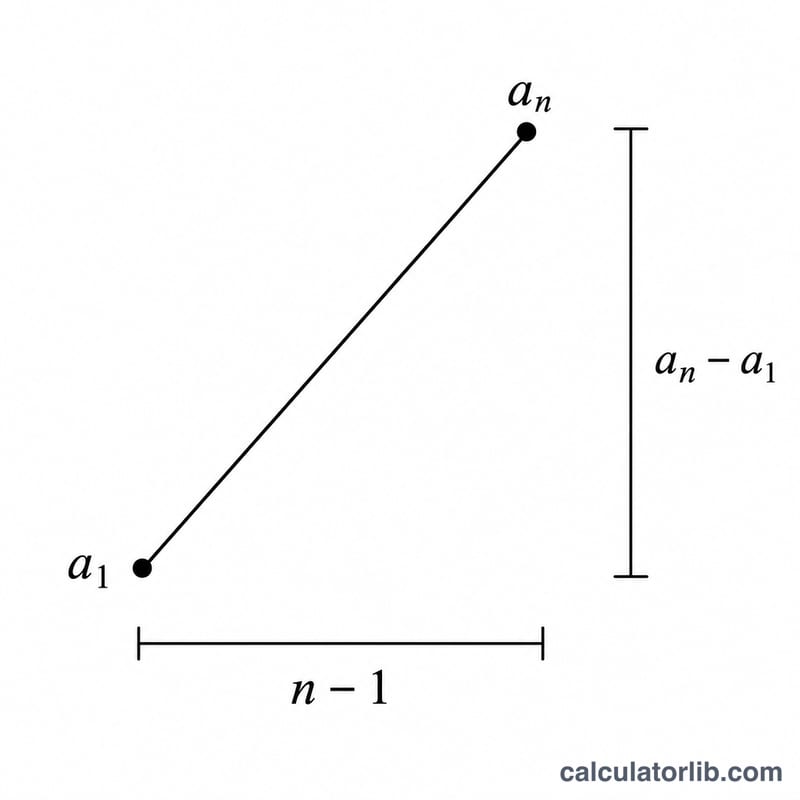
If two terms are adjacent, the common difference is simply their gap: $$d = a_{n+1} - a_n$$ When you know the first term and a term further along, the total change \(a_1 \to a_n\) happens over \((n - 1)\) equal steps, so:
$$d = \frac{a_n - a_1}{n - 1}$$
Worked example
Suppose \(a_1 = 2\), the 10th term is \(a_{10} = 20\), so \(n = 10\). Then $$d = \frac{20 - 2}{10 - 1} = \frac{18}{9} = 2$$ The second term is \(a_2 = 2 + 2 = 4\), confirming the sequence 2, 4, 6, 8, …, 20.
FAQ
Can the common difference be negative? Yes. A decreasing sequence like 10, 7, 4, 1 has \(d = -3\).
Can it be a decimal or fraction? Absolutely — \(d\) can be any real number, such as 0.5 or 2.25.
What if d = 0? Then all terms are equal (a constant sequence), which is still a valid arithmetic sequence.