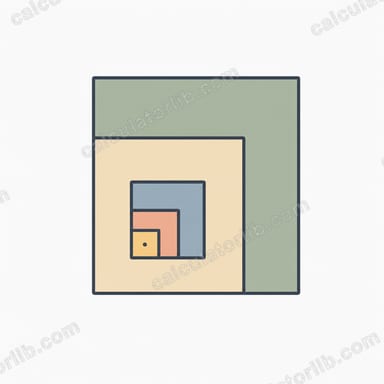

What is an infinite geometric series?
An infinite geometric series is the endless sum of terms where each term is obtained by multiplying the previous one by a fixed number called the common ratio (r): \(a + ar + ar^2 + ar^3 + \ldots\) . When the magnitude of the common ratio is small enough (\(|r| < 1\)), the terms shrink toward zero fast enough that the total approaches a single finite value. This calculator computes that limit instantly.
How to use this calculator
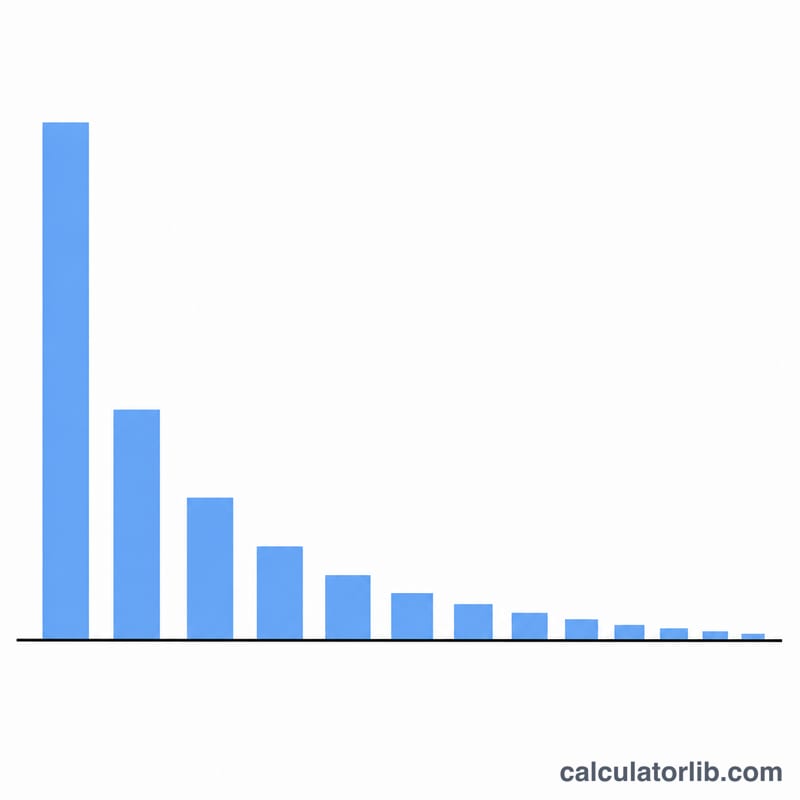
Enter the first term a and the common ratio r, then read off the sum. If \(|r| \ge 1\), the calculator tells you the series diverges — it has no finite sum because the terms do not shrink to zero.
The formula explained
The closed-form sum is $$S = \frac{a}{1 - r}$$ valid only when \(|r| < 1\). It comes from the finite partial sum \(S_n = \frac{a(1 - r^n)}{1 - r}\). As n grows without bound, \(r^n \to 0\) whenever \(|r| < 1\), leaving \(S = \frac{a}{1 - r}\). If \(|r| \ge 1\) the term \(r^n\) does not vanish, so the partial sums grow without limit or oscillate, and the series diverges.
Worked example
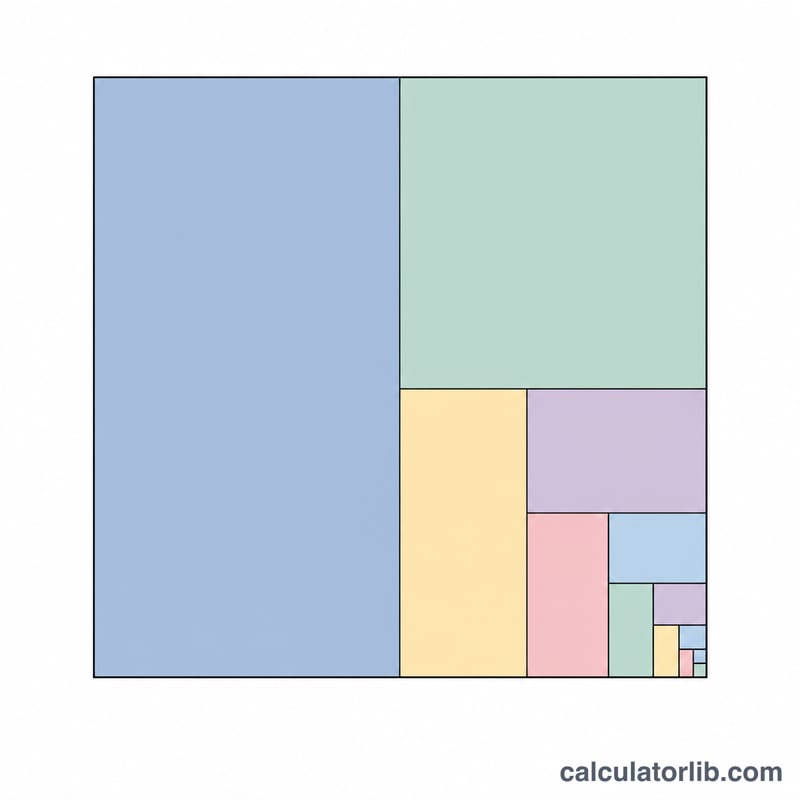
Suppose a = 1 and r = 0.5. Since \(|0.5| < 1\) the series converges. $$S = \frac{1}{1 - 0.5} = \frac{1}{0.5} = 2$$ So \(1 + 0.5 + 0.25 + 0.125 + \ldots = 2\).
FAQ
What if r is negative? The formula still works as long as \(|r| < 1\). For a = 3, r = −0.5, \(S = \frac{3}{1 - (-0.5)} = \frac{3}{1.5} = 2\).
When does the series diverge? Whenever \(|r| \ge 1\) (for example r = 2 or r = −1). The terms never shrink to zero, so there is no finite sum.
What if a = 0? Every term is zero, so the sum is simply 0.