
What this calculator does
An ultrasound dating scan measures how far along a pregnancy is by the size of the baby, reporting a gestational age (GA) such as "8 weeks 3 days." This calculator turns that GA — measured on a specific scan date — into an estimated due date (EDD). It is widely used because early ultrasound dating is often more accurate than dates based on the last menstrual period, especially when cycles are irregular.
How to use it
Enter the date your ultrasound was performed, then type the gestational age the sonographer reported as weeks and days. The calculator returns your estimated due date, the GA expressed in total days, the number of days remaining to a full 280-day term, and an approximate conception date.
The formula explained
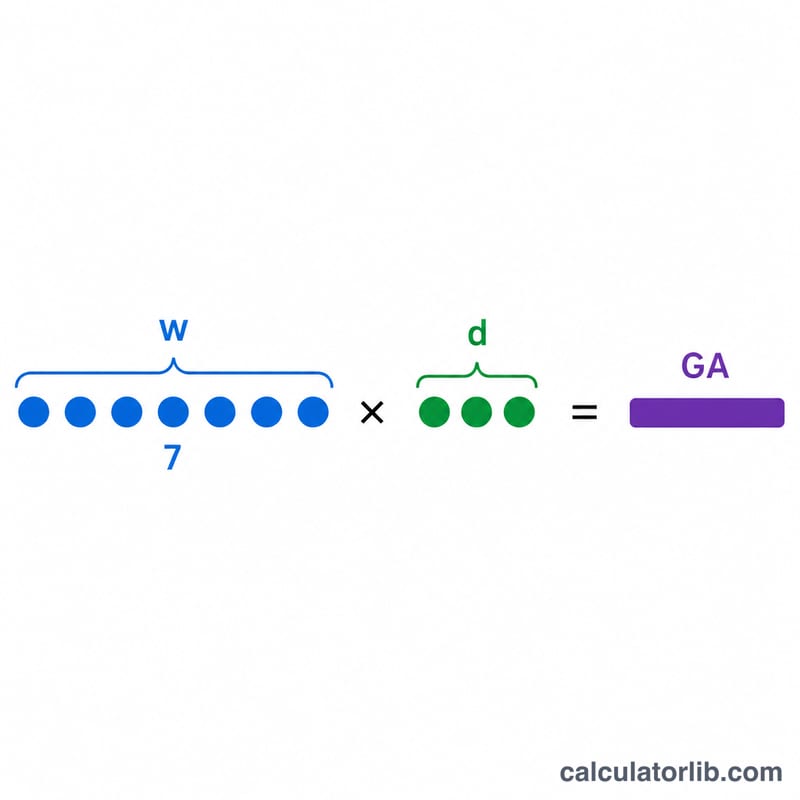
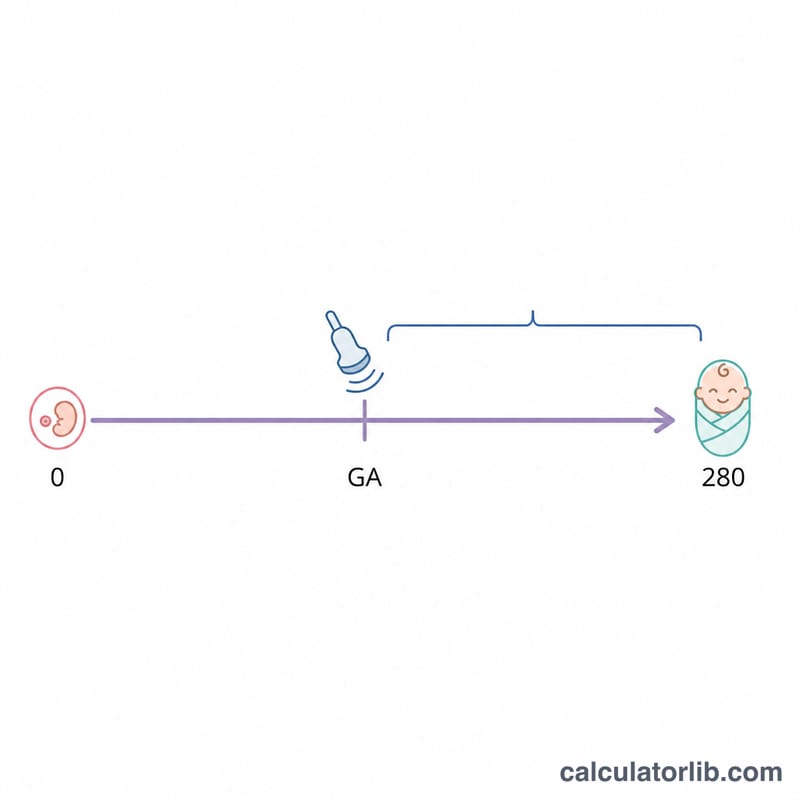
A full-term pregnancy is conventionally counted as 280 days (40 weeks) from the first day of the last menstrual period. First we convert the scan's GA into days: \( \text{GA}_{\text{days}} = \text{weeks} \times 7 + \text{days} \). The remaining time to term is \( 280 - \text{GA}_{\text{days}} \). Adding those days to the scan date gives the EDD:
$$\text{EDD} = \text{ScanDate} + \left(280 - \text{GA}_{\text{days}}\right)$$
The conception estimate subtracts 266 days from the EDD (term minus the ~14 days before ovulation).
Worked example
Suppose your ultrasound on 2024-01-01 shows a GA of 8 weeks 0 days. GA in days = \( 8 \times 7 + 0 = 56 \) days. Days to term = \( 280 - 56 = 224 \) days. Adding 224 days to 2024-01-01 gives an EDD of 2024-08-12.
FAQ
Is the due date exact? No. An EDD is an estimate; only about 4% of babies arrive on the predicted date. Most births occur within two weeks either side.
Why use the ultrasound instead of my last period? Early scans (before ~14 weeks) measure the embryo directly and are usually the most reliable way to date a pregnancy.
Does this replace medical advice? No. Always confirm dating and due dates with your obstetric care provider.