
What is the Monthly to Annual Inflation Rate Converter?
This tool converts a monthly inflation rate into the equivalent annual inflation rate. Because inflation compounds, you cannot simply multiply a monthly figure by 12 — that ignores the inflation-on-inflation effect that occurs month after month. This calculator applies the correct compounding formula so you get an accurate annualized rate.
How to use it
Enter the monthly inflation rate as a percentage (for example, type 1 for 1% per month). The calculator returns the compounded annual rate. This is useful for comparing inflation figures reported on different time scales, building economic forecasts, or pricing contracts with escalation clauses.
The formula explained
The conversion uses geometric compounding:
$$\text{annual\_rate} = (1 + \text{monthly\_rate})^{12} - 1$$
Here the rates are expressed as decimals. A 1% monthly rate becomes 0.01, so the annual rate is \((1.01)^{12} - 1 \approx 0.126825\), or about 12.68% — noticeably higher than the naive 12% you'd get by multiplying.
Worked example
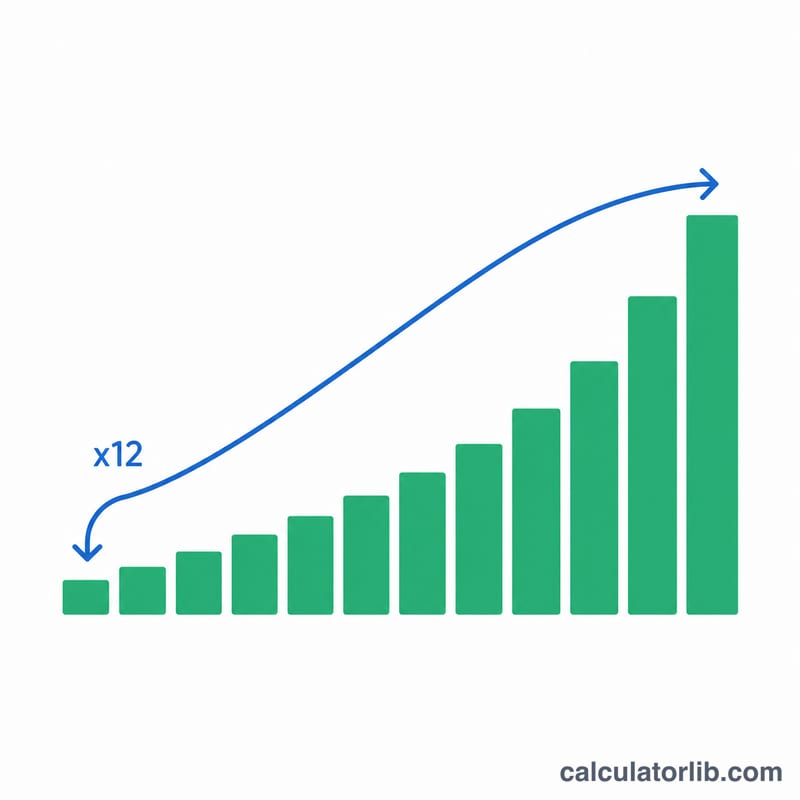
Suppose prices rise 2% each month. Convert: $$(1 + 0.02)^{12} - 1 = (1.02)^{12} - 1 = 1.268242 - 1 = 0.268242,$$ or about 26.82% annual inflation. Multiplying \(2\% \times 12\) would have given only 24%, understating the true annual erosion of purchasing power.
FAQ
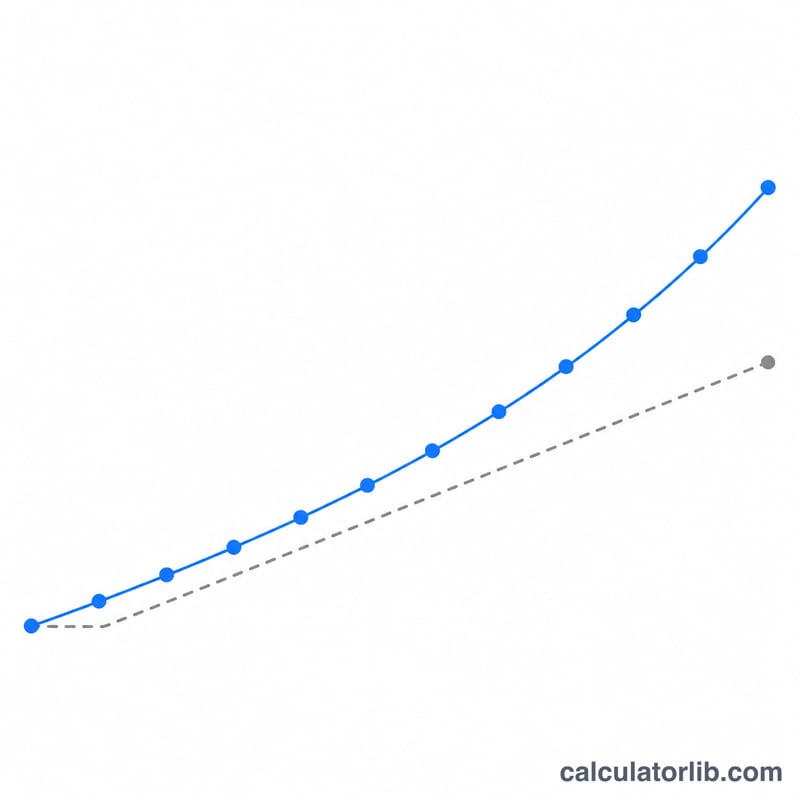
Why not just multiply by 12? Simple multiplication ignores compounding. Each month's inflation applies to a base that already grew, so the true annual rate is always slightly higher than 12× the monthly rate.
Can I enter a negative rate? Yes — a negative monthly rate represents deflation and the formula returns the equivalent annual deflation rate.
Is this the same as APR or APY? The math is identical to converting a periodic compounding rate to an effective annual rate, which is the concept behind APY.