
What the Monthly Inflation Rate Calculator Does
This calculator works out the average monthly rate at which a price rose between two points in time. Instead of simply dividing the total increase by the number of months, it uses a compound (geometric) approach, so the result tells you the consistent month-on-month percentage that would turn your starting price into your ending price. It's useful for tracking grocery bills, rent, raw-material costs, subscription fees, or any value that changes gradually over several months.
The Inputs You Provide
- Initial Price — the price at the start of the period (Pi).
- Final Price — the price at the end of the period (Pf).
- Number of Months — how many months passed between the two prices (n).
From these three values the tool also reports the annualized rate, the total price increase, and the average monthly increase in currency terms.
The Formula Explained
The core calculation is:
IRm = [ (Pf / Pi)1/n − 1 ] × 100%
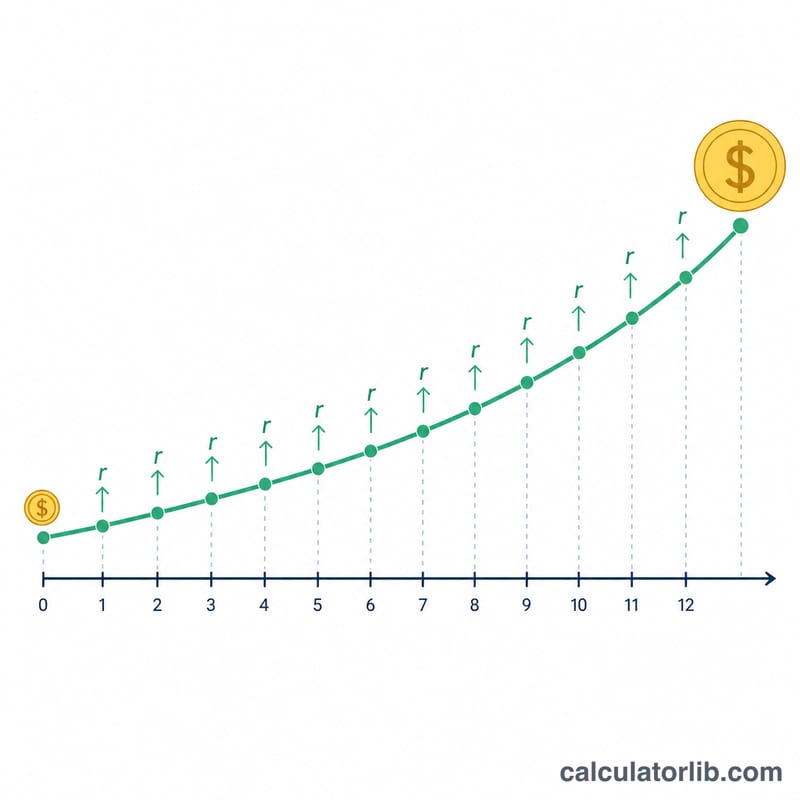
Taking the n-th root of the price ratio finds the steady monthly growth factor, then subtracting 1 and multiplying by 100 converts it to a percentage. The calculator then annualizes it with (1 + IRm/100)12 − 1, giving the yearly equivalent if that monthly rate continued for 12 months. It also computes the raw increase (Pf − Pi) and divides it by n for a simple average monthly change in money terms.
Worked Example
Suppose a basket of goods cost 100 at the start and 112 after 6 months.
- Monthly rate: (112 / 100)1/6 − 1 = 1.01906 − 1 ≈ 1.91% per month
- Annualized rate: (1.0191)12 − 1 ≈ 25.4% per year
- Total increase: 112 − 100 = 12
- Average monthly increase: 12 / 6 = 2 per month
Notice the compound monthly rate (1.91%) is slightly below 2% because each month's growth builds on the previous larger base.
Frequently Asked Questions
Why isn't the monthly rate just the total percentage divided by months? Because inflation compounds. A geometric average accounts for growth applying to a steadily rising base, giving a more accurate "per month" figure than a simple division.
What does the annualized rate mean? It shows what your yearly inflation would be if the calculated monthly rate persisted unchanged for a full 12 months — handy for comparing periods of different lengths.
Can I use it for deflation? Yes. If the final price is lower than the initial price, the monthly rate comes out negative, indicating prices fell over the period.