
What this calculator does
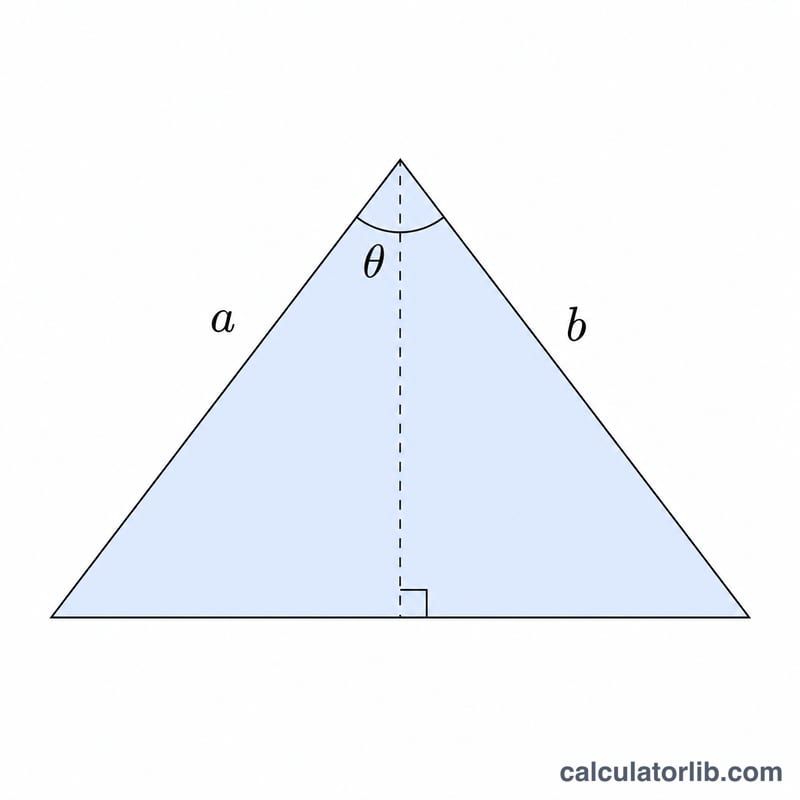
This tool finds the area, perimeter, and height of a triangle when you know two of its sides and the angle between them (the "included angle"). This is the classic SAS — side-angle-side — configuration. Two sides plus the angle they enclose fully determine a triangle, so every other measurement can be derived from them. The calculator is unit-agnostic: enter the sides in any consistent length unit, and the area comes out in that unit squared while the perimeter and height share the side unit.
How to use it
Enter side length a and side length b (both must be greater than zero), then type the included angle and choose whether it is given in degrees or radians. For a real, non-degenerate triangle the angle must be strictly between 0 and 180 degrees (0 and pi radians). Press calculate to see the area S, the full perimeter L, the third side c, and the height h measured against base a.
The formulas explained
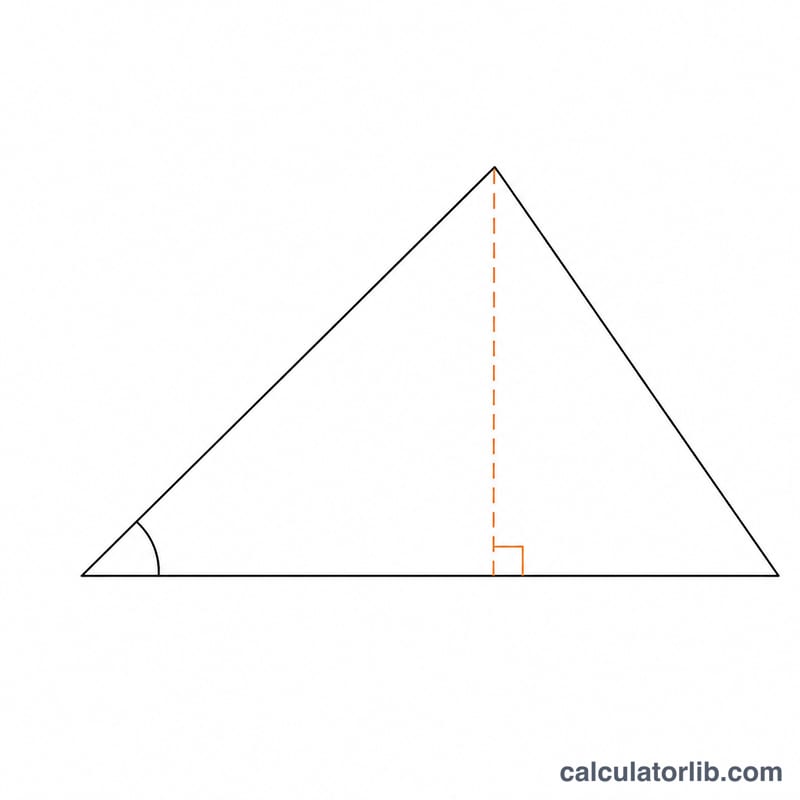
The area uses the sine rule for SAS: $$S = \frac{1}{2}\cdot a \cdot b \cdot \sin(\theta)$$. The third side comes from the law of cosines, $$c = \sqrt{a^2 + b^2 - 2ab\cdot\cos(\theta)}$$, and the perimeter is simply \(L = a + b + c\). The altitude dropped onto base a is \(h = b \cdot \sin(\theta)\), which follows from \(S = \frac{1}{2}\cdot a\cdot h\). The angle is converted to radians before any trig is applied; for degrees it is multiplied by \(\frac{\pi}{180}\).
Worked example
With a = 4, b = 5, and theta = 30 degrees: \(\sin(30°) = 0.5\) and \(\cos(30°) = 0.8660254\). Area $$S = 0.5 \times 4 \times 5 \times 0.5 = 5.$$ Third side $$c = \sqrt{16 + 25 - 34.641016} = \sqrt{6.358984} = 2.521703,$$ so perimeter \(L = 4 + 5 + 2.521703 = 11.521703\). Height \(h = 5 \times 0.5 = 2.5\).
FAQ
Why must the angle be less than 180 degrees? At exactly 0 or 180 degrees the triangle collapses into a line, giving zero area. Values between produce a genuine triangle.
Which base is the height measured against? The reported height \(h = b\cdot\sin(\theta)\) is the altitude onto base a. The altitude onto base b would instead be \(a\cdot\sin(\theta)\).
Can the square root ever fail? No. The expression \(a^2 + b^2 - 2ab\cdot\cos(\theta)\) equals \(c^2\), which is always non-negative; tiny negative rounding errors are clamped to zero.