What is the Testosterone to Estradiol Ratio?
The testosterone-to-estradiol (T/E2) ratio compares your circulating testosterone level to your estradiol level as a single number. Because estradiol is produced from testosterone via the aromatase enzyme, many people who follow their hormone health track this ratio to get a quick sense of how their androgen and estrogen levels relate to one another. This calculator is for general educational use and is not a diagnostic tool — interpret any hormone result with your clinician.
How to Use This Calculator
Enter your testosterone and estradiol values from a recent blood test. Lab reports commonly give testosterone in ng/dL and estradiol in pg/mL, so the default mode automatically converts testosterone (ng/dL) into pg/mL by multiplying by 10 before dividing, giving a unit-consistent ratio. If both of your values already share the same unit, choose "raw ratio" to divide them directly.
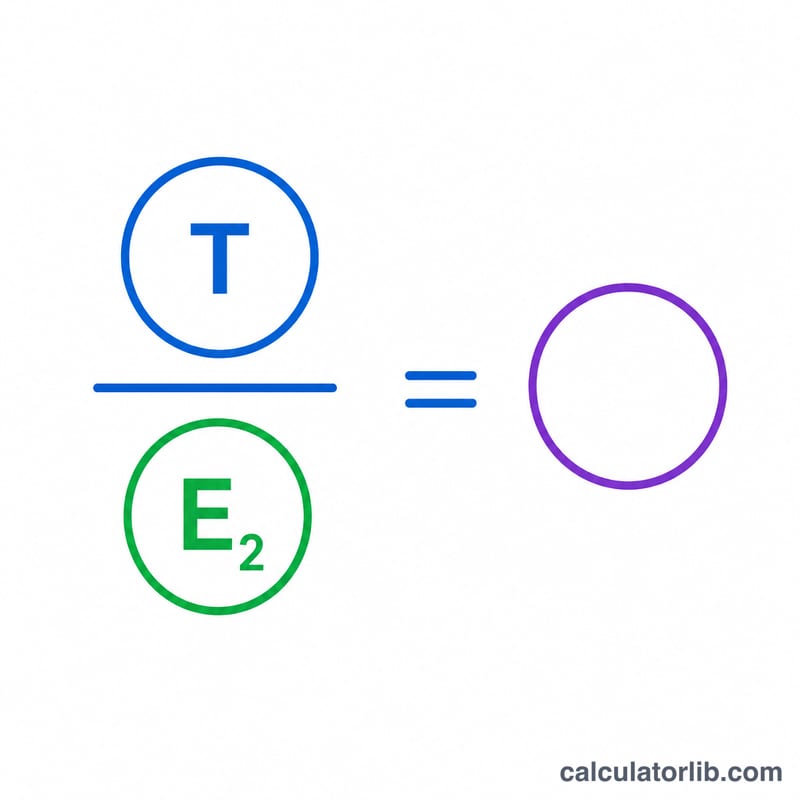
The Formula Explained
The core formula is simply \(\text{Ratio} = \text{Testosterone} \div \text{Estradiol}\). The only subtlety is unit consistency. Since 1 ng/dL equals 10 pg/mL, the auto-convert mode computes
$$\text{Ratio} = \frac{\text{Testosterone (ng/dL)} \times 10}{\text{Estradiol (pg/mL)}}$$Mixing units without converting produces a misleading number, which is why this tool handles the conversion for you.
Worked Example
Suppose your testosterone is 600 ng/dL and your estradiol is 30 pg/mL. Convert testosterone to pg/mL: \(600 \times 10 = 6000\) pg/mL. Then divide: \(6000 \div 30 = 200\). Your T/E2 ratio is 200:1.
Hormone Unit Conversion Table
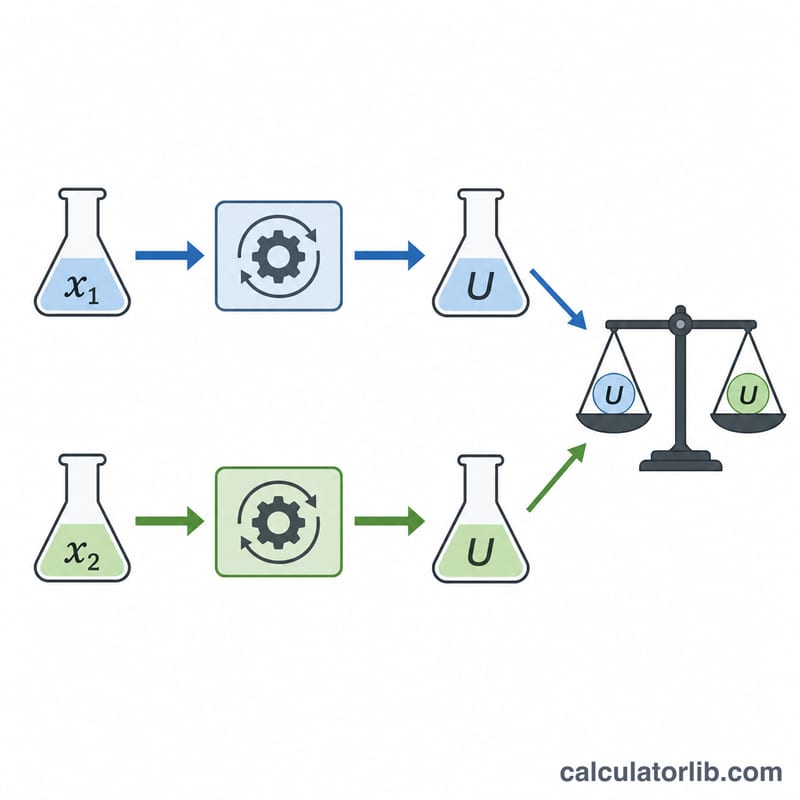
Testosterone and estradiol are reported in different units by different laboratories and countries. Converting both to the same basis is needed before a ratio means anything.
| Hormone | From | To | Factor |
|---|---|---|---|
| Testosterone | 1 ng/dL | nmol/L | × 0.0347 |
| Testosterone | 1 nmol/L | ng/dL | × 28.84 |
| Testosterone | 1 ng/dL | pg/mL | × 10 |
| Estradiol | 1 pg/mL | pmol/L | × 3.671 |
| Estradiol | 1 pmol/L | pg/mL | × 0.2724 |
Example conversions
| Value entered | Converted value |
|---|---|
| 600 ng/dL testosterone | 600 × 0.0347 ≈ 20.8 nmol/L (or 6,000 pg/mL) |
| 30 pg/mL estradiol | 30 × 3.671 ≈ 110 pmol/L |
Note: the ratio depends on whether both hormones were put on the same basis. With testosterone in pg/mL and estradiol in pg/mL, the ratio is \(\frac{10 \times T}{E_2}\), where \(T\) is in ng/dL and \(E_2\) in pg/mL. Dividing the raw ng/dL number by the raw pg/mL number gives a value ten times smaller. The same blood result can therefore produce two very different ratios depending on the unit handling.
Interpreting Your T/E2 Ratio
A higher T/E2 ratio means testosterone is relatively larger than estradiol. A lower ratio means estradiol is relatively larger. The ratio only describes the relative size of the two numbers. It says nothing about whether either hormone is high or low in absolute terms.
- Numerator and denominator both matter. Identical ratios can come from very different absolute levels. For example, 400 ng/dL with 20 pg/mL and 800 ng/dL with 40 pg/mL give the same ratio.
- Assay type. Immunoassays and LC-MS/MS can report different values, especially for estradiol at low concentrations. Because estradiol is the denominator, small measurement differences can change the ratio noticeably.
- Timing of the sample. Testosterone varies through the day and is often higher in the morning. Estradiol also varies, and in menstruating women it changes substantially across the cycle.
- Sex and age. Typical testosterone and estradiol levels differ widely between males and females and shift with age. A ratio is therefore not directly comparable between different people or groups.
- Unit basis. A ratio on a converted basis (pg/mL : pg/mL) is ten times the raw ng/dL : pg/mL ratio. Check which convention a source uses before comparing numbers across sources.
This page is for education only. It gives no targets and is not medical advice. Discuss your lab results with a qualified clinician, who can interpret them alongside symptoms, history and the specific laboratory's reference ranges.
Example T/E2 Ratios Across Different Inputs
The auto-converted ratio is \(\frac{10 \times T}{E_2}\). The raw ratio is simply \(T / E_2\) with the numbers as entered.
| Testosterone (ng/dL) | Estradiol (pg/mL) | Testosterone (pg/mL) | Auto-converted ratio | Raw ratio |
|---|---|---|---|---|
| 400 | 20 | 4,000 | 200 | 20 |
| 600 | 30 | 6,000 | 200 | 20 |
| 600 | 50 | 6,000 | \(\frac{10 \times 600}{50} = \)120 | 12 |
| 800 | 40 | 8,000 | 200 | 20 |
| 300 | 45 | 3,000 | 66.7 | 6.67 |
Rows 1, 2 and 4 show that very different absolute levels can give the same ratio of 200 (auto-converted) or 20 (raw). Row 3 shows that raising estradiol while testosterone stays the same lowers the ratio. These are arithmetic illustrations only, not clinical benchmarks or targets.
FAQ
What is a "normal" T/E2 ratio? There is no universally agreed reference range, and it varies with sex, age, lab method, and individual physiology. Discuss your numbers with a healthcare professional.
Why convert ng/dL to pg/mL? Dividing values in different units gives a meaningless figure. Converting both to pg/mL (testosterone × 10) makes the ratio mathematically valid.
Can I use nmol/L or pmol/L? Yes — convert both readings into the same unit first, then select "raw ratio" to divide them directly.