What is the Medication mL to mg Converter?
The Medication mL to mg Converter turns a liquid medication volume (measured in milliliters) into the equivalent amount of active drug (measured in milligrams). Liquid medicines such as syrups, suspensions, and injectables are labeled with a concentration — the number of milligrams of drug dissolved in each milliliter of liquid. Knowing that concentration lets you translate a measured volume into an actual dose.
The formula explained
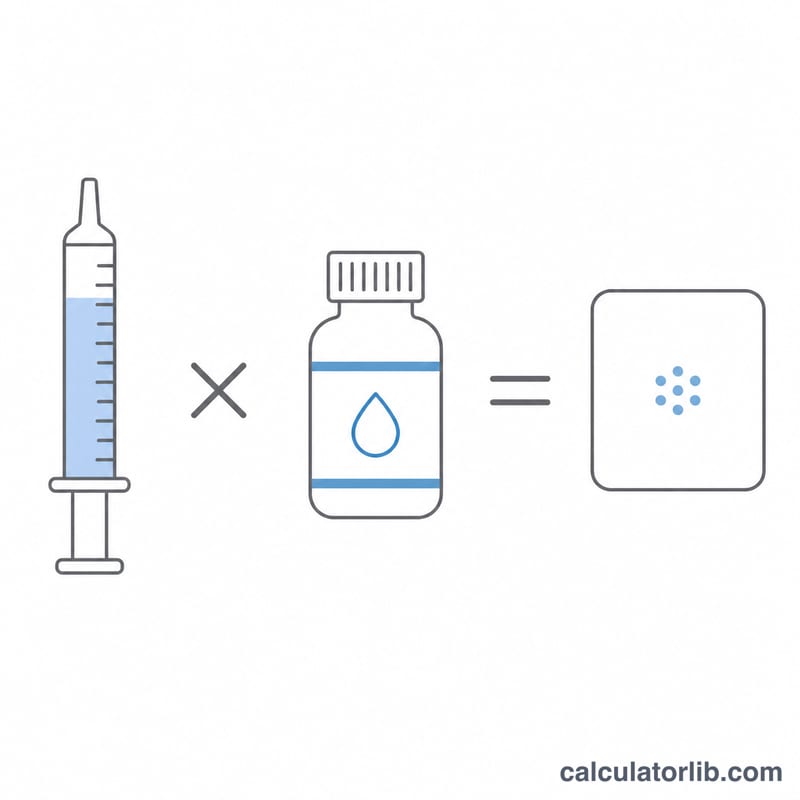
The conversion is a simple multiplication:
$$\text{Dose (mg)} = \text{Volume (mL)} \times \text{Concentration (mg/mL)}$$Here \(\text{Volume}\) is the amount of liquid you administer in mL, and \(\text{Concentration}\) is the strength printed on the label in mg/mL. The result is the total milligrams of active ingredient delivered.
How to use it
Enter the volume of liquid in milliliters and the medication concentration in mg/mL, then read the equivalent dose in milligrams. If a label lists strength as \(250\,\text{mg}\) per \(5\,\text{mL}\), divide to find the concentration: \(250 \div 5 = 50\) mg/mL before entering it.
Worked example
Suppose you give \(5\) mL of a syrup with a concentration of \(10\) mg/mL. The dose is:
$$\text{Dose} = 5\,\text{mL} \times 10\,\frac{\text{mg}}{\text{mL}} = 50\,\text{mg}$$So 5 mL of that syrup delivers 50 mg of active drug.
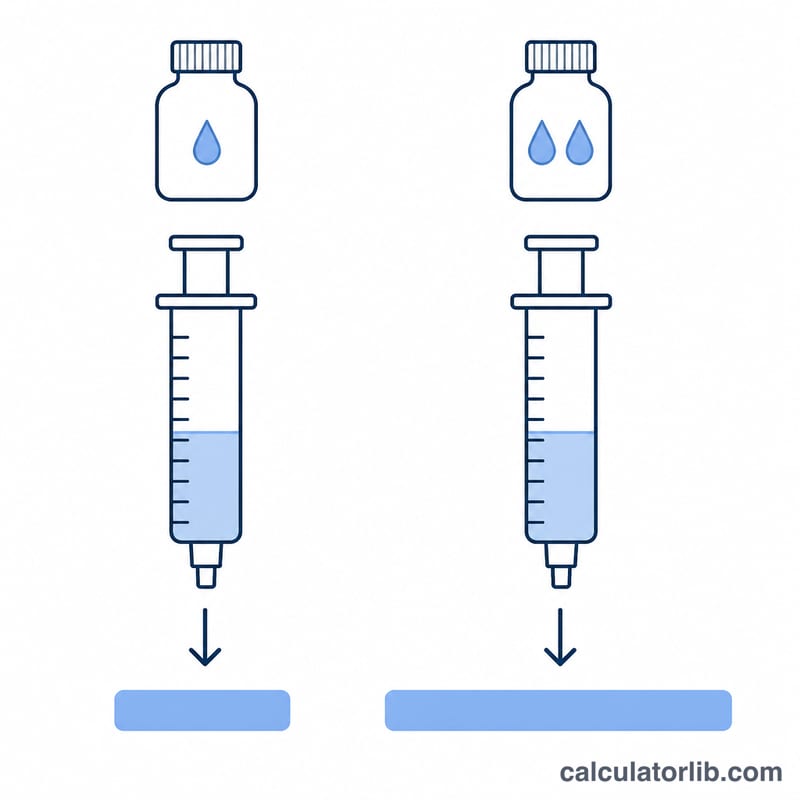
Converting Label Strengths to mg/mL
Liquid medication labels often state strength as an amount of drug in a set volume, such as 160 mg per 5 mL, instead of per single millilitre. To use the calculator, first reduce that strength to mg per 1 mL by dividing the drug amount by the volume:
$$\text{Concentration (mg/mL)} = \frac{\text{Amount of drug (mg)}}{\text{Volume stated on label (mL)}}$$The table below shows only this unit arithmetic for common label formats. It is not a list of products and gives no dosing information.
| Label strength format | Arithmetic | Equivalent concentration |
|---|---|---|
| 100 mg/5 mL | 100 ÷ 5 | 20 mg/mL |
| 125 mg/5 mL | 125 ÷ 5 | 25 mg/mL |
| 160 mg/5 mL | 160 ÷ 5 | 32 mg/mL |
| 200 mg/5 mL | 200 ÷ 5 | 40 mg/mL |
| 250 mg/5 mL | 250 ÷ 5 | 50 mg/mL |
| 400 mg/5 mL | 400 ÷ 5 | 80 mg/mL |
| 500 mg/10 mL | 500 ÷ 10 | 50 mg/mL |
| 1 g/10 mL | 1000 ÷ 10 | 100 mg/mL |
Unit notes:
- 1 g = 1000 mg. Convert grams to milligrams before dividing, as in the 1 g/10 mL row above.
- 1 mg = 1000 mcg (micrograms). If a label gives the strength in mcg/mL, divide by 1000 to get mg/mL.
- A percentage strength (w/v) means grams of drug per 100 mL of liquid. So 1% = 1 g/100 mL = 1000 mg/100 mL = 10 mg/mL. In general, \(\text{mg/mL} = \text{percent} \times 10\).
Two different label formats can give the same concentration. For example, 250 mg/5 mL and 500 mg/10 mL both equal 50 mg/mL. Always read the exact strength printed on the product you are using, because the same medicine can come in several strengths.
More Worked Examples
These examples use neutral, made-up values to show the arithmetic. They do not describe any real medicine or recommend any dose.
Example 1: Label strength given per 5 mL
- The label reads 160 mg/5 mL. Convert it to mg per mL: $$\frac{160\ \text{mg}}{5\ \text{mL}} = 32\ \text{mg/mL}$$
- The measured volume is 7.5 mL. Multiply volume by concentration: $$7.5\ \text{mL} \times 32\ \text{mg/mL} = 240\ \text{mg}$$
- Result: 7.5 mL of this liquid contains 240 mg.
Example 2: Reverse calculation (mg to mL)
- The target amount is 200 mg and the concentration is 40 mg/mL. Rearrange the formula to solve for volume: $$\text{Volume (mL)} = \frac{\text{Dose (mg)}}{\text{Concentration (mg/mL)}}$$
- Substitute the values: $$\frac{200\ \text{mg}}{40\ \text{mg/mL}} = 5\ \text{mL}$$
- Result: 5 mL contains 200 mg. To check, multiply back: 5 mL × 40 mg/mL = 200 mg.
Example 3: Percentage strength
- The solution is labelled 2%, which means 2 g per 100 mL: $$2\% = \frac{2000\ \text{mg}}{100\ \text{mL}} = 20\ \text{mg/mL}$$
- The measured volume is 0.5 mL: $$0.5\ \text{mL} \times 20\ \text{mg/mL} = 10\ \text{mg}$$
- Result: 0.5 mL of a 2% solution contains 10 mg.
Reminder: These examples show unit conversion only. They are general information, not medical advice. Always confirm the strength on your product's label, and check any dose with a pharmacist, doctor or other qualified healthcare professional before giving or taking it.
FAQ
Where do I find the concentration? It is printed on the medication label, often as mg/mL or as a strength like 250 mg / 5 mL.
Can I convert mg back to mL? Yes — divide the desired dose in mg by the concentration in mg/mL to find the volume needed.
Is this a substitute for medical advice? No. Always follow your prescriber or pharmacist and verify doses before administering medication.