What is the Lux to Watts Calculator?
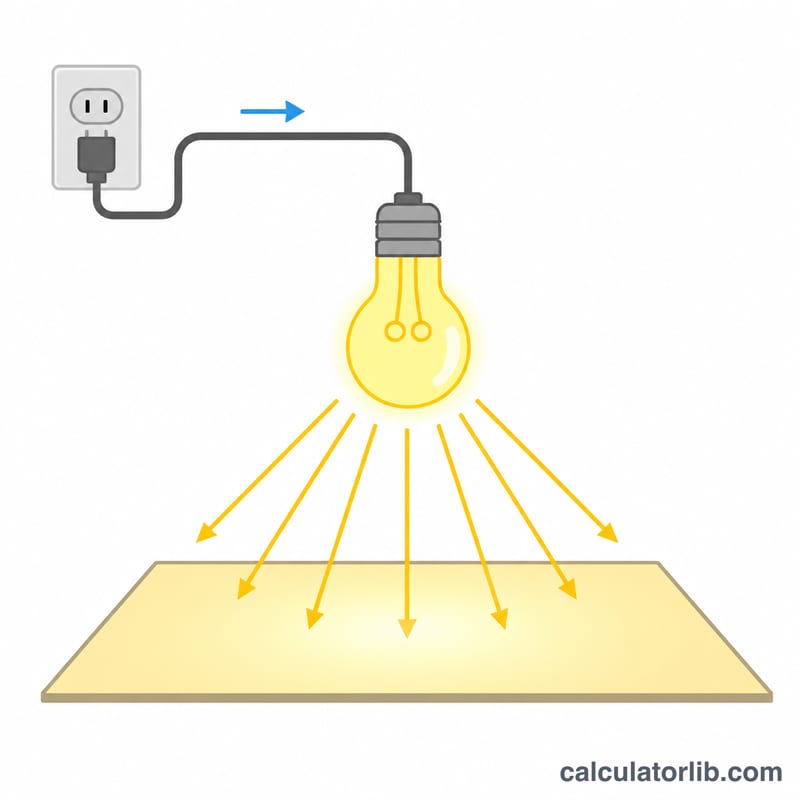
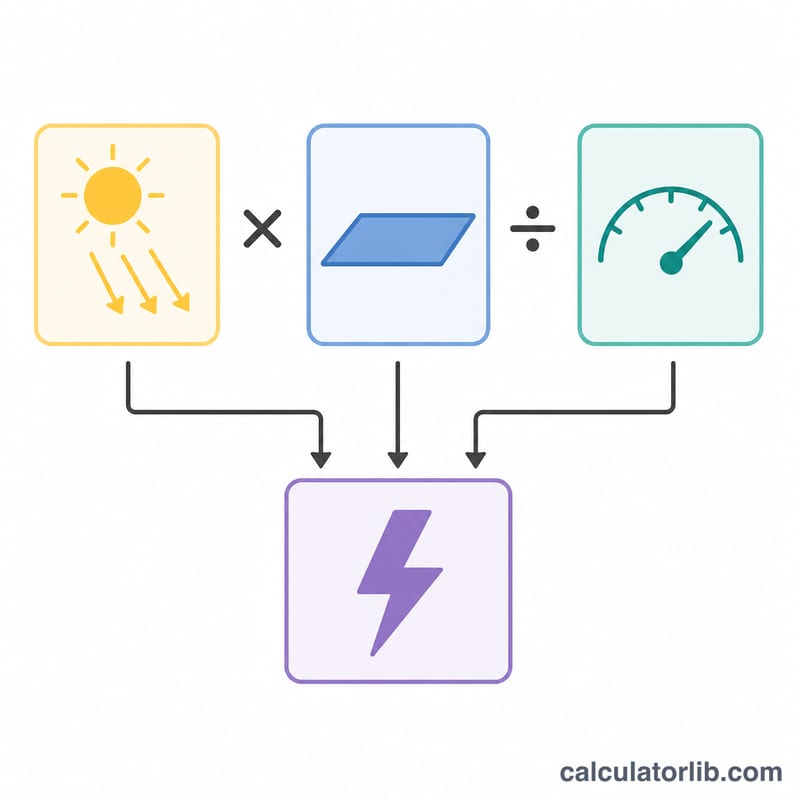
This calculator estimates the electrical power (in watts) required to light a surface to a target illuminance. Lux measures illuminance — lumens per square metre — so it depends on how large an area you are lighting. To turn that into watts you also need the luminous efficacy of the light source, which tells you how many lumens each watt produces.
The core relationship is:
$$P = \frac{ {E_v \times A}}{\eta}$$where \(P\) = power in watts, \(E_v\) = illuminance in lux, \(A\) = lit area in square metres, and \(\eta\) = luminous efficacy in lumens per watt.
How to use it
Enter the target illuminance in lux, the area you want to light in square metres, and the luminous efficacy of your lamp in lumens per watt. Typical LEDs deliver about 80–150 lm/W, while older incandescent bulbs sit near 10–15 lm/W. The calculator first computes total luminous flux \(\Phi_v = E_v \times A\) in lumens, then divides by efficacy to return the wattage.
Worked example
Suppose you want \(500\) lux across a \(10\,\text{m}^2\) room using LED fixtures rated at \(100\) lm/W. First find the flux:
$$\Phi_v = 500 \times 10 = 5000\,\text{lm}$$Then divide by efficacy:
$$P = \frac{5000}{100} = 50\,\text{W}$$So about 50 watts of LED lighting is needed.
Luminous Efficacy by Lamp Type
Luminous efficacy (η, in lumens per watt) tells you how much visible light a source produces per watt of electrical power. It is the divisor in the calculator's formula \(P = \frac{E_v \times A}{\eta}\), so a higher efficacy means less power is needed to reach the same illuminance over the same area. The ranges below are typical values for common light-source types; the exact figure for any specific lamp should be taken from that product's datasheet, because efficacy varies with wattage, color temperature, driver losses, and age.
| Source type | Typical efficacy (lm/W) |
|---|---|
| Incandescent | ~10–17 |
| Halogen | ~16–24 |
| Compact fluorescent (CFL) | ~50–70 |
| Linear fluorescent | ~60–100 |
| LED | ~80–150+ |
| High-pressure sodium (HPS) | ~80–150 |
| Metal halide | ~65–115 |
These are indicative ranges for the lamp technology as a whole, not manufacturer guarantees. When you know the actual efficacy of the fixture you plan to use, enter that value in the efficacy field for the most accurate power estimate.
Recommended Illuminance Levels
Before converting to watts, it helps to know what illuminance (in lux) a space actually needs. The values below are typical maintained illuminance targets drawn from established lighting practice — in Europe the reference is the standard EN 12464-1 ("Light and lighting — Lighting of work places — Indoor work places"), while in North America the Illuminating Engineering Society (IES) publishes comparable recommendations. These are international/regional design standards, not a universal physical law; local codes and the specific standard edition you follow may differ, so treat the figures as a starting point.
| Space or task | Recommended illuminance (lux) |
|---|---|
| Circulation areas and corridors | ~100 |
| Living rooms (general residential) | ~150–300 |
| General offices and kitchens | ~300–500 |
| Detailed or reading work | ~500–750 |
| Precision and fine detail tasks | ~1000 |
Source: recommended maintained illuminance values consistent with EN 12464-1 (indoor work places) and IES guidance. "Maintained" illuminance is the level the installation should still provide after lamp aging and dirt accumulation, so design targets are usually set somewhat higher than the bare minimum. Once you pick a target lux level for your space, enter it in the illuminance field along with the lit area and lamp efficacy to estimate the electrical power required.
FAQ
Can I convert watts back to lux? Yes — rearrange to \(E_v = \dfrac{P \times \eta}{A}\).
Why does area matter? Lux is illuminance per square metre, so the same lumen output spread over a larger area gives fewer lux, requiring more power for the same brightness.
What efficacy should I use? Use the rated lumens per watt from the lamp datasheet; higher efficacy means less power for the same illuminance.