这个计算器能做什么
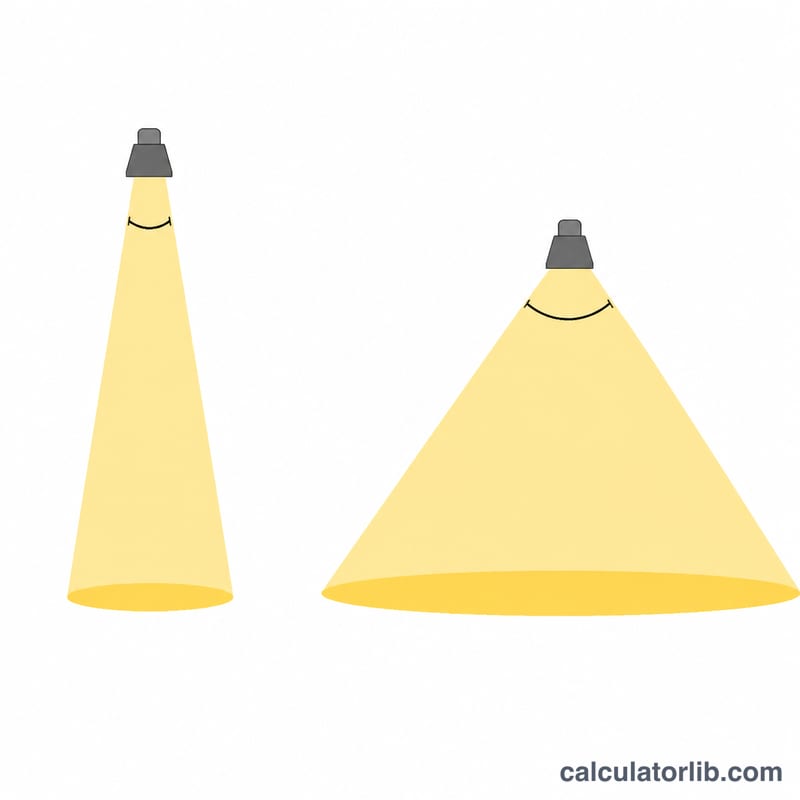
本工具可以把向对称锥形范围内发光的光源的光通量(单位为流明,lm)换算成发光强度(单位为毫坎德拉,mcd)。流明衡量的是光束在各个方向上输出的总光量,而坎德拉和毫坎德拉衡量的则是这些光在光束内集中的程度。在光通量相同的情况下,光束越窄,发光强度就越高。
公式详解
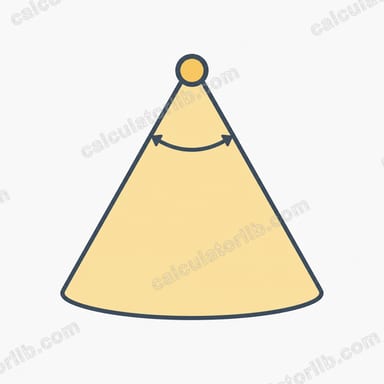
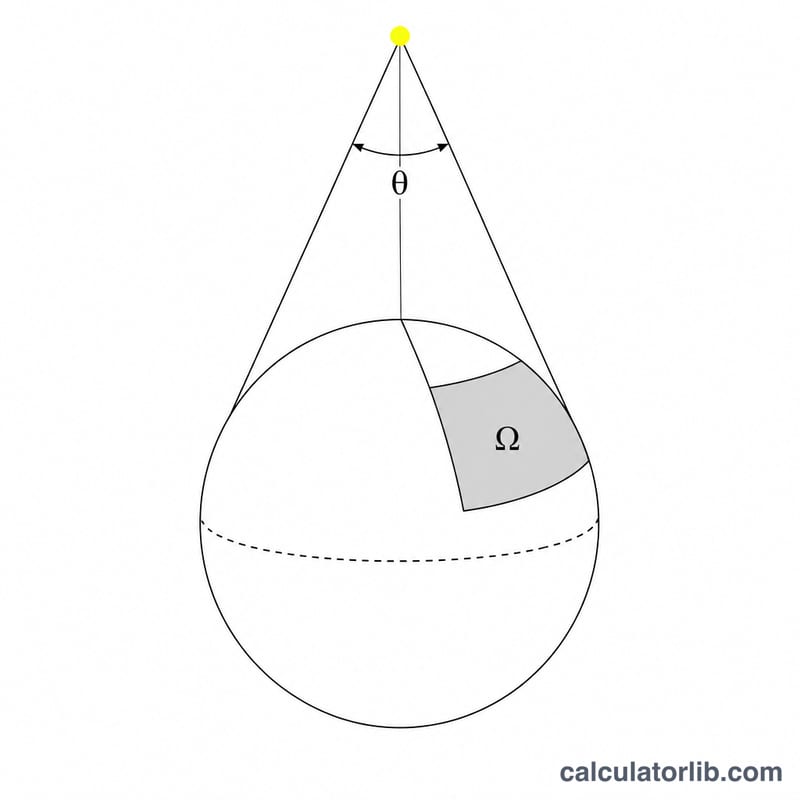
换算结果取决于光束的立体角 \(\Omega\),而立体角由顶角 \(\theta\) 决定:
$$I_{\text{mcd}} = \frac{1000\,\Phi_V}{2\pi\left(1-\cos\frac{\theta}{2}\right)}$$式中 \(\Phi_V\) = 以流明为单位的光通量,\(\theta\) = 以度为单位的锥形完整顶角,系数 \(1000\) 用于把坎德拉换算成毫坎德拉。分母 \(\Omega = 2\pi\left(1-\cos\frac{\theta}{2}\right)\) 就是以球面度(sr)为单位的立体角。
使用方法
先输入光束的总光通量(单位:流明),再输入以度为单位的光束顶角,即可读出以毫坎德拉表示的发光强度。建议采用产品规格书中给出的完整光束角(例如输出降至 50% 时所对应的角度)。
实例演算
假设 \(\Phi_V = 100\ \text{lm}\)、\(\theta = 30^{\circ}\)。先求立体角:
$$\Omega = 2\pi\left(1-\cos 15^{\circ}\right) = 2\pi(1-0.965926) \approx 0.214094\ \text{sr}$$$$I = \frac{1000 \times 100}{0.214094} \approx 467{,}084\ \text{mcd}$$由此可见,100 lm 的光源在 30 度的光束角下,发光强度约为 467,084 mcd。
Referencia de ángulo de haz a ángulo sólido
La conversión de flujo luminoso (lúmenes) a intensidad luminosa (milicandelas) depende por completo del ángulo sólido \(\Omega\) del haz, medido en estereorradianes (sr). Para un cono simétrico con ángulo de haz (completo) en el vértice \(\theta\), el ángulo sólido es:
$$\Omega = 2\pi\left(1 - \cos\frac{ {\theta}}{2}\right)$$
Esta es una relación puramente geométrica de la fotometría del SI y no está vinculada a ningún estándar nacional. La tabla siguiente enumera los ángulos de vértice comunes con el semiángulo \(\theta/2\), su coseno y el ángulo sólido resultante, para que puedas sustituir directamente en la fórmula. Los valores están redondeados a seis decimales.
| Ángulo de vértice \(\theta\) | Semiángulo \(\theta/2\) | \(\cos(\theta/2)\) | Ángulo sólido \(\Omega\) (sr) |
|---|---|---|---|
| 5° | 2.5° | 0.999048 | 0.005980 |
| 10° | 5° | 0.996195 | 0.023909 |
| 15° | 7.5° | 0.991445 | 0.053754 |
| 24° | 12° | 0.978148 | 0.137300 |
| 30° | 15° | 0.965926 | 0.214094 |
| 45° | 22.5° | 0.923880 | 0.478280 |
| 60° | 30° | 0.866025 | 0.841788 |
| 90° | 45° | 0.707107 | 1.840302 |
| 120° | 60° | 0.500000 | 3.141593 |
Una vez conocido \(\Omega\), la intensidad en milicandelas se obtiene de \(I_V = \dfrac{1000\,\Phi_V}{\Omega}\). Un haz más estrecho produce un \(\Omega\) menor, concentrando el mismo flujo en una intensidad mayor.
常见问题
什么是光束顶角? 它指的是光束的完整锥角,也就是从顶点算起、覆盖一侧边缘到另一侧边缘的夹角,因此半角为 \(\theta/2\)。
坎德拉和毫坎德拉是什么关系? \(1\ \text{cd} = 1000\ \text{mcd}\)。
为什么光束越窄,mcd 反而越大? 因为相同的光通量被压缩到更小的立体角里,发光强度自然随之升高。