
What Is the Boer Goat Gestation Calculator?
This tool estimates when a Boer goat doe is likely to kid (give birth) based on the date she was bred. Boer goats have an average gestation length of roughly 150 days, though normal births occur anywhere from about 148 to 155 days. Knowing the expected kidding date lets you prepare a clean kidding pen, adjust feed, and watch for signs of labor at the right time.
How to Use It
Enter the breeding (mating) date and the average gestation length you want to use. The default of 150 days suits most Boer does; you can adjust between 140 and 160 days to match your herd records. The calculator returns the estimated due date, an earliest/latest birthing window, and how many days remain from today.
The Formula Explained
The core calculation simply adds the gestation length to the breeding date:
$$D_{due} = D_{breed} + G$$where \(D_{breed}\) = the breeding date, \(G\) = gestation length in days (default \(150\)), and \(D_{due}\) = the expected kidding date. The typical window spans:
$$[\,D_{breed}+148,\ D_{breed}+155\,]$$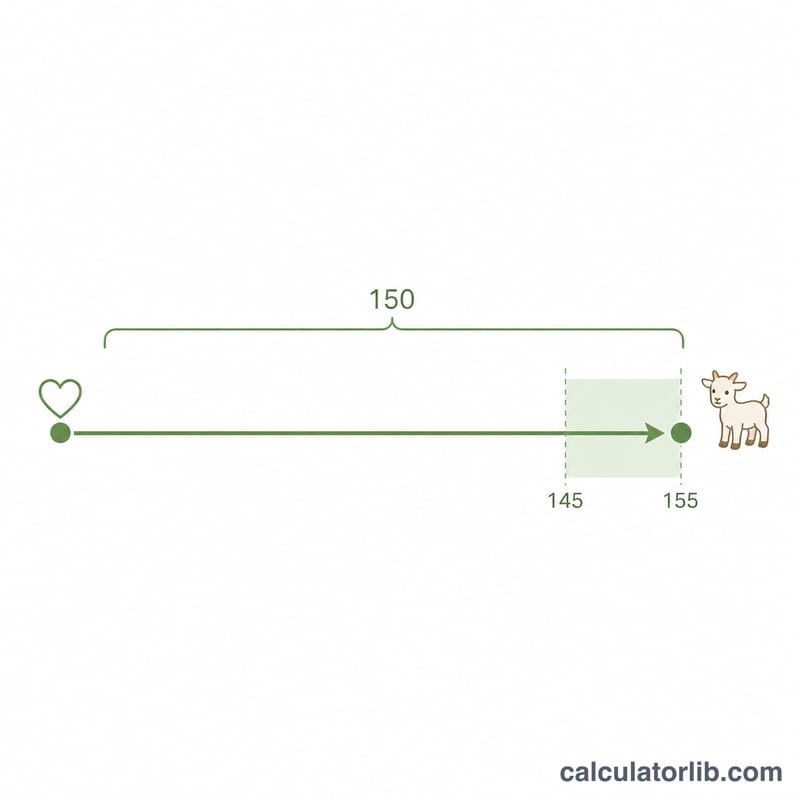
Worked Example
Suppose a doe is bred on January 1, 2024 with a 150-day gestation. Adding 150 days:
$$D_{due} = \text{2024-01-01} + 150\ \text{days} = \text{2024-05-30}$$The earliest expected birth (148 days) is 2024-05-28 and the latest (155 days) is 2024-06-04.
Preparing for Kidding
Once you have a due date, work backward to build a simple preparation timeline. The goal is to have everything ready before the earliest possible kidding date (about 148 days after breeding) so an early doe never catches you off guard.
- Last 4–6 weeks before due date: Adjust late-gestation nutrition. Most fetal growth happens now, so gradually increase quality forage and a balanced concentrate to meet rising energy and protein needs, and ensure adequate calcium, selenium, and vitamin E per your local recommendations. Avoid sudden ration changes and over-conditioning, which raise the risk of pregnancy toxemia and kidding difficulty.
- About 1 week before the earliest date: Clean, disinfect, and bed a draft-free kidding pen with fresh straw. Separate the doe into the pen as the window approaches so she can settle in calmly.
- Gather kidding supplies in advance: Clean towels, disposable gloves, iodine or chlorhexidine for navels, dental floss or umbilical clamps, lubricant, a bulb syringe, a heat lamp or warming box for cold weather, colostrum or a replacer, a bottle and nipple, and your veterinarian's phone number.
- As the window opens (roughly 148–155 days): Watch for labor signs — the udder fills and tightens, the vulva softens and swells, a thick mucus discharge may appear, the pelvic ligaments on either side of the tail head soften and "disappear," and the doe becomes restless, paws bedding, or separates from the herd. Active labor usually delivers the first kid within an hour of hard straining.
- Know when to call for help: Contact your veterinarian if the doe strains hard for 30–45 minutes with no progress, if only a head or single leg presents, or if she seems exhausted or distressed.
This is general husbandry information, not veterinary advice. Conditions vary by herd, climate, and individual doe — consult your veterinarian for guidance specific to your animals.
Key Terms Explained
- Doe: An adult female goat. A doe that has never kidded is sometimes called a doeling until her first pregnancy.
- Buck: An intact adult male goat used for breeding (also called a billy).
- Kid: A baby goat, from birth through weaning.
- Kidding: The act of a doe giving birth; the goat equivalent of calving or lambing.
- Gestation length: The duration of pregnancy from conception to birth. In Boer and other meat goats it averages about 150 days, with a normal range of roughly 145–155 days.
- Breeding (settling) date: The date the doe was successfully mated and conceived. "Settling" refers to the doe becoming pregnant; this date is the starting point for calculating the due date.
- Dam: The mother of a kid; the female parent in a pedigree.
- Parturition: The general biological term for the process of giving birth, which in goats is kidding.
FAQ
How long are Boer goats pregnant? On average about 150 days, with a normal range of roughly 148 to 155 days.
Why does my doe kid earlier or later? Litter size, doe age, breed lines, and nutrition can shift the date by several days. Twins and triplets often arrive a little earlier than single kids.
Is this accurate for other goat breeds? Most goat breeds gestate near 150 days, so it works as a close estimate for dairy and meat goats too, but adjust the gestation length to match your breed records.