
What Is the Death Rate Calculator?
The crude death rate (CDR), or mortality rate, measures how many deaths occur in a population over a period of time, usually one year. It is one of the most widely used demographic indicators and helps compare mortality across regions and time periods. This calculator divides the number of deaths by the total population and scales the result to a convenient base — typically per 1,000 people.
How to Use It
Enter the number of deaths recorded during the period and the total (or mid-year) population. Choose whether you want the rate expressed per 100 (a percentage), per 1,000, per 10,000, or per 100,000 people. The tool returns both the scaled death rate and the equivalent mortality percentage.
The Formula
The crude death rate is defined as:
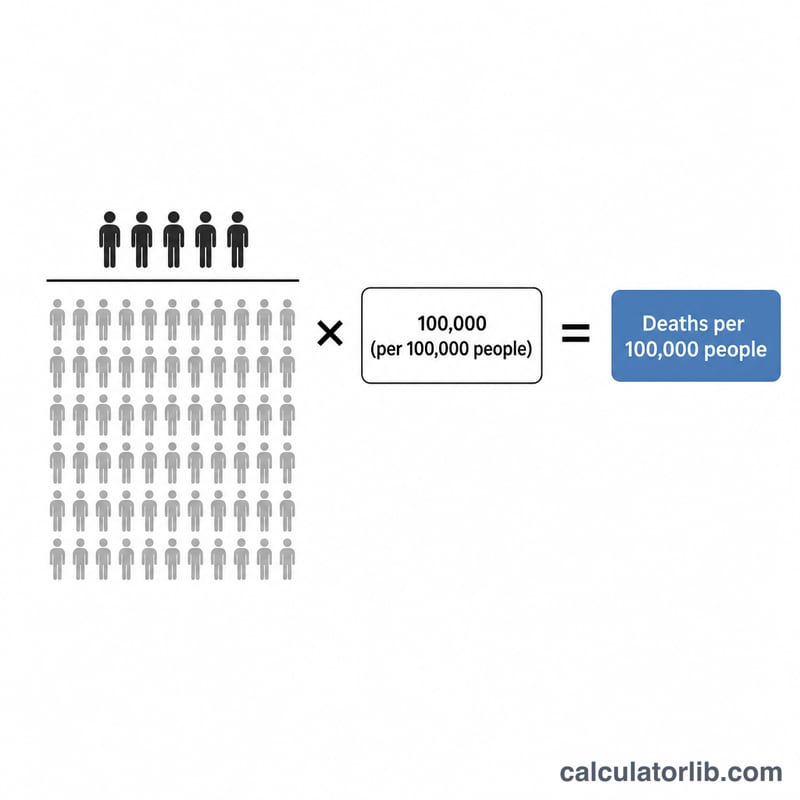
$$R = \frac{D}{P} \times K$$where \(D\) = number of deaths, \(P\) = total population, and \(K\) = the scaling base (e.g. \(K = 1000\)). Setting \(K = 100\) gives the mortality percentage.
Worked Example
Suppose a town of \(100{,}000\) people recorded \(850\) deaths in one year, and you want the rate per 1,000:
$$R = \frac{850}{100{,}000} \times 1000 = 8.5\ \text{deaths per 1,000}$$As a percentage this is \(\frac{850}{100{,}000}\times 100 = 0.85\%\).
FAQ
What is a "crude" death rate? "Crude" means it is not adjusted for age, sex, or other factors. Age-standardised rates allow fairer comparison between populations with different age structures.
Why per 1,000 or per 100,000? Scaling makes small fractions easier to read. Whole-country mortality is often quoted per 1,000, while specific causes of death are quoted per 100,000.
Which population should I use? Demographers usually use the mid-year (mid-period) population, which best represents the average population at risk during the interval.