
What is the Horsepower from Quarter-Mile Calculator?
This tool estimates an engine's flywheel horsepower from a vehicle's drag-strip trap speed (the speed at the end of a quarter mile) and its weight. It uses the well-known Hale/Fox trap-speed equation, a favourite shortcut among drag racers and tuners for sanity-checking dyno numbers without a dyno.
How to use it
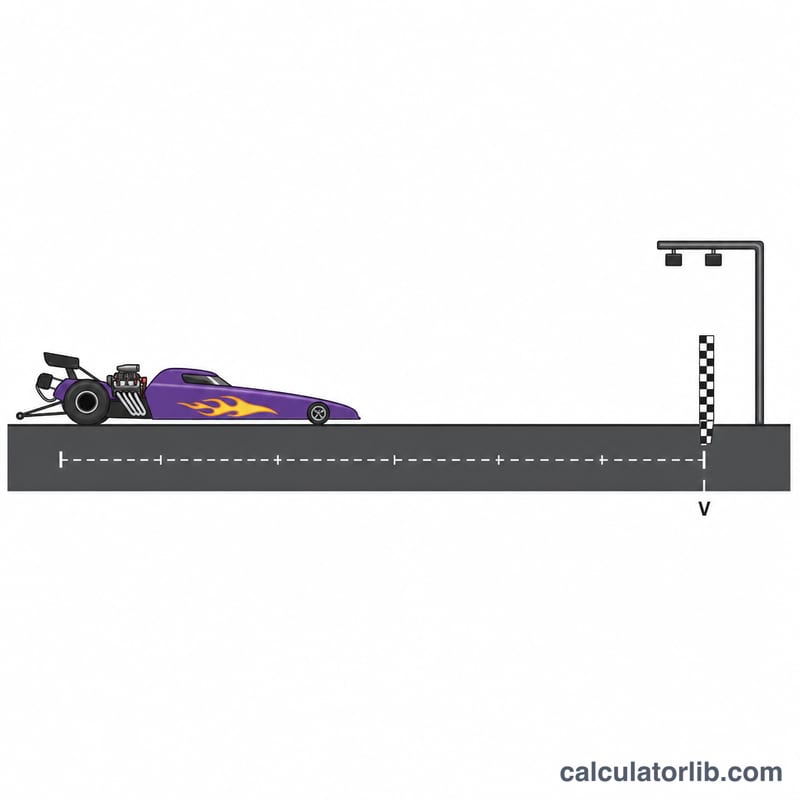
Enter your vehicle's race weight in pounds (include driver and fuel for best accuracy) and the trap speed in miles per hour recorded at the end of your quarter-mile pass. The calculator returns estimated horsepower and the kilowatt equivalent.
The formula explained
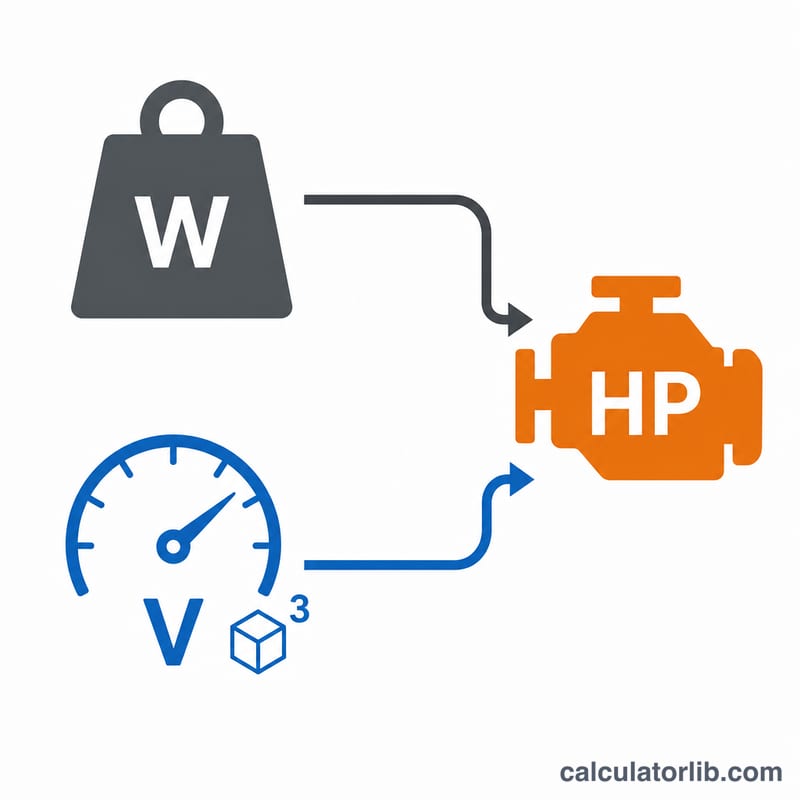
The trap-speed method is $$\text{HP} = \text{Weight (lb)} \times \left(\frac{\text{Trap Speed (mph)}}{234}\right)^{3}$$ The constant 234 is empirical and bundles aerodynamic drag, rolling resistance and drivetrain efficiency for a typical car. Because horsepower scales with the cube of speed, small trap-speed gains imply large power gains. Kilowatts are found with \(\text{kW} = \text{HP} \times 0.7457\).
Worked example
A 3,200 lb car traps 115 mph. Ratio = \(115 / 234 = 0.491453\). Cubed = \(0.118688\). Times 3,200 = about 379.8 hp, or roughly 283 kW. That is a realistic figure for a strong V8.
FAQ
Is this flywheel or wheel horsepower? The constant 234 yields an approximate flywheel (crank) figure for typical cars.
Why does weight matter? A heavier car must make more power to reach the same trap speed, so weight is directly proportional in the formula.
How accurate is it? Trap-speed estimates are usually within 5–10% of dyno results, but traction, altitude and aero modifications can shift the answer.