
What is the Concrete Yardage Calculator?
Concrete is sold by the cubic yard, but slabs and footings are measured in feet and inches. This calculator converts your dimensions into cubic yards so you know exactly how much to order. It works for driveways, patios, sidewalks, garage floors, footings and equipment pads.
How to use it
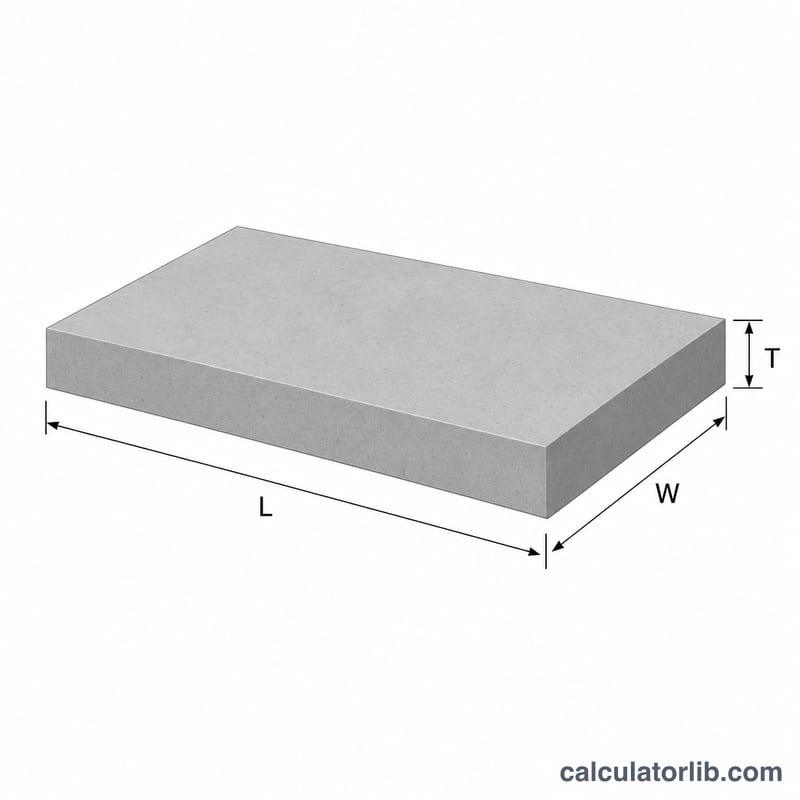
Enter the length and width of the pour in feet, and the thickness (depth) in inches. Add an optional waste / overage percentage — 5–10% is typical to cover spillage, over-excavation and uneven subgrade. The calculator returns the net volume plus the recommended amount to order.
The formula explained
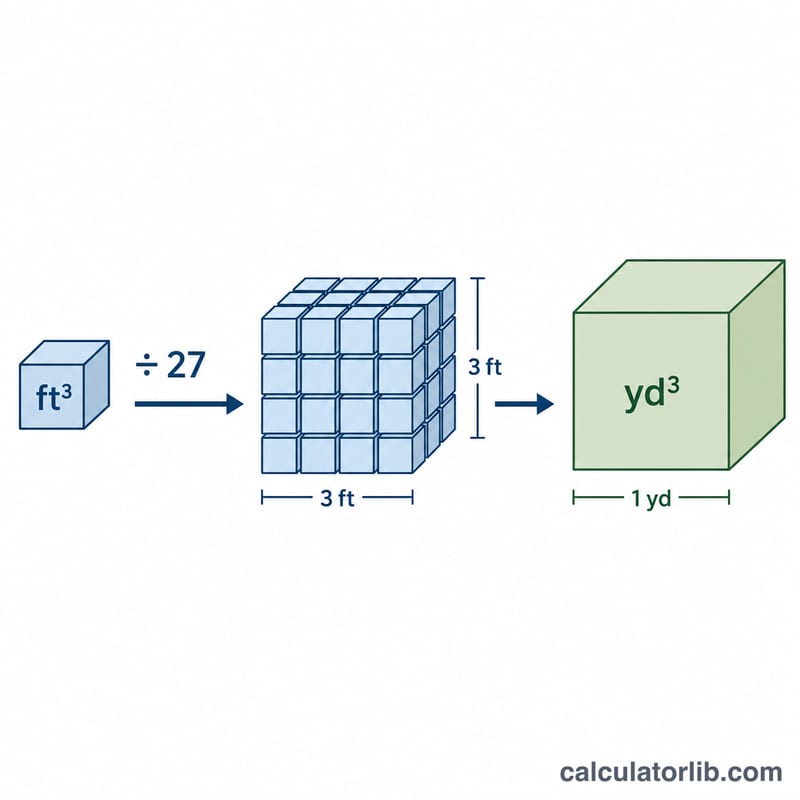
Volume in cubic feet is length × width × (thickness ÷ 12), because thickness is in inches and there are 12 inches per foot. Dividing by 27 converts cubic feet to cubic yards (a cubic yard is 3 ft × 3 ft × 3 ft = 27 ft³).
So: $$\text{cubic yards} = \frac{L \times W \times \dfrac{T}{12}}{27}$$ The order quantity multiplies this by \(\left(1 + \dfrac{\text{waste\%}}{100}\right)\).
Worked example
For a 10 ft × 10 ft slab that is 4 inches thick: $$10 \times 10 \times \frac{4}{12} = 33.33 \text{ ft}^3$$ Divide by 27 to get $$\frac{33.33}{27} = 1.235 \text{ cubic yards}$$ With a 10% waste allowance you would order about \(1.36\) cubic yards — so you'd round up to the supplier's minimum or to \(1.5 \text{ yd}^3\).
FAQ
Should I round up? Yes. Always round up to the nearest quarter or half yard — running short mid-pour creates a cold joint and a weak slab.
How much waste should I add? 5–10% for flat slabs; up to 15% for footings or rough subgrade where forms may bulge.
Does this include rebar or gravel? No — it estimates only the concrete volume itself.