
What Is Equity Value?
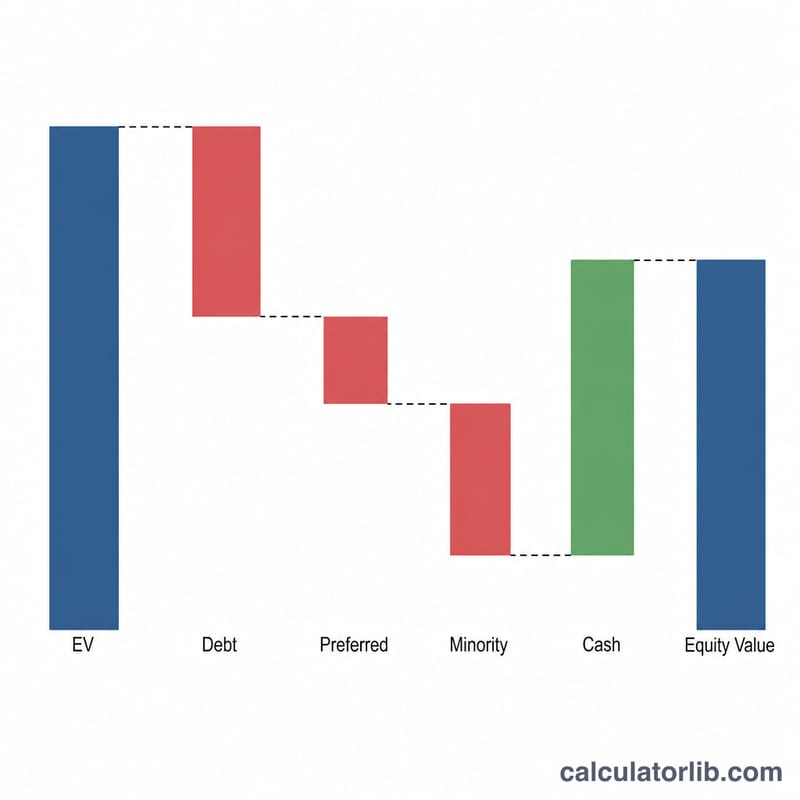
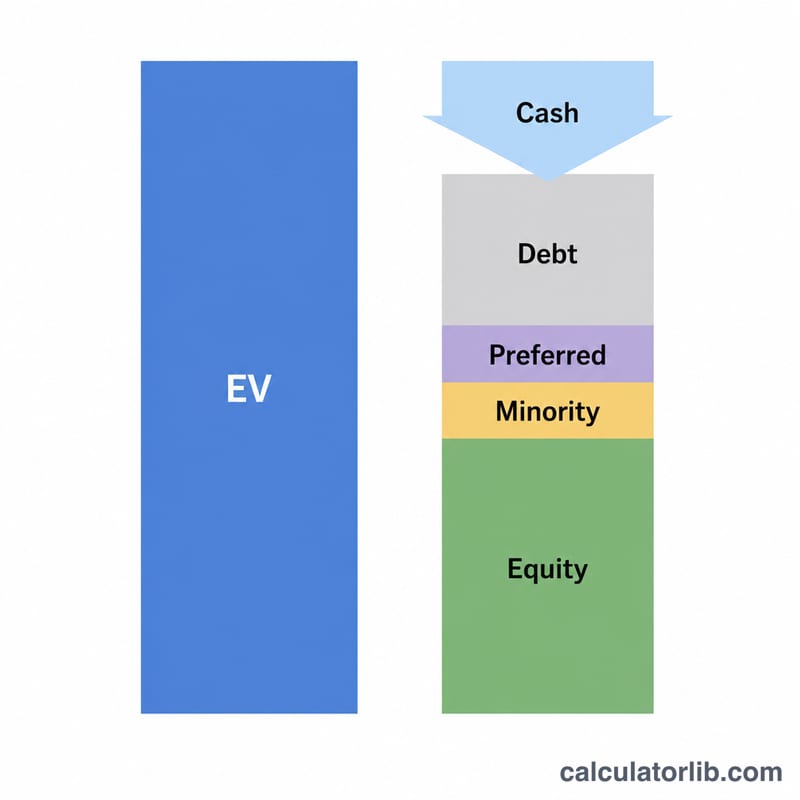
Equity value (also called market capitalization for public firms) is the value of a business attributable to its common shareholders. It differs from enterprise value (EV), which measures the value of the whole operating business to all capital providers — debt, preferred, minority and equity holders. This calculator runs the standard "EV-to-equity bridge" to translate one into the other.
How to Use It
Enter the company's enterprise value, its total interest-bearing debt, cash and cash equivalents, and any preferred equity or minority (non-controlling) interest. The calculator subtracts the claims that rank ahead of common shareholders and adds back cash to arrive at equity value. Leave preferred and minority interest at zero if the company has none.
The Formula Explained
$$\text{Equity Value} = \text{Enterprise Value} - \text{Total Debt} - \text{Preferred Equity} - \text{Minority Interest} + \text{Cash}$$ Because EV already includes debt-funded value, you remove debt; cash is a non-operating asset that belongs to shareholders, so you add it back. Preferred and minority claims are senior to common equity and are therefore subtracted. The reverse of this bridge (\(\text{EV} = \text{Equity} + \text{Debt} + \text{Preferred} + \text{Minority} - \text{Cash}\)) is used when starting from market cap.
Worked Example
Suppose EV is $1,000,000, total debt is $300,000, cash is $50,000, with no preferred or minority interest. $$\text{Equity Value} = 1{,}000{,}000 - 300{,}000 - 0 - 0 + 50{,}000 = \$750{,}000$$ Net debt is \(300{,}000 - 50{,}000 = \$250{,}000\).
FAQ
Is equity value the same as market cap? For a public company, yes — market cap is equity value computed as share price times shares outstanding.
Why add cash back? Cash is a non-operating asset not captured by enterprise value, and it ultimately belongs to shareholders.
What if equity value is negative? A negative result implies debt and senior claims exceed enterprise value plus cash, signaling financial distress or a highly leveraged structure.