
What is Customer Lifetime Value (LTV)?
Customer Lifetime Value — also called CLV or LTV — estimates the total profit a business can expect from a single customer over the entire duration of their relationship. It is one of the most important metrics in marketing and SaaS finance because it tells you how much you can afford to spend acquiring a customer while staying profitable. This calculator works for any currency or country; just enter values in your own currency.
How to use this calculator
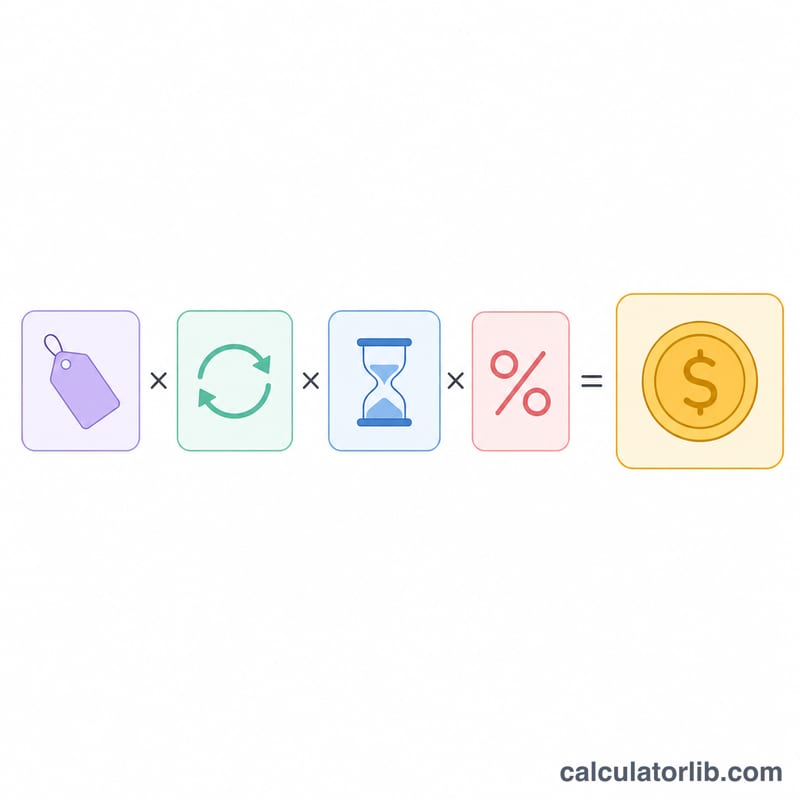
Enter four numbers: the average purchase value (how much a customer spends per order), the purchase frequency (number of purchases per year), the customer lifespan (how many years they stay), and your gross margin as a percentage. The tool multiplies these to produce the lifetime profit per customer, plus the lifetime revenue and the annual value.
The formula explained
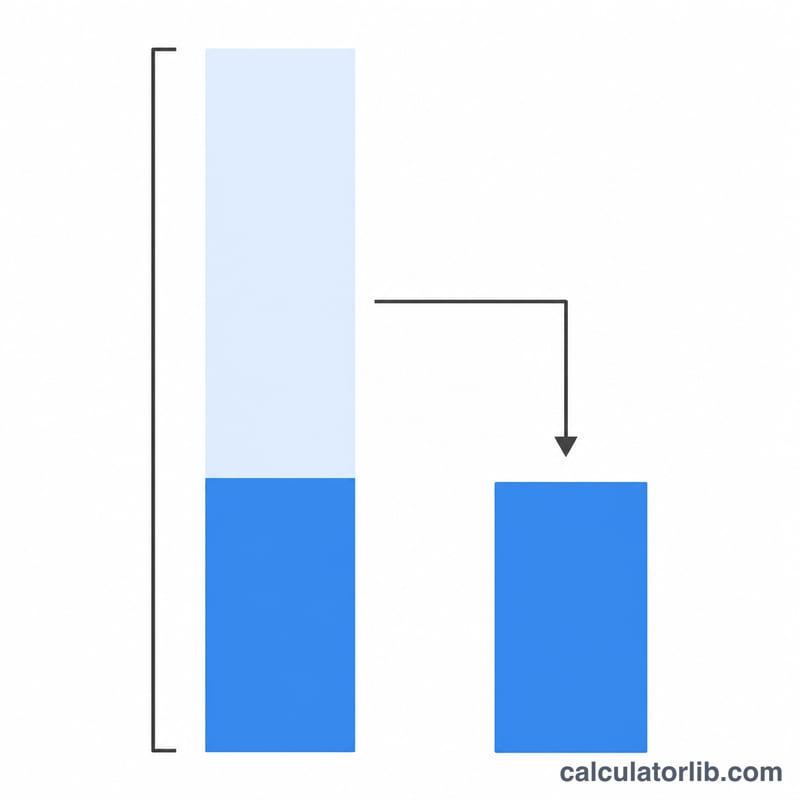
The core equation is $$\text{LTV} = (\text{Average Purchase Value} \times \text{Purchase Frequency} \times \text{Customer Lifespan}) \times \text{Gross Margin}$$ The first three terms give total lifetime revenue. Multiplying by gross margin (expressed as a fraction, e.g. \(60\% = 0.60\)) converts revenue into profit, because LTV should reflect money you keep, not just money you collect.
Worked example
Suppose a customer spends $50 per order, buys 12 times a year, stays for 3 years, and your gross margin is 60%. Lifetime revenue $$50 \times 12 \times 3 = \$1{,}800$$ Applying the 60% margin: $$\text{LTV} = 1{,}800 \times 0.60 = \$1{,}080$$ The annual value is \(50 \times 12 \times 0.60 = \$360\) per year.
FAQ
Should LTV use revenue or profit? Best practice is profit, which is why this tool applies gross margin. Revenue-only LTV overstates the true value.
How does LTV relate to CAC? Compare LTV to Customer Acquisition Cost. A healthy LTV:CAC ratio is roughly 3:1 or higher.
What if I don't know customer lifespan? Estimate it as 1 divided by your annual churn rate — a 25% churn rate implies a 4-year average lifespan.