What is the TI-RADS calculator?
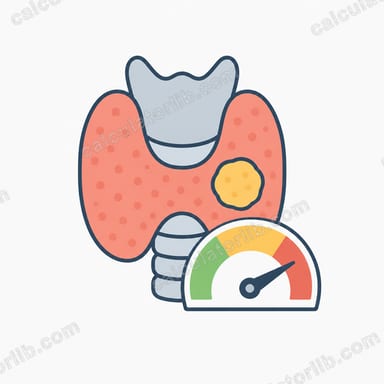
The American College of Radiology Thyroid Imaging Reporting and Data System (ACR TI-RADS) is a standardized way to estimate the malignancy risk of a thyroid nodule seen on ultrasound. Five feature categories each contribute points, and the sum places the nodule into a category from TR1 (benign) to TR5 (highly suspicious). This calculator adds the points for you and returns the category plus a size-based management suggestion.
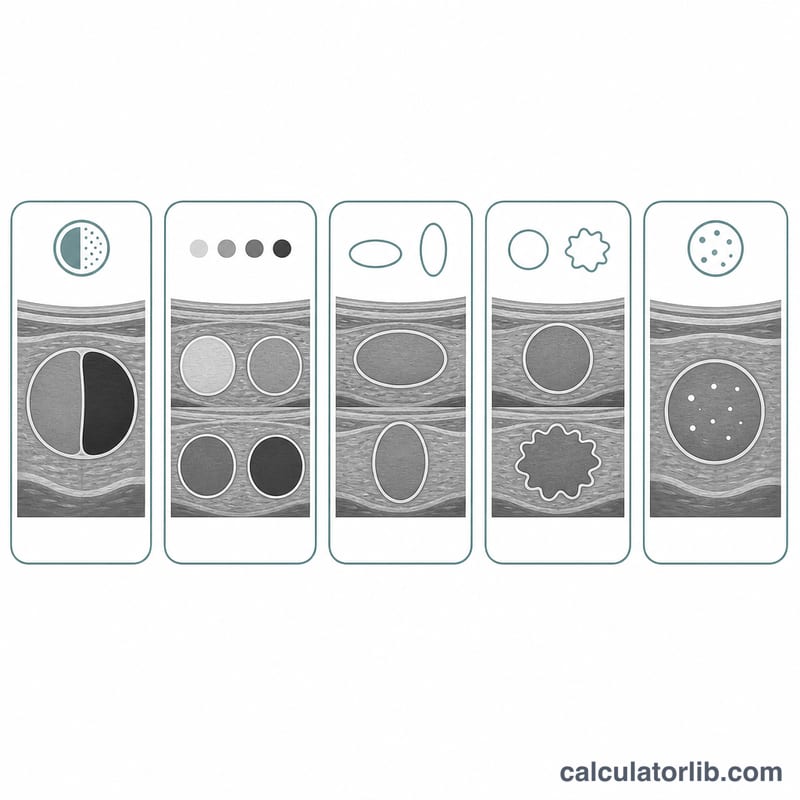
How to use it
Choose the option that best matches the ultrasound report for composition, echogenicity, shape, and margin, tick every type of echogenic foci present, then enter the nodule maximum diameter in centimeters. The tool sums the points and reports the TR category. Fine-needle aspiration (FNA) and follow-up thresholds depend on both category and size.
The formula explained
The total score is the sum of the five feature points, where \(C\) = composition, \(E\) = echogenicity, \(S\) = shape, \(M\) = margin, and \(F\) = echogenic foci:
$$\text{Score} = C + E + S + M + F$$
The score maps to a category: 0 points gives TR1, 2 points TR2, 3 points TR3, 4 to 6 points TR4, and 7 or more points TR5.
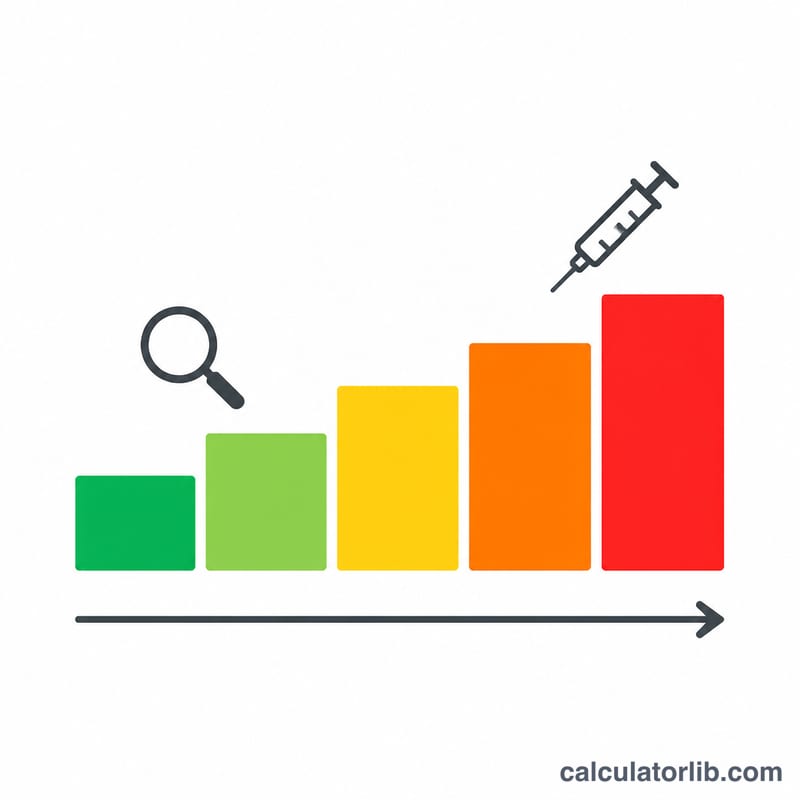
Worked example
A solid nodule (\(C=2\)) that is very hypoechoic (\(E=3\)), taller-than-wide (\(S=3\)), with lobulated margins (\(M=2\)) and punctate echogenic foci (\(F=3\)) scores:
$$\text{Score} = 2 + 3 + 3 + 2 + 3 = 13$$
A score of 13 is \(\ge 7\), so the nodule is TR5 (highly suspicious), and FNA is advised once it reaches 1.0 cm.
FAQ
Does a high score mean cancer? No. TI-RADS estimates relative risk and guides whether to biopsy or monitor; only cytology or histology confirms a diagnosis.
Why does size matter? FNA and follow-up thresholds fall as the category rises: TR3 at 2.5 cm, TR4 at 1.5 cm, and TR5 at 1.0 cm for biopsy.
Can foci add more than once? Yes. ACR TI-RADS adds the points of every type of echogenic focus present (macrocalcifications 1, peripheral or rim calcifications 2, punctate echogenic foci 3), so tick each one the report describes.