What is the TI-RADS Score Calculator?
The Thyroid Imaging Reporting and Data System (TI-RADS), published by the American College of Radiology (ACR), is a standardized way to stratify the malignancy risk of a thyroid nodule seen on ultrasound. This calculator turns five ultrasound feature categories into a single point total and a TR1-TR5 category, giving a reproducible, evidence-based risk level.
How to use it
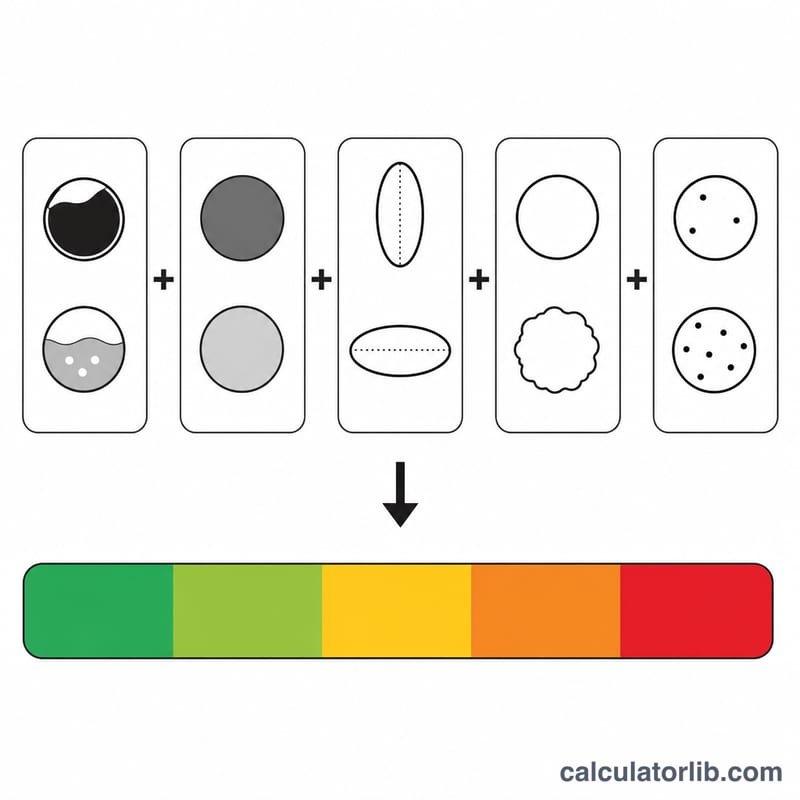
Select the option that best matches the nodule for each of the five feature groups: composition, echogenicity, shape, and margin are single-choice, while echogenic foci is additive because more than one type of focus can be present. The calculator sums the points and assigns the category. The main formula is:
$$\text{Points} = C + E + S + M + F$$where \(C\) = composition, \(E\) = echogenicity, \(S\) = shape, \(M\) = margin, and \(F\) = the sum of all echogenic foci points.
How the points are assigned
Composition ranges from 0 (cystic or spongiform) to 2 (solid). Echogenicity ranges from 0 (anechoic) to 3 (very hypoechoic). A taller-than-wide shape adds 3, lobulated or irregular margins add 2, and extra-thyroidal extension adds 3. Foci add 1 for macrocalcifications, 2 for peripheral calcifications, and 3 for punctate echogenic foci.
Worked example
Consider a solid nodule that is very hypoechoic, taller-than-wide, with irregular margins and punctate echogenic foci:
$$\text{Points} = 2 + 3 + 3 + 2 + 3 = 13$$A total of \(13\) points is well above the \(7\)-point threshold, so the nodule is classified as \(\text{TR5}\), highly suspicious, and fine-needle aspiration (FNA) is recommended for nodules \(\ge 1\,\text{cm}\).
FAQ
Does the score replace clinical judgment? No. TI-RADS guides FNA and follow-up decisions but must be combined with nodule size, patient history, and radiologist expertise.
Why are echogenic foci additive? A nodule can show more than one type of focus, so ACR TI-RADS sums their individual points rather than picking one.
What size triggers FNA? The size threshold depends on the category: \(\ge 1\,\text{cm}\) for TR5, \(\ge 1.5\,\text{cm}\) for TR4, and \(\ge 2.5\,\text{cm}\) for TR3.