What This Calculator Does
The CSPF Air Conditioner Electricity Cost Calculator turns an air conditioner's efficiency rating into a real running-cost estimate. CSPF (Cooling Seasonal Performance Factor) expresses how much cooling output a unit delivers per unit of electricity consumed across a season, so a higher CSPF means lower energy use for the same cooling. By combining the unit's cooling capacity, CSPF, daily running hours, days of use, and your electricity tariff, the tool shows the electrical power drawn, the energy consumed, and the total cost.
The Formula Explained
The electrical power the unit draws is its cooling capacity divided by its CSPF:
$$P = \frac{\text{Capacity}}{\text{CSPF}}$$where \(P\) = power input in kW, Capacity is the rated cooling output in kW, and CSPF is the dimensionless efficiency ratio. Multiplying power by running hours, days, and tariff gives the total cost:
$$\text{Cost} = P \times \text{Hours} \times \text{Days} \times \text{Tariff}$$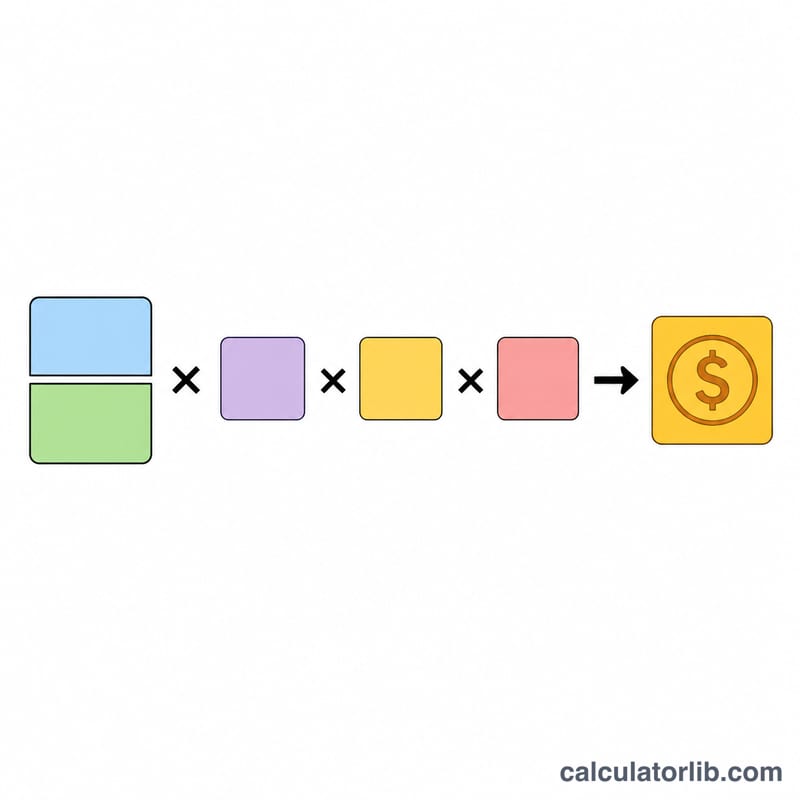
How to Use It
Enter the unit's cooling capacity in kW (found on the nameplate or spec sheet), its CSPF rating, how many hours per day you run it, the number of days, and your electricity price per kWh. The calculator returns the power draw, total energy in kWh, and the estimated cost.
Worked Example
A 3.5 kW unit with a CSPF of 5.0, run 8 hours a day for 30 days at 0.15 per kWh:
$$P = \frac{3.5}{5.0} = 0.7\,\text{kW}$$$$E = 0.7 \times 8 \times 30 = 168\,\text{kWh}$$$$\text{Cost} = 168 \times 0.15 = \$25.20$$So running this unit for a month costs about $25.20.
Scenario Comparison
An air conditioner's electricity cost depends on how efficiently it turns electricity into cooling. The CSPF (Cooling Seasonal Performance Factor) tells you how many units of cooling you get per unit of electricity, so the electrical power the unit actually draws is the cooling capacity divided by the CSPF:
$$\text{Cost} = \frac{\text{Capacity (kW)}}{\text{CSPF}} \times \text{Hours/day} \times \text{Days} \times \text{Tariff}$$
The table below holds cooling capacity fixed at 3.5 kW over a 30-day month and varies CSPF, daily running hours, and tariff. The tariff is illustrative (shown here as $0.15 per kWh unless noted) — substitute your own local electricity rate and currency, since prices vary widely by country and provider.
| Scenario | CSPF | Hours/day | Tariff (per kWh) | Power draw (kW) | Monthly kWh | Monthly cost |
|---|---|---|---|---|---|---|
| Standard unit, light use | 3.0 | 4 | $0.12 | 1.17 | 140.0 | $16.80 |
| Standard unit, typical use | 3.0 | 8 | $0.15 | 1.17 | 280.0 | $42.00 |
| Basic inverter | 4.0 | 8 | $0.15 | 0.88 | 210.0 | $31.50 |
| High-efficiency inverter | 5.0 | 8 | $0.15 | 0.70 | 168.0 | $25.20 |
| Premium inverter | 6.0 | 8 | $0.15 | 0.58 | 140.0 | $21.00 |
| Premium inverter, heavy use, high tariff | 6.0 | 12 | $0.20 | 0.58 | 210.0 | $42.00 |
Worked example for the "standard unit, typical use" row, showing the full substitution:
$$\text{Cost} = \frac{3.5}{3.0} \times 8 \times 30 \times 0.15 \approx 1.167 \times 8 \times 30 \times 0.15 = \$42.00$$
Two patterns stand out: doubling the running hours doubles both the kWh and the cost, and moving from a CSPF of 3.0 to 6.0 halves the power draw — so at 8 hours a day the premium inverter costs about half as much to run as the standard unit for the same 3.5 kW of cooling.
Typical CSPF Ratings and Values
CSPF (Cooling Seasonal Performance Factor) is a seasonal efficiency metric defined in the Japanese standard JIS C 9612 and used on air-conditioner energy labels in several Asian markets, including Malaysia and Thailand. It is a regional measure — many other countries rate efficiency with different metrics such as SEER, CSPF's units differ, and energy-label star thresholds vary by country — so treat the figures below as general orientation rather than a universal standard. A higher CSPF means more cooling per unit of electricity, which lowers running cost. On star-rated energy labels, units with a higher CSPF earn more stars.
The following ranges reflect commonly documented values for residential split-type units and are approximate; always check the specific CSPF printed on the product's energy label.
| Unit type | Typical CSPF range |
|---|---|
| Standard / non-inverter | 3.0 – 3.5 |
| Basic inverter | 3.5 – 4.5 |
| High-efficiency inverter | 4.5 – 6.0 |
| Premium inverter | 6.0 – 7.0+ |
Common residential cooling capacities are often marketed in "horsepower" (HP) in Southeast Asia; the kW-to-HP figures below are approximate industry conventions, and suitable room size also depends on insulation, ceiling height, sun exposure, and occupancy:
| Cooling capacity (kW) | Approx. rating | Rough room guidance |
|---|---|---|
| 2.5 | ~1.0 HP | Small bedroom |
| 3.5 | ~1.5 HP | Medium bedroom / small living area |
| 5.0 | ~2.0 HP | Large room / living area |
| 7.0 | ~2.5 HP | Large living or open-plan area |
Typical daily running hours for residential cooling range from about 4 hours (occasional evening use in a mild climate) to 8–12 hours (regular use in a hot, humid climate or during the day at home). Because monthly cost scales directly with running hours, an honest estimate of how long the unit actually runs matters as much as the CSPF and tariff you enter above.
FAQ
Is a higher CSPF better? Yes. A higher CSPF means the unit uses less electricity to deliver the same cooling, lowering your running cost.
Where do I find my CSPF? It is listed on the energy label or technical specification sheet of the air conditioner.
Does this include standby power? No. The estimate covers active cooling based on the inputs; real bills may vary with weather, thermostat settings, and idle draw.