What is the Reading Challenge Calculator?
The Reading Challenge Calculator turns a yearly (or any time frame) reading goal into a realistic, day-to-day pace. Whether you're tackling a 52-book challenge, a Goodreads goal, or just want to read more, this tool tells you how many books to finish per week, month or year — and how many days you have for each book.
How to use it
Enter your reading goal (the total number of books you want to read), the time frame in days (a full year is 365), and choose whether you want your pace shown per week, month or year. The calculator instantly returns your required reading rate and the average days you can spend on a single book.
The formula explained
First the time frame is split into periods: time periods = total days ÷ period days (7 for a week, 30 for a month, 365 for a year). Then your pace is books per period = goal books ÷ time periods. The per-book budget is simply days per book = total days ÷ goal books.
$$\text{time periods} = \frac{\text{total days}}{\text{period days}}$$$$\text{books per period} = \frac{\text{goal books}}{\text{time periods}}$$$$\text{days per book} = \frac{\text{total days}}{\text{goal books}}$$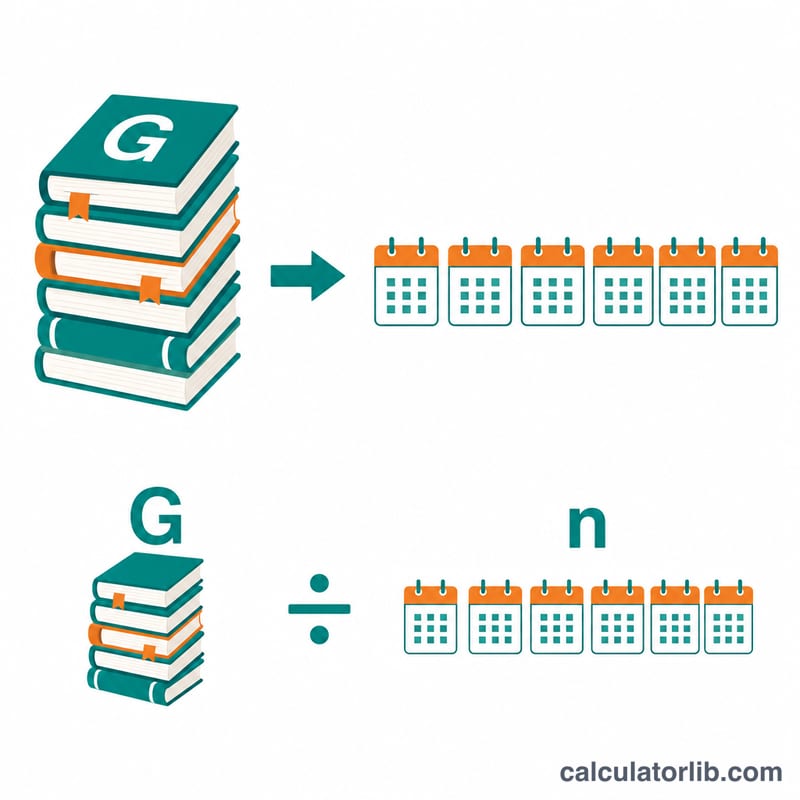
Worked example
Suppose you want to read 24 books in 365 days and view your pace per month. There are \(365 \div 30 \approx 12.17\) months, so you need \(24 \div 12.17 \approx\) 1.97 books per month. Your per-book budget is \(365 \div 24 \approx\) 15.2 days per book — about two weeks each.
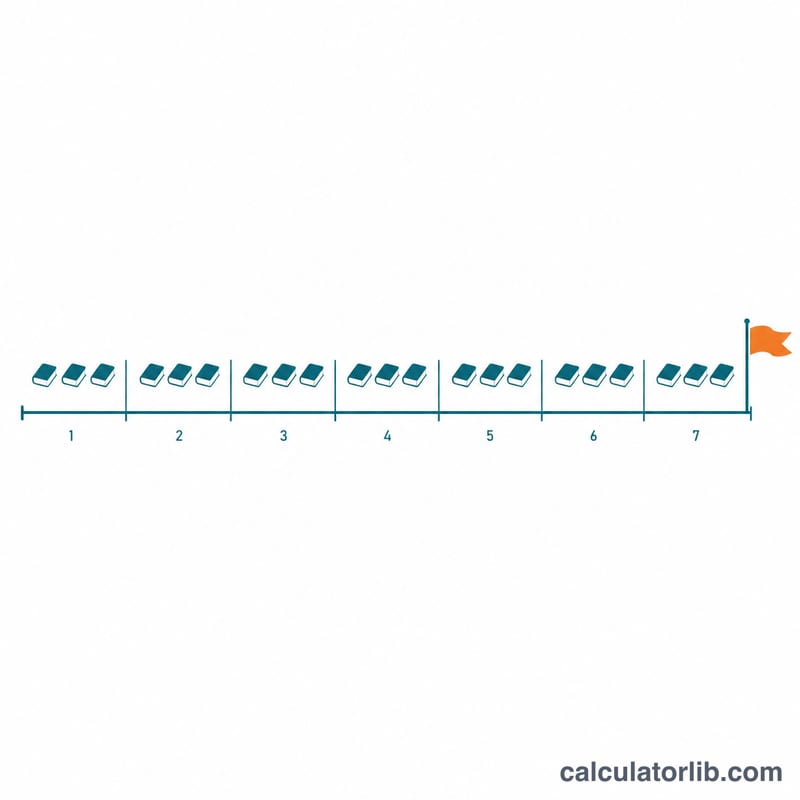
Reading Goal Scenarios: Books per Week, Month and Year
The table assumes a 365-day year, 7-day weeks and 30-day months, the same conventions the calculator uses. A year therefore has 365 ÷ 7 ≈ 52.14 weeks and 365 ÷ 30 ≈ 12.17 months. Each figure is the goal divided by those counts, and days per book is 365 ÷ goal.
| Yearly goal (books) | Books per week (goal ÷ 52.14) | Books per month (goal ÷ 12.17) | Days per book (365 ÷ goal) |
|---|---|---|---|
| 12 | 0.23 | 0.99 | 30.4 |
| 24 | 0.46 | 1.97 | 15.2 |
| 36 | 0.69 | 2.96 | 10.1 |
| 52 | 1.00 | 4.27 | 7.0 |
| 100 | 1.92 | 8.22 | 3.65 |
Example for the 100-book goal: \(\text{Books per week} = \frac{100}{365/7} = \frac{700}{365} \approx \) 1.92. That is about two books every week, or one book every 3.65 days.
A 52-book goal works out to almost exactly one book per week (364 ÷ 365 ≈ 0.997).
Tips for Hitting Your Reading Goal
- Round the pace up. If the result is 0.46 books per week, plan as if you need a book every two weeks. Use whole books as your milestones, because you cannot finish a fraction of a book on a calendar date.
- Build a 5-10% buffer. Aim a little above your target to cover busy weeks. For a 52-book goal, plan for about 55 to 57 books (52 × 1.05 ≈ 54.6; 52 × 1.10 ≈ 57.2).
- Re-run the calculator as you go. Enter the books you have left as the goal and the days remaining as the total days. The new pace shows whether you are ahead or behind.
- Convert days per book into pages per day. Divide the book length by the days per book. For a 320-page book at 15.2 days per book: \(\frac{320}{15.2} \approx 21\) pages per day.
- Mix in shorter books or audiobooks to catch up. A short novel or an audiobook during a commute or chores can recover a few days without changing your daily routine.
- Pick a weekly check-in day. Compare books finished with the pace the calculator gave you, then adjust the plan rather than waiting until the end of the year.
A reading goal is a personal target, so set one that fits your schedule and keep it enjoyable.
FAQ
How many days are in a month here? We use 30 days per month and 7 per week as standard averages, which keeps the math consistent across any time frame.
Can I plan a 30-day or 90-day sprint? Yes — just set the time frame to the number of days in your challenge and the calculator adapts.
What if I fall behind? Re-run the calculator with the days remaining and the books left to read to get an updated catch-up pace.