
What is the Reading Level Calculator?
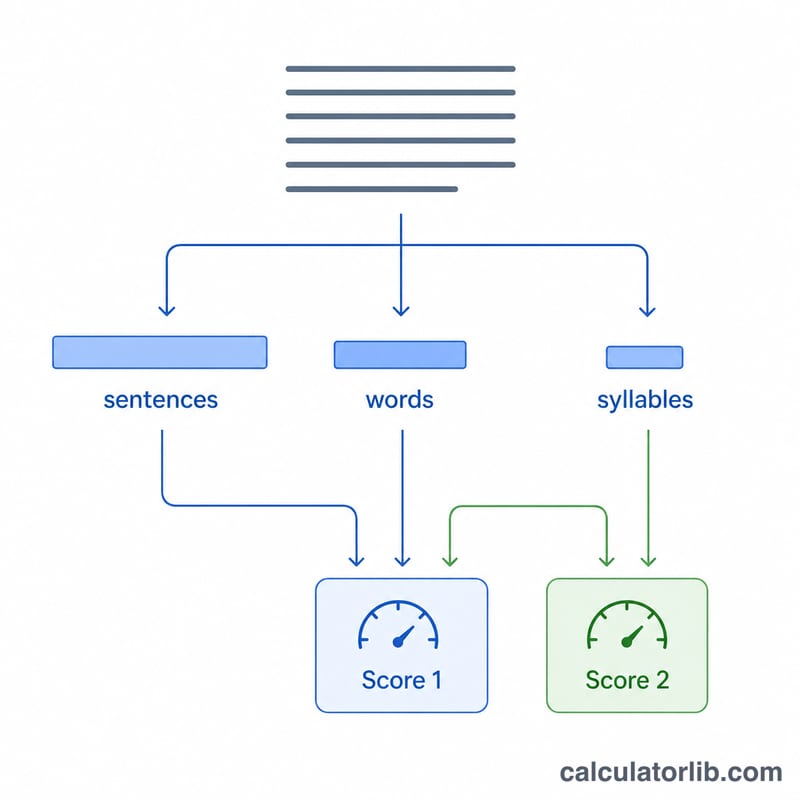
This tool measures how easy your writing is to read using two classic readability formulas: the Flesch Reading Ease score and the Flesch-Kincaid Grade Level. Both are based on simple, language-independent statistics — the number of words, sentences, and syllables in a passage. They are widely used in education, publishing, and government plain-language guidelines.
How to use it
Count the words, sentences, and syllables in a representative sample of your text (a paragraph or two is enough). Enter the three numbers and the calculator returns both scores instantly, along with words-per-sentence and syllables-per-word averages and a plain-English interpretation of the result.
The formula explained
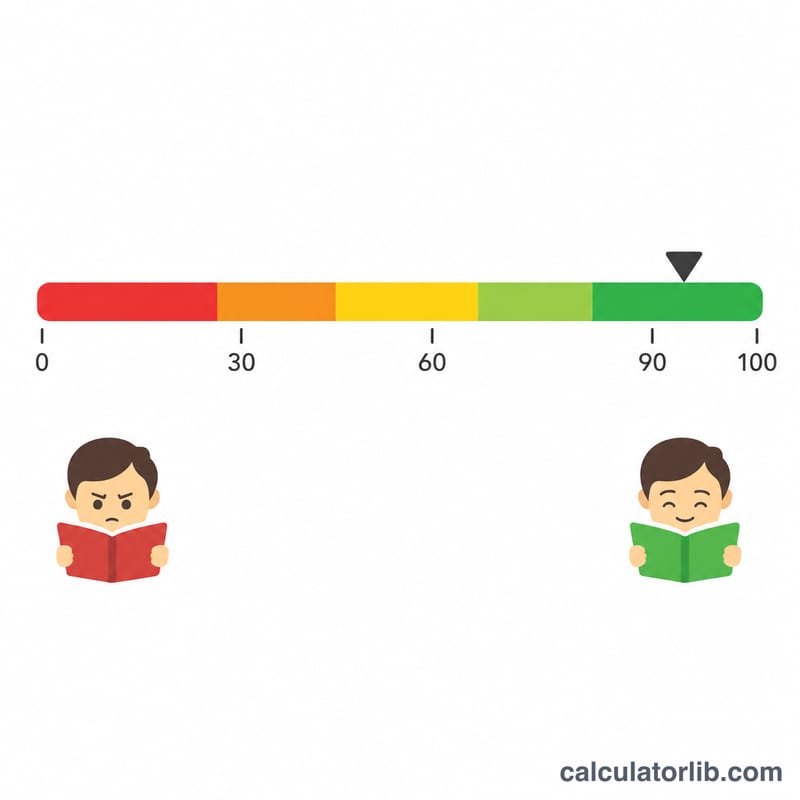
The Flesch Reading Ease formula is: $$\text{FRE} = 206.835 - 1.015\left(\frac{\text{Words}}{\text{Sentences}}\right) - 84.6\left(\frac{\text{Syllables}}{\text{Words}}\right)$$ Scores range from about 0 (very hard) to 100 (very easy). The Flesch-Kincaid Grade Level converts the same averages into a US grade: $$\text{FKGL} = 0.39\left(\frac{\text{Words}}{\text{Sentences}}\right) + 11.8\left(\frac{\text{Syllables}}{\text{Words}}\right) - 15.59$$
Worked example
Suppose a passage has 120 words, 8 sentences, and 180 syllables. Words per sentence = \(120 \div 8 = 15\). Syllables per word = \(180 \div 120 = 1.5\). $$\text{FRE} = 206.835 - 1.015 \times 15 - 84.6 \times 1.5 = 206.835 - 15.225 - 126.9 = 64.71$$ $$\text{FKGL} = 0.39 \times 15 + 11.8 \times 1.5 - 15.59 = 5.85 + 17.7 - 15.59 = 7.96$$ so roughly an 8th-grade reading level.
FAQ
What is a good Flesch score? 60–70 is considered plain English suitable for most adults. Higher is easier.
How do I count syllables? Count vowel sounds per word; tools and dictionaries can help with longer samples.
Are these formulas language-specific? They were calibrated for English. Other languages need adapted formulas.